
c. 60 – 129·Feast September 21
St. Quadratus of Athens
Apostolic disciple and first Christian apologist
Overview
Quadratus of Athens stands among the earliest Christian apologists, a man whom tradition numbers with the Seventy Disciples and counts as a disciple of the Apostles themselves. Born near the close of the first century, probably in Asia Minor, he traveled for a time as an itinerant preacher before settling in Athens, where he taught as an independent master rather than an officer of the hierarchy, in the company of writers like Aristides and Athenagoras. His name survives chiefly for the defense of Christianity he presented to the emperor Hadrian during the imperial visit to Athens around 124–125, a work that circulated widely among the early churches and won the praise of Eusebius for its intellect and fidelity to apostolic doctrine. Of the Apology a single fragment remains, an eloquent appeal to the living evidence of Christ's miracles, men and women healed and raised who were still present within living memory. Dionysius of Corinth records that after the martyrdom of Publius, Quadratus led the church of Athens as its bishop, reuniting and reviving its faith. Tradition holds that his preaching to pagans brought imprisonment, and that he ended his life in prison, wasted by hunger, about the year 129. The churches honor him as a saint and as patron of apologists.
The Complete Life
A Disciple of the Apostles
Quadratus came into the world as the first century drew toward its close, probably somewhere in Asia Minor; one modern estimate, that of James Wallace, places his birth around the year 60. The earliest and most treasured fact about him comes from Eusebius of Caesarea, who in his Chronicle calls him a disciple of the Apostles, one who had heard the faith from those who had received it from Christ. While still young he went from place to place as a wandering herald of the Gospel, passing through lands such as Asia Minor after the manner of the first Christian missionaries. In time he settled in Athens, the city with which his name has been joined ever since. There he stood in a distinguished line of Athenian Christian writers alongside Aristides and Athenagoras; the Foulis brothers, writing in the eighteenth century, described Quadratus and Aristides as former philosophers, men who had brought the habits of the schools to the service of the Gospel. Unlike clergy of a later pattern, he held at first no formal position within the church's hierarchy; he taught as an independent master, sharing his knowledge and his faith freely in the city that had heard St. Paul himself.
§ Background
The Apology to Hadrian
The act that fixed Quadratus's place in history was an address delivered to the ruler of the Roman world. Hadrian visited Athens around 124–125, and on that occasion Quadratus presented to him a written defense of the Christian faith aimed at its critics. The Apology circulated widely in early Christian circles, and Eusebius, who preserved the memory of it, praised the work for its intellect and its adherence to apostolic doctrine. Of the whole treatise one fragment alone survives, and it remains among the most striking sentences of early Christian literature. Quadratus pointed not to argument but to evidence: the works of Christ, he wrote, were always present, real, consisting of people healed of their diseases and raised from the dead, seen not only at the moment of healing but long afterward, remaining a considerable time after the Lord's departure, with some of them surviving down to his own day. The appeal was as bold as it was simple: the miracles were not fading stories but standing facts, open to inspection within living memory. Later readers have heard in the fragment's language an implication of Christ's pre-existence and a vision of his earthly life as a temporary sojourn, and they have noted his use of the title Soter, Savior, common to Jewish and Greco-Roman speech alike.
§ Apology
The Mind of an Apostolic Teacher
What can be recovered of Quadratus's thought shows a theologian of the apostolic age rather than a mere pamphleteer. His surviving words rest the whole case for Christianity on the reality of Christ's works: men and women healed, others raised from the dead, some of whom he implies he or his hearers might still have found alive. From this same passage readers have drawn his implicit conviction that Christ existed before his earthly appearance, and that the years in the flesh were a limited sojourn within a larger divine life. He called Jesus Soter, a title that carried weight both in Jewish expectation and in the vocabulary of the Greco-Roman world, claiming for Christ the language of salvation that the empire gave to its own benefactors. Eusebius judged him orthodox and wholly consistent with apostolic teaching, a verdict that carried his memory safely through the centuries. Modern study has added further readings: John H. Roller has argued that his views fit Christian conditionalism, a position on the nature of the soul's immortality, and scholars have weighed his fragments against other works of the age, though none of these attributions has won general consent.
§ Beliefs
Bishop of Athens and Prisoner of the Faith
Dionysius of Corinth, in a letter preserved by antiquity, records that Quadratus was appointed Bishop of Athens after the martyrdom of Saint Publius, and that through his zeal the Christians of the city were reunited and their faith revitalized. By that account he became the third bishop of Athens at some point in the first half of the second century; the succession lists give his tenure as running from 125 to 129, before Leonidas took up the office. The identification of the apologist with this bishop has been debated, since some chronologies place the third bishop around 180, beyond the apologist's approximate death year of 130, and Jerome conflated the apologist with a bishop of Marcus Aurelius's reign; yet the Oxford Dictionary of the Christian Church finds no compelling reason to reject it. Tradition relates that his preaching to the pagans of Athens led to his arrest, and that he died in prison of starvation around the year 129. Eusebius portrays him as intelligent and orthodox, one of the first Christians to address the Roman state and its educated critics in the language of reasoned defense, and in that posture the later apologists followed him.
§ Death and legacy
Memory and Feast
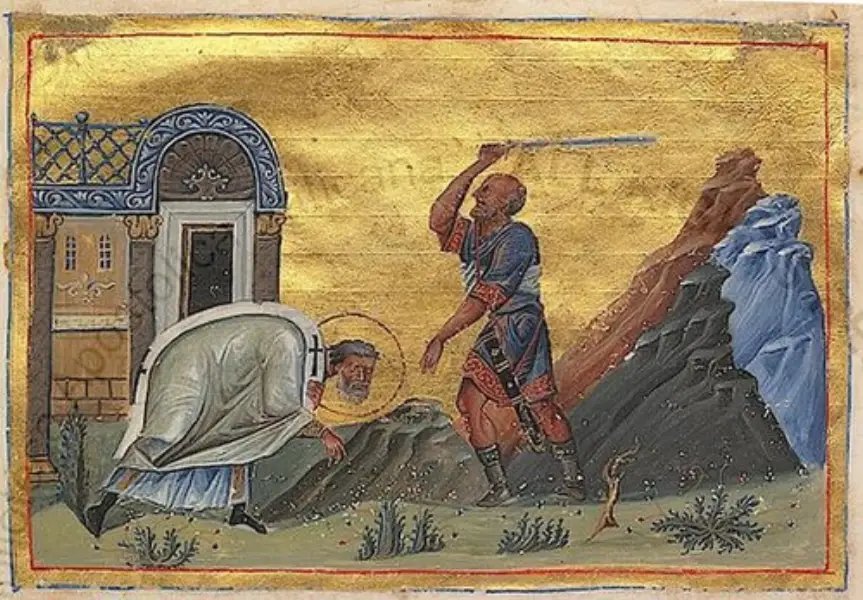
The churches of East and West received Quadratus among their earliest saints without any formal process, in the manner of the pre-congregation age, and honored him as one of the Seventy Apostles of the Lord. His feast is celebrated annually on September 21 in both the Catholic Church and the Eastern Orthodox Church, and he is commemorated a second time on January 4, when the calendars keep the memory of the Seventy together. The Byzantine tradition gave his figure a place in its illuminated books: the eleventh-century Menologion of Basil II depicts the martyrdom of Saint Quadratus in colors that monks applied while the memory of the apostolic age was still clothed in legend and reverence. Modern devotion has kept the ancient assignments, naming him patron of apologists, those who defend the faith with reasons as he did before Hadrian. Scholars continue to argue over his identity, his works, and his dates, but the judgment of the early Church has not been revoked: the man who heard the Apostles and spoke to the emperor remains on the calendar of the undivided faith, a witness from the first generation of Christian letters.
§ Feast day
Timeline
- 60
James Wallace estimates his birth around this year, probably in the region of Asia Minor.
§ Background
- 124
During Hadrian's visit to Athens he presents his Apology, a defense of Christianity against its critics.
§ Apology
- 125
According to Dionysius of Corinth, he succeeds the martyred Publius as Bishop of Athens, beginning a tenure recorded as lasting to 129.
§ Bishop of Athens
- 129
Imprisoned for preaching to pagans, he dies of starvation at Athens around this year.
§ Death and legacy
- 1913
The Catholic Encyclopedia dismisses as insufficient the evidence for identifying the apologist with Quadratus the prophet.
§ Identity
- 1947
P. Andriessen proposes that the Epistle to Diognetus is in reality the lost Apology of Quadratus, a theory Michael Holmes later found intriguing and Edgar Goodspeed judged improbable.
§ Attribution
In Their Own Words
Our Saviour's works, moreover, were always present: for they were real, consisting of those who had been healed of their diseases, those who had been raised from the dead; who were not only seen while they were being healed and raised up, but were afterwards constantly present. Nor did they remain only during the sojourn of the Saviour on earth, but also a considerable time after His departure; and, indeed, some of them have survived even down to our own times.
There is perhaps no compelling reason to reject his identification with the Bishop of Athens.
The Record
- Major works
- Apology to Emperor Hadrian (presented at Athens c. 124–125), of which a single fragment survives
- Patron of
- Apologists
- Canonization
- Pre-congregation canonization; venerated as a saint from the earliest centuries by the Catholic and Eastern Orthodox churches.
Prayer
Bibliography
Show 10 sources
- Roller, J. H. (2009). The doctrine of immortality in the early church. Afterlife, p. 29
- Wallace, J. Warner (2017). Forensic Faith: A Homicide Detective Makes the Case for a More Reasonable, Evidential Christian Faith. David C Cook. ISBN 978-0-7814-1418-0
- Ališauskas, V. (2019). "Antikos žanrų transformacija: Kvadratas ir krikščioniškoji apologija" [Transformation of ancient genres: Quadratus and Christian apologetics]. Literatūra, 61(3), 42–57
- "CHURCH FATHERS: Fragments (Quadratus)", www.newadvent.org, retrieved 2025-12-13
- Walker, Williston; Norris, Richard; Lotz, David; Handy, Robert (1985). The History of the Christian Church (4th ed.). New York: Simon & Schuster. ISBN 9780684184173
- Herbermann, Charles, ed. (1913). "Quadratus". Catholic Encyclopedia. New York: Robert Appleton Company
- Andriessen, "The Authorship of the Epistula ad Diognetum", Vigiliae Christianae 1 (1947), pp. 129–36
- Holmes, Michael W. The Apostolic Fathers in English. Grand Rapids: Baker Academic, 2006, p. 290
- Goodspeed, Edgar J. (1966). A History of Early Christian Literature. Chicago: University of Chicago Press. ISBN 0226303861
- Martyrologium Romanum (2004). Vatican City: Administrationem Patrimonii Sedis Apostolicae in Civitate Vaticana, pp. 304–306
Profile text adapted from the Wikipedia article, licensed CC BY-SA 4.0.
Pray with this saint every day
Save St. Quadratus of Athens to your favorites, read the full profile, and get feast-day reminders in the Saints app.
Get the Saints AppFree on the App Store for iPhone and iPad