
1st century·Feast November 10
St. Quartus of Berytus
Apostle of the Seventy and Bishop of Berytus
Overview
Quartus is one of the few saints whose name stands in the pages of Scripture itself: at the close of the Letter to the Romans, among the greetings sent from Corinth, Paul passes on the salutation of Gaius and Erastus and adds Quartus, whom the apostle calls the brother. Church tradition identifies him as Quartus of Berytus, numbers him among the Seventy Disciples of the Lord, and honors him as Bishop of Beirut and a hieroconfessor who suffered for the faith. The old accounts describe him as a wealthy and learned nobleman of Athens who believed in Christ, received the grace of the Comforter at Pentecost, and preached the Gospel in many countries. In the city of Magnis he won the people to the faith, baptized them, and taught them the commandments. When he returned to preach in his native Athens, the crowd stoned and tortured him severely; he survived these torments and died peacefully at Berytus. The Eastern Orthodox, Oriental Orthodox, and Syriac Orthodox churches keep his memory, on November 10 and again with the Seventy on January 4.
The Complete Life
A Noble of Athens
Tradition gives Quartus a birthplace and a station in life: he was born in Athens, a citizen of that brilliant and ancient city, and he belonged to its wealthy and learned nobility. He had, by the world's measure, everything that an Athenian gentleman of the first century could desire, education, property, and standing among his peers. The old account is brief about what followed but decisive in what it says: he came to faith in Christ the Lord and gave him his service. A name like his, Latin in origin, has suggested to scholars a household of Roman connections, but the tradition of the Church concerned itself with his soul rather than his pedigree. From Scripture it is known only that he stood close enough to the apostolic mission in Corinth to be entrusted with a greeting of his own at the end of the Letter to the Romans, where Paul, after naming Gaius his host and Erastus the city treasurer, adds Quartus the brother. Most interpreters read the phrase as marking him out simply as a fellow believer, singled out by name among the saints of the first generation.
§ Description
The Grace of Pentecost
The church's memory does not leave Quartus as a name in a list of greetings. It numbers him among the Seventy Disciples whom the Lord chose and sent ahead of him, and it assigns him a share in the church's first and greatest day: according to the tradition, when the Comforter came down at Pentecost upon the gathered disciples, Quartus too was filled with that grace. From that hour his life belonged to the mission of the Gospel. He set out from Jerusalem and preached in many countries, leaving the comfortable world of Athens behind for roads and cities unknown to him. The work that tradition best remembers was in the city of Magnis, where he proclaimed the faith there, the townspeople came to belief, and he gave the new believers baptism and instruction in the Lord's commandments, planting a church in a place that had none. The pattern of his ministry was that of the apostolic age itself, preaching, baptism, and catechesis, a messenger moving from city to city and gathering the peoples he found into congregations that worshiped the one God.
§ Description
Stones at Athens, Peace at Berytus
The Gospel brought Quartus back, in the course of his labors, to the city of his birth, and Athens repaid its native son as it had repaid other preachers before him. When he returned to preach there, the people rose against him: they stoned him and tortured him severely. The old account lingers on neither the details of the violence nor his words under it, only on the fact that matters to the Church's memory of him: despite all his sufferings, he survived. For that endurance the tradition gives him the title of hieroconfessor, one who confesses the faith through holy suffering without sealing it in blood. His life ended not at the place of his torments but in the East, for he died peacefully at Berytus, the city of his episcopate, the modern Beirut. There he had served as bishop, and there his course closed in the quiet that follows a life of labor, a confessor's death in a bishop's city rather than a martyr's end beneath the stones of Athens.
§ Description
One of the Seventy
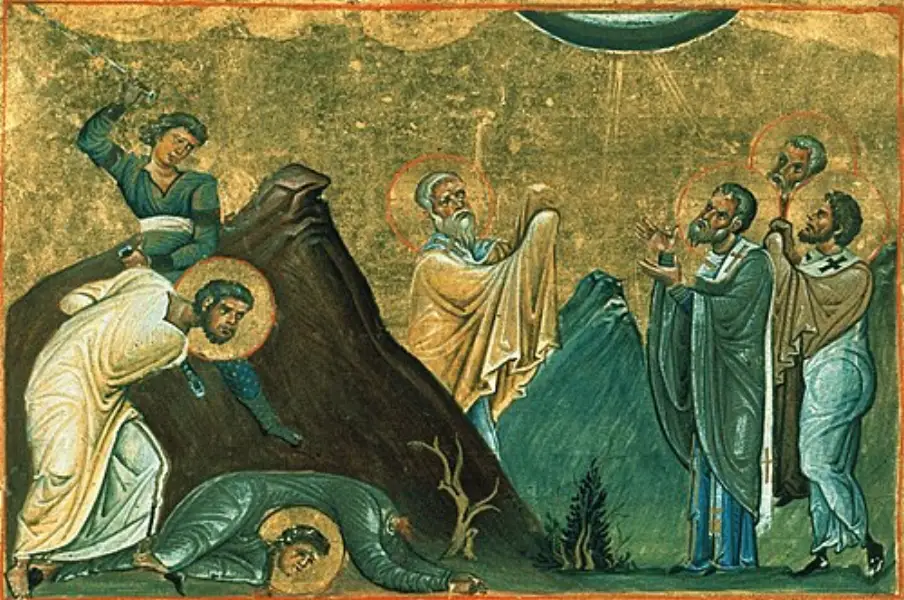
The churches that descend from the apostolic age have kept Quartus's memory in their calendars and in their song. The Eastern Orthodox Church, the Oriental Orthodox Church, and the Syriac Orthodox Church all venerate him, keeping his feast on November 10 and commemorating him again on January 4, when the Synaxis of the Seventy Apostles gathers into one celebration the disciples whom the Lord sent out two by two. The liturgical poetry of the feast, preserved in the Prologue from Ohrid of St. Nikolai Velimirovic, joins him with Erastus, Olympas, Herodian, Sosipater, and Tertius, the band of apostles with whom he is also pictured in the Menologion of Basil II, the great eleventh-century manuscript that shows the saints of the Byzantine year. The kontakion for the feast describes the work of the whole company in words that fit Quartus's own course: illumined by divine light, the holy apostles overthrew the works of idolatry, won the nations for Christ and led them to their Lord, and schooled them in the worship of the Trinity. A single verse of Scripture gave him to history; the prayer of the churches has kept him in it. Feast, hymn, and painted miniature agree in giving him the same title the apostle gave: a brother of the faith, remembered with the band of disciples who carried the Gospel to the cities of the first century.
§ Hymns
In Their Own Words
Gaius, host to me and to the whole church, greets you. Erastus, the city treasurer greets you, and Quartus, the brother.
Holy Apostles, Erastus, Olympas, Herodian, Sosipater, Quartus and Tertius, entreat the merciful God, to grant our souls forgiveness of transgressions.
Illumined by divine light, O holy apostles, you wisely destroyed the works of idolatry. When you caught all the pagans you brought them to the Master and taught them to glorify the Trinity.
The Record
- Major works
- The church of Berytus (Beirut), over which he presided as bishop
- Canonization
- Pre-congregation canonization; numbered among the Seventy Disciples from the earliest church tradition.
Prayer
Bibliography
Show 5 sources
- Smith, William (1967), "Quartus", Smith's Bible Dictionary, Westwood: Revell, OCLC 6053170
- "Apostles of the Seventy: Erastus, Olympas, Herodion, Sosipater, Quartus, and Tertius", www.oca.org, retrieved 14 August 2024
- "Synaxis of the Seventy Apostles", www.oca.org, retrieved 14 August 2024
- Murray, John. Epistle to the Romans, Volume II, p. 239
- "Apostles of the Seventy: Erastus, Olympas, Herodion, Sosipater, Quartus, and Tertius — Troparion & Kontakion", Orthodox Church in America, retrieved 4 January 2020
Profile text adapted from the Wikipedia article, licensed CC BY-SA 4.0.
Pray with this saint every day
Save St. Quartus of Berytus to your favorites, read the full profile, and get feast-day reminders in the Saints app.
Get the Saints AppFree on the App Store for iPhone and iPad