
died c. 287·Feast October 31
St. Quentin
Missionary Martyr of Amiens
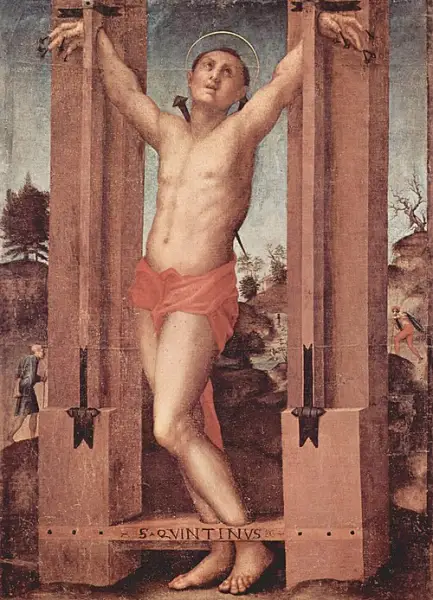
Overview
Quentin, called Quintinus in Latin and remembered also as Quentin of Amiens, was a missionary who sealed his preaching with martyrdom in northern Gaul toward the end of the third century. Tradition describes him as a Roman citizen, the son of a senator named Zeno, who crossed into Gaul fired with apostolic zeal. He labored there alongside Lucian of Beauvais, while Victoricus and Fuscian numbered among his companions. Making his home at Amiens, he drew converts through sermons and wonders worked in Christ's name. The prefect Rictiovarus had him seized, chained, and repeatedly tortured, yet Quentin would not renounce his faith. When the prefect set out for Reims to have the prisoner formally judged, he halted at the town now called Saint-Quentin in the Aisne, pronounced sentence there, and had the martyr beheaded, his body cast into the Somme marshes. A blind Roman woman named Eusebia recovered the remains five years on, and in 641 Bishop Eligius found the forgotten tomb and enclosed the relics in a shrine of his own making behind the high altar of the church he rebuilt.
The Complete Life
A Roman's Call to Gaul
The story of Quentin begins in the ordered world of Roman civic life. Tradition makes him a citizen of the empire and the child of the senator Zeno. Such a background promised him a comfortable path within the imperial order, yet the faith he embraced pointed in another direction. Ancient accounts speak of a man filled with apostolic zeal, restless until the Gospel reached the far provinces of the west. He left the center of the Roman world behind and traveled to Gaul as a missionary, joining a band of evangelists at work among the Gallo-Roman population. Among his fellow laborers was Lucian, who would later give his own life at Beauvais; the tradition also counts the martyrs Victoricus and Fuscian as followers gathered around Quentin's preaching. The company to which he belonged formed part of the first great wave of Christian witness in northern Gaul, a movement that planted churches in the cities of the Rhone, the Seine, and the Somme. When the band of missionaries dispersed to their several fields, Quentin chose Amiens as his own, a city on the Somme where his name and cult would remain anchored for the rest of history.
§ Hagiography
Preaching at Amiens
At Amiens Quentin settled and made the city the seat of his mission. The accounts of his life credit him with many miracles worked there, wonders that accompanied his proclamation of Christ and gave weight to his words before a population still divided between the old cults and the new faith. Preaching in a provincial capital inevitably drew the attention of the authorities, and in time it drew the prefect Rictiovarus, an official who had traveled to Amiens from Trier. The confrontation that followed was the trial Quentin's whole life had prepared him for. His sermons were judged a threat to public order and to the gods of the empire, and he was thrown into prison. There he was manacled like a dangerous criminal and put to torture again and again, each session designed to wring from him a renunciation of the faith. The tortures failed. Whatever the prefect's officers inflicted, the prisoner held to his confession, and the record of his passion presents each fresh torment as one more occasion on which his endurance confounded his judge. His mission thus reached its climax not in triumph but in a prison cell, where a preacher's fidelity proved stronger than the empire's power to hurt.
§ Martyrdom
Sentence at Augusta Veromanduorum
Rictiovarus, finding his prisoner unbroken, resolved to give the case a formal ending. He determined to conduct Quentin to Reims, the capital of the province of Gallia Belgica, where the martyr was to be judged by the proper authority. The condemned man was therefore taken under guard along the road toward that city, still chained, still a confessor whose testimony had outlasted every punishment his captors could devise. The journey, however, never reached its destination. At a town named Augusta Veromanduorum, the settlement that grew into the modern Saint-Quentin in the Aisne, the prefect decided to cut the proceedings short and pass sentence on the spot. Quentin was handed to the torturers once more, and when they too failed to shake him, the order for death was given. The executioner's sword ended his life by beheading, and the soldiers, ordered to dispose of the body contemptuously, threw it into the marshes that spread around the river Somme. There, in the wet ground outside the walls of a provincial town, the missionary who had given Gaul his last strength was left without honorable burial, his grave known only to God and to the Christians who dared to remember where he had fallen.
§ Martyrdom
The Recoveries of the Body
Five years after the execution, according to the tradition, a blind woman named Eusebia came from Rome, a member of a senatorial family obeying what she understood as a divine command. At the Somme marshes she miraculously discovered the martyr's body, and a blind woman who touched the sacred relics recovered her sight. The Christians of the place raised a small chapel near the spot where the remains had been found, and there the first cult of Quentin took root. Time, however, obscured what Eusebia had found. The exact site of the tomb passed out of memory, and by the seventh century even the clergy of the region had lost it. The life of Bishop Eligius, written mainly in that century, records that in 641 Eligius searched for several days and at last, by what his biographers call a miracle, rediscovered the grave. When the relics came to light, the diggers brought to light beside them the long nails that had been driven through the martyr's body. Eligius, himself a master goldsmith, gave the nails, together with some of the martyr's teeth and hair, to churches elsewhere, and gathered the remaining sacred treasure into a rich shrine of his own manufacture, which he placed behind the high altar of the church he rebuilt on the site.
§ Second inventio
A Name on the Land
Few martyrs of the early Gallic church left so deep an imprint on the geography of their country as Quentin. His cult flourished above all during the Middle Ages, and it was strongest in the north of France, where the considerable number of place names drawn from his own name still testifies to the devotion he inspired. Towns, villages, churches, and chapels across the region bear the form Saint-Quentin, each one a marker of communities that honored the missionary beheaded in their corner of Gaul. The church that Eligius rebuilt over the recovered tomb grew in later centuries into the great Basilica of Saint-Quentin, which remains the center of his cult and the goal of pilgrims in the Aisne. His feast is kept on October 31, and he is venerated in both the Roman Catholic and the Eastern Orthodox churches, a rare continuity of memory reaching back to the age of the persecutions. In Christian iconography he appears in many guises: a young man holding two spits, a deacon at the altar, a figure bound to a broken wheel or transfixed to a chair, a soldier of Christ with the sword of his passion, or the beheaded martyr from whose severed neck a dove rises heavenward.
§ Devotion
Timeline
- 287
Arrested at Amiens by the prefect Rictiovarus and tortured, Quentin refused every demand to abandon his faith.
§ Martyrdom
- 287
Beheaded at Augusta Veromanduorum, today Saint-Quentin in the Aisne, when Rictiovarus halted his journey to Reims; soldiers threw the body into the Somme marshes.
§ Martyrdom
- 292
Eusebia, a blind woman of senatorial family, came from Rome at what she knew to be God's command and miraculously found the body, near which a small chapel rose.
§ First inventio
- 641
Bishop Eligius rediscovered the forgotten tomb after days of searching, gave away the great nails, teeth, and hair, and set the relics in a rich shrine of his own craft behind the high altar.
§ Second inventio
The Record
- Major works
- The Christian community he planted at Amiens
- Patron of
- bombardiers·chaplains·locksmiths·porters·tailors·surgeons·invoked against coughs, sneezes, and dropsy
- Symbols
- a young man with two spits·a deacon·a broken wheel·a chair to which he is transfixed·a sword·beheaded, with a dove flying from his severed head
- Canonization
- Pre-congregation; venerated from antiquity as a martyr in both the Roman Catholic and Eastern Orthodox churches
Prayer
Bibliography
Show 4 sources
- Stracke, Richard (20 October 2015). "Saint Quentin: The Iconography".
- de Voragine, Jacobus (3 September 2003). "The Golden Legend" (PDF).
- Butler, Alban. The Lives or the Fathers, Martyrs and Other Principal Saints, vol III.
- "St. Eligius". Catholic News Agency. Archived from the original on July 20, 2019.
Profile text adapted from the Wikipedia article, licensed CC BY-SA 4.0.
Pray with this saint every day
Save St. Quentin to your favorites, read the full profile, and get feast-day reminders in the Saints app.
Get the Saints AppFree on the App Store for iPhone and iPad