
died c. 579·Feast February 15
St. Quinidius
Hermit turned charitable Bishop of Vaison
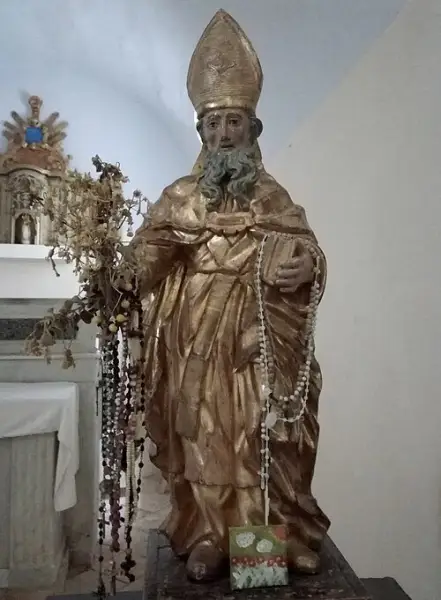
Overview
Quinidius, known in French as Quenin, was a hermit, deacon, and bishop of Vaison in Provence who died around the year 579. Born into a noble Christian family of his native town, he withdrew early in life to the solitary religious life, first near Toulon and then at the famous island abbey of Lérins, before settling as a recluse near Camps-la-Source. His reputation for holiness drew the attention of Theodosius, Bishop of Vaison, who recalled him to serve the church of his birthplace as archdeacon. In that office he signed the acts of the fifth Synod of Arles in 552 on his bishop's behalf, and soon after, with King Childebert I's approval, he was named coadjutor with right of succession. On Theodosius's death in 556 he became Bishop of Vaison and won renown as a pastor of charity and fairness, devoting himself to the sick, to children, to the elderly, and to prisoners, while raising churches and hospices and taking part in the Councils of Paris of 558 and 573. His tomb at Vaison became a scene of reported miracles, and he remains the town's patron saint.
The Complete Life
A Promised Child of Vaison
Quinidius came into the world at Vaison-la-Romaine, the son of a noble Christian household of the Rhône valley. The story of his beginnings carries the coloring of legend told with confidence: while his mother carried him, she journeyed on pilgrimage to the shrine of Trophimus in Arles, and an angel was said to appear to her with the prophecy that the child within her would lead multitudes toward beatitude. Whatever the historical weight of that vision, the family clearly raised him in the faith, and he responded with a yearning for the hidden life. As a young man he withdrew from society to pursue prayer and ascetical discipline, first taking up a hermit's dwelling in the hill country near Toulon. From there he moved to the celebrated monastery island of Lérins, the nursery of so many Gallic bishops, whose blend of contemplation and rigorous asceticism formed the spirituality of an entire generation of church leaders. He later spent a period as a solitary at Camps-la-Source. These years of retreat might have remained his whole life had not the church of his birthplace come to need him.
§ Life
From Hermitage to Cathedral
The holiness that Quinidius cultivated in solitude could not long remain hidden. Theodosius, the aged Bishop of Vaison, esteemed him greatly and called him back to the town of his birth to serve the cathedral church. There he was made archdeacon, the bishop's principal assistant in governance and discipline. In 552 he signed the resolutions of the fifth Synod of Arles on Theodosius's behalf, an act that placed the obscure Provençal see within the wider ecclesiastical life of Gaul. Shortly afterwards the arrangement was formalized: with the approval of King Childebert I, Quinidius was constituted coadjutor to Theodosius with the right of succession, ensuring an orderly transfer of the diocese. When Theodosius died in 556, Quinidius succeeded him as Bishop of Vaison. The path he had traveled, from anchorite at Toulon and Lérins to the episcopal throne of his native city, illustrates a pattern the Gallic church knew well, in which the desert furnished the cathedral with its shepherds. He wore the episcopal office, however, not as an honor but as a charge, and the years that followed revealed the depth of the charity his retreat had formed.
§ Life
A Shepherd of Charity and Fairness
As bishop, Quinidius achieved a reputation for charity and even-handed dealing that made him beloved in his see and respected beyond it. The Avignon martyrology describes him as a zealous and charitable pastor, and his daily habits bore that description out: he gave a large share of his time to the personal care of the sick, of children, of the elderly, and of prisoners, the most neglected groups of a violent age. His concern took institutional form as well, for he had churches raised and hospices built so that pilgrims, the poor, and the infirm might find shelter and worship within his diocese. He continued to serve the church of Gaul in council, attending the Councils of Paris of 558 and 573. Nor was his episcopate without conflict: he stood firm against the demands of the patrician Mummolus, the conqueror of the Lombards, who took offense at what he judged insufficient deference from the bishop. Against a general whose armies had humbled a foreign nation, Quinidius defended the freedom and dignity of his church, showing that the meekness of a pastor need not mean submission to power.
§ Life
Death and a Tomb of Miracles
Quinidius died on February 15, around the year 579, and his remains were placed below the high altar of Vaison's cathedral. The veneration that gathered at his grave began almost at once, for his sarcophagus in the Old Cathedral of Vaison-la-Romaine soon became the scene of numerous reported miracles. Pilgrims' devotion drew monastic life to the town: a community of Benedictines established an abbey where the chapel of Saint-Quenin rises today, whose apse, apparently an eighth-century work, ranks among the oldest in France. Danger overtook the shrine in the age of the Saracen raids, when the invading forces threatened the coast and hinterland of Provence. The monks carried the saint's head to the monastery of Mauriac in the Auvergne for safekeeping, while the remaining relics were hidden and so escaped destruction. Centuries later, in 1950, a sarcophagus unearthed in the cathedral was judged likely to contain the saint's possible remains. He had entered into rest as he had lived, quietly, at the heart of the city whose patron he remains.
§ Death and veneration
Enrollment Among the Saints
The cult of Quinidius, rooted in the miracles reported at his tomb, was given formal recognition in the early thirteenth century. In 1205, during the pontificate of Innocent III, he was formally inscribed in the roll of saints through the petition of that city's own bishop, Rambaud Flotte, an unusually well documented instance of a local Provençal cult rising to papal registration. His feast is kept on February 15, the day traditionally associated with his death, and he is honored as the patron saint of Vaison-la-Romaine. He is venerated in the Roman Catholic Church, and the memory of his pastoral charity endures in the institutions and shrines of his native town, from the Old Cathedral that shelters his sarcophagus to the chapel of Saint-Quenin built by the Benedictines over the place of his wonders. For the people of Vaison he remains the holy Quenin, the native son whose prayerful youth, kindly episcopate, and powerful intercession have watched over the town for well over fourteen centuries.
§ Death and veneration
Timeline
- 552
As archdeacon of Vaison, signed the resolutions of the fifth Synod of Arles on behalf of Bishop Theodosius.
§ Life
- 556
Succeeded Theodosius as Bishop of Vaison upon the old bishop's death, after serving as his approved coadjutor.
§ Life
- 558
Took part in the Council of Paris as Bishop of Vaison.
§ Life
- 573
Participated in the second Council of Paris late in his episcopate.
§ Life
- 15 Feb 579
Died at Vaison and was buried beneath the main altar of the cathedral there.
§ Death and veneration
- 1205
Registered in the catalogue of saints under Pope Innocent III at the petition of Bishop Rambaud Flotte.
§ Death and veneration
- 1950
A sarcophagus unearthed in the cathedral of Vaison was judged likely to hold his relics.
§ Death and veneration
The Record
- Major works
- Churches and hospices built throughout the diocese of Vaison·Episcopal service at the Councils of Paris of 558 and 573
- Patron of
- Vaison-la-Romaine
- Symbols
- Bishop's vestments·Sarcophagus at the Old Cathedral of Vaison
- Canonization
- Officially registered in the catalogue of saints in 1205 by Pope Innocent III, at the request of Rambaud Flotte, bishop of Vaison.
Prayer
Bibliography
Show 4 sources
- "Martyrologium Romanum". Digitalisierte Sammlungen der Staatsbibliothek zu Berlin. 1599.
- "Saint Quinide". Nominis (in French).
- Herbermann, Charles, ed. (1913). "Ancient Diocese of Vaison". Catholic Encyclopedia. New York: Robert Appleton Company.
- Sainte-Marthe, Denis de. Gallia Christiana, in provincias ecclesiasticas distributa. Vol. 1, Johannes-Baptista Coignard, 1715.
Profile text adapted from the Wikipedia article, licensed CC BY-SA 4.0.
Pray with this saint every day
Save St. Quinidius to your favorites, read the full profile, and get feast-day reminders in the Saints app.
Get the Saints AppFree on the App Store for iPhone and iPad