
died c. 525·Feast November 13
St. Quintian of Rodez
Bishop of Rodez and Clermont in Gaul
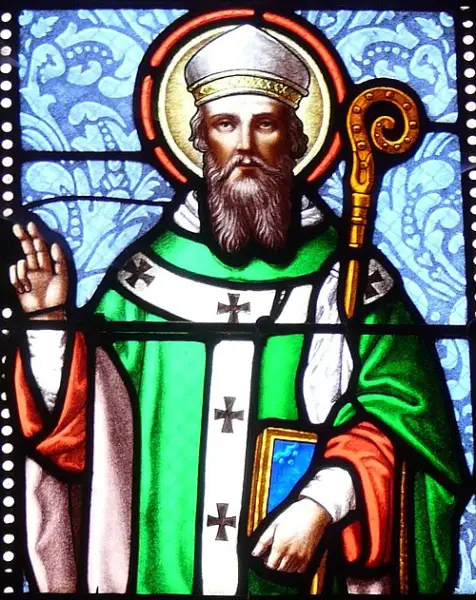
Overview
Quintian, known also as Quintianus, Quinctianus, and Quintien, died around the year 525 after governing two of the great sees of southern Gaul. By tradition he was African-born, a priest formed at Carthage who took refuge in France from the Vandal persecutions. In 487, upon the death of Saint Amantius, he became Bishop of Rodez. When war broke out between the Franks and the West Goths he threw his support zealously behind Clovis I, and the Arian reaction that followed forced him to abandon his city. He fled to Auvergne, where Bishop Euphrasius received him hospitably at Clermont, and there King Theodoric I appointed him successor to the bishop governing that see. On the bishop's death Quintian took possession of the See of Clermont and led it until his own death on November 13, in 525 or 526. He had taken part in the Council of Agde in 508 and the Council of Orléans in 511, two landmarks of the organized Gallic church. His feast falls on November 13, though Rodez keeps it instead on June 14; the Roman Martyrology enters his name under both dates.
The Complete Life
A Priest of Carthage in Exile
The tradition of the Gallic church remembers Quintian as an African, born in the fifth century in the old Roman province that centered on Carthage. There he was ordained a priest, serving the church of that great North African metropolis until the Vandal conquest upended the lives of its Catholic clergy. The Vandal kings of the fifth century pursued a sustained persecution of the orthodox Catholic population in favor of their own Arian confession, and many priests and bishops fled across the sea to the Visigothic and Frankish lands of Gaul. Among these refugees was Quintian, who left Carthage for France, carrying with him nothing of his African patrimony but his priesthood and his orthodoxy. The upheaval that cost him his homeland became the instrument of his vocation: the church of Gaul, itself contested between Catholic Franks and Arian Visigoths, had urgent need of prelates who had already proven their fidelity under fire. In that providential exchange, the persecuted deacon of Carthage would become the shepherd of two of the most important cities of Aquitaine and Auvergne.
§ Life
Bishop of Rodez
In 487 Saint Amantius, bishop of Rodez, died, and Quintian was chosen to succeed him in the government of that Rouergue see. The city lay in the borderlands between the expanding Frankish kingdom of the north and the Visigothic realm of Aquitaine, and its bishop could not remain neutral for long. Quintian made his choice openly: when Frankish and Visigothic armies went to war, he threw his weight enthusiastically behind Clovis I, the Frankish king whose conversion to Catholic Christianity was reshaping the religious geography of Gaul. That allegiance carried a price. The Arian Visigothic authorities turned against the bishop of Rodez, and persecution threatened him in his own cathedral city. Rather than compromise or await arrest, Quintian left Rodez and made his way into Auvergne, where the Catholic faith under Bishop Euphrasius at Clermont offered refuge. The expelled bishop of Rodez was received with the hospitality that the canons of the church enjoined, and his flight, undertaken for the faith, would prove to be not the end of his episcopate but the passage to a second and greater charge.
§ Life
Translation to Clermont and Service to the Church
At Clermont Quintian found not merely asylum but a new field of labor. King Theodoric I appointed him successor to the bishop of that city, the see so memorably governed a century earlier by Sidonius Apollinaris, whose grandson of the same name held it when the refugee arrived. Upon the bishop's death Quintian succeeded to the See of Clermont and occupied it until his own death on November 13, in 525 or 526. His episcopate thus spanned two of the principal cities of the south, and his standing among the bishops of Gaul is measured by the councils he attended: the Council of Agde in 508, where the church of the Visigothic lands ordered its discipline, and the Council of Orléans in 511, the first great assembly of the Gallic episcopate under Catholic Frankish rule, convened in the year after Clovis's death. In both assemblies he helped shape the legislation by which the young Christian society of the Franks and Goths would be governed, a refugee African priest who had become one of the architects of the church in his adopted land.
§ Life
Two Feasts and a Martyrology
Quintian was never subject to a formal canonization process, for he belongs to the company of saints whose cult arose from the devotion of the churches they had served. Veneration developed early at both of his sees, and it preserved the memory of his two episcopates in a double observance: his feast is kept on November 13, the traditional day of his death, except at Rodez, where it is celebrated on June 14. The Roman Martyrology, in recording his name, honors the claims of both cities and enters him under the two dates. He is venerated in the Roman Catholic Church, the Eastern Orthodox Church, and the Anglican Communion, one of those Gallican bishops whose witness bridged the old Roman world and the Frankish age. To the faithful of Auvergne and the Rouergue he remains the saintly confessor-bishop who chose exile rather than betrayal of the Catholic faith, and whose double flock, at Rodez and at Clermont, has never quite allowed his memory to divide.
§ Veneration
Timeline
- 487
Succeeded Saint Amantius as Bishop of Rodez upon the latter's death.
§ Life
- 508
Participated in the Council of Agde as a bishop of the Gallic church.
§ Life
- 511
Took part in the Council of Orléans held in the kingdom of the Franks.
§ Life
- 13 Nov 525
Died as Bishop of Clermont, the date given as November 13 of 525 or 526.
§ Life
The Record
- Major works
- Episcopal leadership of the See of Rodez from 487·Episcopal leadership of the See of Clermont until his death·Participation in the Councils of Agde (508) and Orléans (511)
- Symbols
- Bishop's vestments and crozier
- Canonization
- Pre-congregation; venerated as a saint from the early medieval period, with his name recorded in the Roman Martyrology.
Prayer
Bibliography
Show 2 sources
Profile text adapted from the Wikipedia article, licensed CC BY-SA 4.0.
Pray with this saint every day
Save St. Quintian of Rodez to your favorites, read the full profile, and get feast-day reminders in the Saints app.
Get the Saints AppFree on the App Store for iPhone and iPad