
died 30 March 116 (traditional)·Feast April 30
St. Quirinus of Neuss
Roman tribune-martyr venerated on the Rhine
Overview
Quirinus of Neuss, called in German Quirin and sometimes Quirinus of Rome, receives the veneration of both the Catholic and the Eastern Orthodox Churches as a martyr and saint, though the center of his devotion lies far from the city of his death. The historical witness to the saint is early and precise: a Roman martyr of this name was buried in the Catacomb of Prætextatus on the Via Appia, a fact recorded both by the Martyrologium Hieronymianum and by the medieval itineraries drawn up for pilgrims visiting the graves of the Roman martyrs. Legend supplies his story. In the Acts of Pope Alexander I he appears as a Roman tribune ordered to execute the pontiff and his companions; converted by the miracles he witnessed, he was baptized by Alexander, together with his daughter Balbina, and in his turn condemned to a torturing death, suffering mutilation before decapitation in the year 116. His relics were translated in 1050, when Pope Leo IX gave the martyr's body to Neuss on the Rhine, whose great Romanesque church of Saint Quirinus became the heart of one of the most flourishing cults of the German lands, and whose people honored him as their own particular patron.
The Complete Life
A Tribune Converted at the Prison Door
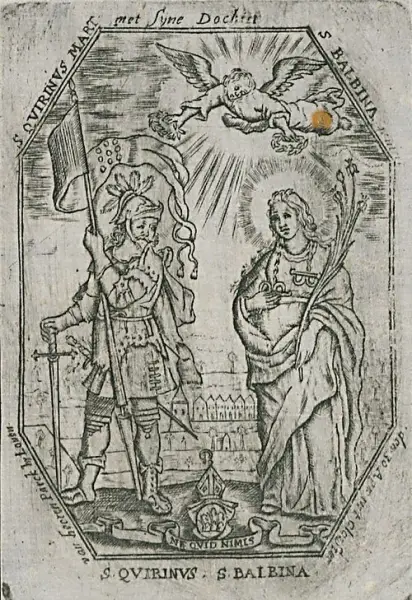
The legend that shaped Quirinus's cult introduces him not as a clergyman but as a Roman officer. In the legendary Acts of Sts. Pope Alexander I and Balbina he appears as a tribune, a soldier of rank, entrusted with carrying out the sentence passed on Pope Alexander and his companions Eventius and Theodolus, whom the emperor Trajan had caused to be seized. The task assigned to the tribune became the occasion of his undoing as an official of the empire: watching the prisoners, he witnessed miracles performed by the three confessors, and the pagan officer charged with killing them became instead their convert. Alexander received him into the church through baptism, and with him his daughter Balbina, who would herself be honored among the saints of Rome. The story gave the later devotion to Quirinus its distinctive color, for he was remembered as a military saint, a knight in armor, whose weapons had been exchanged for the crown of martyrdom. In the Rhineland, where his cult flourished for centuries, soldiers and horsemen claimed him as their patron, honoring the tribune who had once guarded prisoners and ended by joining them.
§ Legend
The Passion of the Mutilated Martyr
The legend relates that Quirinus was condemned to a punishment of peculiar cruelty: his tongue, his hands, and his feet were to be cut off. Popular devotion, which loved to trace the details of his passion, told how the severed tongue was offered to a falcon and how the bird refused to eat it, while the hands and feet, cast to the dogs, were likewise left untouched, so that the very beasts bore witness to the sanctity of the sufferer. The Acts themselves record nothing of these marvels, but they agree upon the course of his final hours: the mutilated martyr was dragged by oxen to the place of execution, and there he was beheaded. The year given by tradition is 116, and the date kept for centuries was the 30th of March. He was buried, according to the constant Roman tradition, in the Catacomb of Prætextatus on the Via Appia, where pilgrims of the early centuries sought the graves of the martyrs. The tortures endured by Quirinus left their mark on his cult, for the faithful of later ages invoked him especially against diseases of the legs, feet, and ears, and against paralysis and ulcers, ailments that mirrored his own wounds.
§ Legend
A Name Fixed in the Martyrologies
Quirinus belongs to the martyrs whose veneration rests on the oldest documents of the Roman church rather than on any later process. The Martyrologium Hieronymianum, in the edition of De Rossi and Duchesne, records both his name and his place of burial, and the medieval itineraries to the graves of the Roman martyrs, preserved in De Rossi's Roma sotterranea, repeat the same two facts, fixing the cult at the catacomb on the Via Appia. The Hieronymianum assigns his commemoration to April 30, the date already found in the fourth-century catalogue of the Roman martyrs. The legendary Acts carried his name into other calendars: Ado took it up and entered it in his Martyrology under the 30th of March, the day on which it long stood in the Roman Martyrology, though the latest edition of that book has returned to the ancient Roman date of 30 April. He is venerated in both the Catholic Church and the Eastern Orthodox Church as a martyr of the apostolic age, one of that earliest company whose testimony the calendars of the undivided church preserved without interruption from the centuries of persecution.
§ Veneration
Memory and Meaning After the Martyrdom
In the century after his death the memory of Quirinus lived on at two levels: in the sober record of the Roman martyrologies, which knew only a martyr's name and grave, and in the legend that gave the martyr a history, a conversion, and a daughter among the saints. The legendary Acts ensured that the tribune-martyr would be pictured in art as a soldier, and the story of the falcon that would not devour his tongue became one of the most striking scenes of his iconography. His cult also attached itself to the city whose people had received him, in the telling of the legend, as their executioner: the double name, Quirinus of Rome and Quirinus of Neuss, reflects the journey of a Roman martyr into the heart of Germany. Ado's martyrology spread knowledge of his passion through the Carolingian church, and by the later middle ages his feast on the 30th of March had entered the working calendar of the countryside, so that the farmers of the Rhineland watched the weather of St. Quirinus's Day as a sign of the summer to come, and named their springs and their cattle alike under his protection.
§ Legend
The Marshal of God on the Rhine
The translation of 1050 transformed the cult of Quirinus. Pope Leo IX bestowed the martyr's body on Gepa, abbess of Neuss and called the pope's sister, and the relics were enshrined in the Romanesque Church of St. Quirinus that still dominates the city, its tower crowned with a statue of the saint. From Neuss his veneration spread to Cologne, Alsace, Scandinavia, the western German lands, and the Netherlands, and crossed the Alps to Italy, where Correggio chose him as its patron. The citizens of Neuss credited him with their defense during the siege laid by Charles the Bold from 1474 to 1475, and pilgrims flocked to drink the Quirinuswasser drawn from the Quirinusbrunnen, one of many wells and springs dedicated to him. He was invoked against bubonic plague, smallpox, and gout, against the diseases of cattle and horses, and honored as a patron of animals, of knights, soldiers, and horsemen. In the Rhineland he stood among the Four Holy Marshals of God, alongside Hubertus, Cornelius, and Anthony, and his portrait, with that of Valentine, adorned the opening of the Nuremberg Chronicle. During the Napoleonic Wars Jean-Baptiste Bernadotte sought to plunder the statue above the church, but the saint of Neuss kept his place above the city.
§ Veneration
Timeline
- 30 Mar 116
Tradition holds that the former tribune was martyred in Rome, suffering mutilation and decapitation for his Christian faith.
§ Legend
- 1050
Pope Leo IX donated the martyr's body to Gepa, abbess of Neuss, bringing the relics to the Rhineland.
§ Veneration
- 1474
The citizens of Neuss invoked Quirinus's aid during the year-long siege of their city by Charles the Bold.
§ Veneration
- 1485
A document from Cologne recorded the tradition of Pope Leo IX's donation of the relics a century before.
§ Veneration
In Their Own Words
Wie der Quirin, so der Sommer
The Record
- Major works
- Romanesque Church of St. Quirinus at Neuss, raised over his relics·Wells and springs dedicated to him across the Rhineland, notably the Quirinusbrunnen
- Patron of
- Neuss·Correggio, Italy·Against bubonic plague, smallpox, and gout·Against afflictions of the legs, feet, and ears·Against paralysis, ulcers, goiter, and skin conditions·Against diseases of cattle and horses; patron of animals·Patron of knights, soldiers, and horsemen
- Symbols
- Military attire·Knight with lance, sword, and hawk·Banner or sign with nine balls, a play on the Latin name of Neuss, Novesia
- Canonization
- Pre-congregation; venerated as a martyr from antiquity, with his name fixed in the early Roman martyrologies.
Prayer
Bibliography
Show 6 sources
- Herbermann, Charles, ed. (1913). "Sts. Quirinus". Catholic Encyclopedia. New York: Robert Appleton Company.
- Baring-Gould, The Lives of the Saints, vol. IV, p. 504.
- Josef Theodor Rath (1994). "Quirinus of Neuss". In Bautz, Traugott (ed.). Biographisch-Bibliographisches Kirchenlexikon (BBKL) (in German). Vol. 7. Herzberg: Bautz. cols. 1130–1131. ISBN 3-88309-048-4.
- Quentin, "Les martyrologes historiques", 490.
- Walter Bader: St Quirinus zu Neuss. 1955.
- Max Tauch: Quirinus von Neuss. 2000, ISBN 3-87909-692-9.
Profile text adapted from the Wikipedia article, licensed CC BY-SA 4.0.
Pray with this saint every day
Save St. Quirinus of Neuss to your favorites, read the full profile, and get feast-day reminders in the Saints app.
Get the Saints AppFree on the App Store for iPhone and iPad