
died 309·Feast June 4
St. Quirinus of Sescia
Bishop and Martyr of Sescia in Pannonia
Overview
Quirinus served as bishop of Sescia, the Roman town that survives as Sisak in Croatia, during the era of the Great Persecution. His existence is secure enough to be recorded by Eusebius of Caesarea, though the Passion recounting his death is regarded as untrustworthy in its details. According to that narrative, he was arrested in 309 after trying to slip away from the persecution, and from his prison cell he won his jailer, Marcellus, to the Christian faith. Hauled before Amantius, governor of Pannonia Prima, he was taken to Sabaria, present-day Szombathely in Hungary, where his refusal to sacrifice led the governor to have him drowned in the Gyöngyös River with a millstone fastened about his neck. A divergent strand of the story claims the stone failed to hold him and that he escaped to preach anew, an echo of the similar tale told of Saint Florian. Christians of Savaria recovered the body and buried it near a gate called the Scarabateus, probably at Sopron. As barbarian pressures mounted on Pannonia around the turn of the fifth century, his remains were carried to Rome and laid in the Platonia behind the apse of San Sebastiano fuori le mura on the Appian Way. His cult there was flourishing by the seventh century, and he is remembered today as patron of the Diocese of Sisak and one of the national protectors of San Marino.
The Complete Life
A Bishop on the Roman Frontier
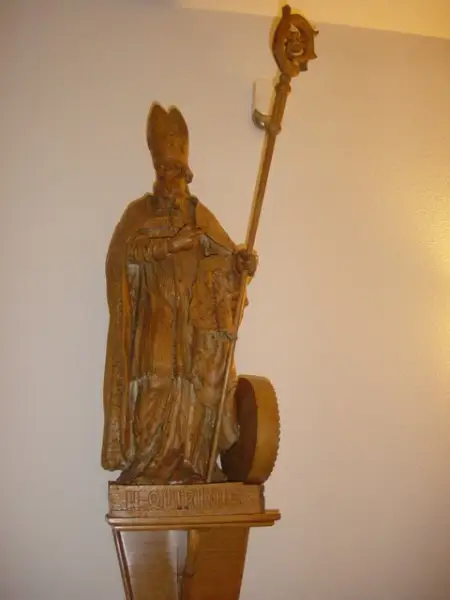
Quirinus led the church of Sescia, a settlement on the Sava whose name lives on in Sisak, Croatia, and his historical standing rests on a mention by Eusebius of Caesarea, the early Church's foremost chronicler. That reference makes him one of the few bishops of the Danubian provinces whose episcopate can be anchored in near-contemporary record rather than later legend alone. The detailed Passion preserving his trial and death is considered unreliable, yet it preserves the outline of a shepherd caught in the machinery of the Diocletianic persecution and faithful to his flock to the end. He never required formal canonization: the Church honored him as a martyr from the beginning, in the manner now called pre-congregation. Sisak's present-day diocese acknowledges him as its heavenly patron, Jesenovik in Croatia maintains a parish church under his dedication, and his memory returns each 4 June. In art he is identified by the millstone that hangs from his neck, the instrument of his execution transformed into an emblem of steadfastness. A hymn in his honor was composed by Prudentius, and his acts were gathered among the collections of the martyrs compiled by Thierry Ruinart.
§ Introduction
Arrest, Prison, and the River
In 309, as the persecution ordered by Diocletian ground on, Quirinus attempted to withdraw out of harm's way but was seized and confined. Far from silencing him, the prison became a place of mission: within three days he had persuaded his keeper, a man named Marcellus, to accept the Christian faith. Amantius, governor of Pannonia Prima, then ordered the bishop conveyed to Sabaria, the town known today as Szombathely in Hungary. Interrogated there and pressed to renounce his belief, Quirinus refused, and the governor's sentence followed: drowning in the Gyöngyös, the local river, with a millstone lashed to his neck. A second strand of the legend colors the ending differently: the stone was fastened to him and he was cast into the water, yet he shook off the weight, came out alive, and went on preaching until his enemies caught up with him. Whatever shape the earliest account took, the drowning with a millstone became the fixed memory of his martyrdom, and it joined him in the devotional imagination to Saint Florian, another saint associated with Pannonia said to have perished in the same manner.
§ Introduction
From Savaria to Rome and San Marino
Local Christians in Savaria gathered up the martyr's body and buried it close to a gate known as the Scarabateus, a spot usually identified with Sopron. When barbarian incursions swept into Pannonia at the close of the fourth century and the opening of the fifth, his relics were removed to Rome and deposited in a vaulted chamber called the Platonia, behind the apse of the Basilica of San Sebastiano fuori le mura on the Appian Way. For a long time that structure was thought to have served as a temporary resting place for the bodies of Peter and Paul; in fact it held the remains of Quirinus. Pilgrims sought him out in such numbers that the Roman itineraries of the seventh century attest the popularity of his cult, and over the centuries his bones were divided among Correggio in Emilia-Romagna, Milan, Aquileia, and the Basilica of Santa Maria in Trastevere, with a possible portion carried to Tivoli, where a separate Saint Quirinus, perhaps the same man, received veneration. His most striking later honor came in San Marino: on 4 June 1543 a dense fog, which the Sammarinese credited to him, shielded their republic from the attempted conquest of Fabiano di Monte San Savino, nephew of the future Pope Julius III, and he has ranked among the nation's protectors ever since. A Franciscan Capuchin church of San Quirino rose in the capital around 1550 in gratitude.
§ Veneration
Timeline
- 309
Arrested in the Diocletianic persecution after trying to flee; from prison he brought his keeper Marcellus to the Christian faith
§ Introduction
- 309
Drowned in the Gyöngyös River at Sabaria on the order of Governor Amantius, a millstone tied about his neck
§ Introduction
- 4 Jun 1543
A dense fog on his feast day, credited to his intercession, foiled Fabiano di Monte San Savino's attempt to conquer San Marino
§ Veneration
- 1550
The Franciscan Capuchin Church of San Quirino was built in the capital of San Marino
§ Veneration
The Record
- Patron of
- Sisak·Diocese of Sisak·Republic of San Marino
- Symbols
- millstone hanging from his neck
- Canonization
- Pre-congregation; honored as a martyr from the earliest centuries of the Church
Prayer
Bibliography
Show 8 sources
- Stracke, Richard (2015-10-20). “Altar Frontal of the Madonna and Child with Saints”
- Borrelli, Antonio. “San Quirino di Siscia”. santiebeati.it; accessed 8 December 2015 (in Italian)
- Kirsch, Johann Peter. “Sts. Quirinus.” The Catholic Encyclopedia Vol. 12. New York: Robert Appleton Company, 1911
- Monks of Ramsgate. “Quirinus”. Book of Saints, 1921. CatholicSaints.Info. 24 February 2017
- Škiljan, Filip (2008). Kulturno – historijski spomenici Banije s pregledom povijesti Banije od prapovijesti do 1881. Zagreb: Serb National Council. ISBN 978-953-7442-04-0
- Nevio and Annio Maria Matteimi. The Republic of San Marino: Historical and Artistic Guide to the City and the Castles, 2011, p. 20
- “Church of San Quirino”. SanMarinoSite. Retrieved January 4, 2020
- Herbermann, Charles, ed. (1913). “Sts. Quirinus”. Catholic Encyclopedia. New York: Robert Appleton Company
Profile text adapted from the Wikipedia article, licensed CC BY-SA 4.0.
Pray with this saint every day
Save St. Quirinus of Sescia to your favorites, read the full profile, and get feast-day reminders in the Saints app.
Get the Saints AppFree on the App Store for iPhone and iPad