
died c. 270·Feast March 25
St. Quirinus of Tegernsee
Roman Martyr Venerated at Tegernsee
Overview
Quirinus of Tegernsee, sometimes called Quirinus of Rome, is a martyr of the third century whose historical profile is slight but whose cult has endured for well over a millennium. Tradition holds that he was beheaded at Rome during the reign of the emperor Claudius Gothicus, around 270, and that his body, thrown into the Tiber, was recovered on Tiber Island. The legendary acts of Saints Maris and Martha know of a martyr of this name buried in the Catacomb of Pontian, though the pilgrim itineraries of Rome make no mention of him. His lasting fame rests on Bavaria: late in the 700s the founders of Tegernsee Abbey obtained his relics from Pope Paul I and enshrined them in the abbey's first church, the Church of Our Saviour. From Tegernsee his veneration spread widely; a larger stone church was raised in 1450 to hold his coffin, and his feast of 25 March is joined by a second observance on 16 June commemorating the translation of the relics. He is honored in both the Roman Catholic and Eastern Orthodox churches and should not be confused with Quirinus of Neuss, another Roman martyr who sometimes bears the same title.
The Complete Life
A Martyr of the Third Century
Quirinus is honored as a Roman martyr of the third century, put to death, by one tradition, under the emperor Claudius Gothicus between 268 and 270. In that account his executioners beheaded him and hurled the corpse into the Tiber; the body was afterwards recovered on Tiber Island. The legendary acts of Saints Maris and Martha know of a Roman martyr named Quirinus, also called Cyrinus, who was buried in the Catacomb of Pontian, yet the itineraries that guided pilgrims to the graves of Rome's martyrs make no mention of him, leaving the outlines of his passion uncertain. An entry reading “Romæ sancti Cyri” in the Martyrologium Hieronymianum under 24 March may preserve his name, though the identification remains conjectural. His feast has long been kept on 25 March, and the proximity of that date to the Hieronymianum entry has suggested to some scholars that the same martyr is meant. What can be affirmed with confidence is that a cult of a Roman martyr of this name flourished at Rome itself and eventually traveled north across the Alps, where it found a permanent and fruitful home.
§ Introduction
The Saint of Tegernsee
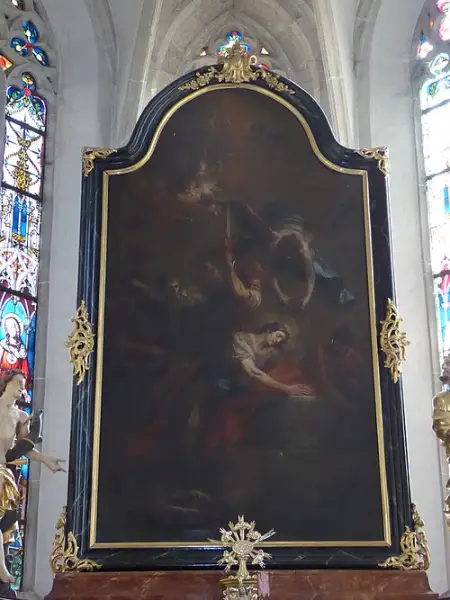
Quirinus' cult took root far from the Tiber at Tegernsee Abbey in Bavaria, to which his relics were translated in the eighth century — in one account during the reign of King Pippin and Pope Zacharias. The German scholar Ulrich Schmid demonstrated, however, that the abbey's founders in fact obtained the relics from Pope Paul I, who held the see from 757 to 767, and that the remains made the journey north out of Rome toward the close of the 700s, to be housed in the Church of Our Saviour, first of Tegernsee's churches. From that center his veneration spread through the surrounding region, and in 1450 a larger stone church was built to shelter his coffin. His feast is celebrated on 25 March, with a second observance on 16 June marking the translation of his relics, and he is venerated in both the Roman Catholic and Eastern Orthodox churches. In art he bears an orb and a sceptre, emblems reflecting the dignity his cult acquired over the centuries. A chapel dedicated to him stands at Tegernsee, and his death was depicted by the painter Martin Johann Schmidt in 1782.
§ Veneration
Timeline
- 270
Beheaded at Rome under Claudius Gothicus by one tradition; his body was cast into the Tiber and later found on Tiber Island
§ Introduction
- 757
The founders of Tegernsee Abbey received the martyr's relics from Pope Paul I, whose pontificate began that year
§ Background
- 1450
A larger stone church was built at Tegernsee to house the saint's coffin
§ Veneration
The Record
- Symbols
- orb·sceptre
- Canonization
- Pre-congregation; venerated as a martyr since antiquity in East and West
Prayer
Bibliography
Show 7 sources
- “Quirinus vom Tegernsee”. bautz.de (in German)
- “Sts. Quirinus”. Catholic Encyclopedia
- “Ulrich Schmid”, The Catholic Encyclopedia and Its Makers, Encyclopedia Press, Incorporated, 1917, p. 155
- Schmid, Ulrich. “Tegernsee.” The Catholic Encyclopedia Vol. 14. New York: Robert Appleton Company, 1912
- “Den hellige Quirinus av Tegernsee (d. 269)”. katolsk.no (in Norwegian). February 21, 2000. Retrieved August 12, 2019
- Troxler, Walter (1994). “Quirinus vom Tegernsee”. In Bautz, Traugott (ed.). Biographisch-Bibliographisches Kirchenlexikon (BBKL) Vol. 7. Herzberg: Bautz. cols. 1132–1133. ISBN 3-88309-048-4
- Herbermann, Charles, ed. (1913). “Sts. Quirinus”. Catholic Encyclopedia. New York: Robert Appleton Company
Profile text adapted from the Wikipedia article, licensed CC BY-SA 4.0.
Pray with this saint every day
Save St. Quirinus of Tegernsee to your favorites, read the full profile, and get feast-day reminders in the Saints app.
Get the Saints AppFree on the App Store for iPhone and iPad