
2nd century (traditional)·Feast May 22
St. Quiteria
Virgin Martyr of Braga and Gascony
Overview
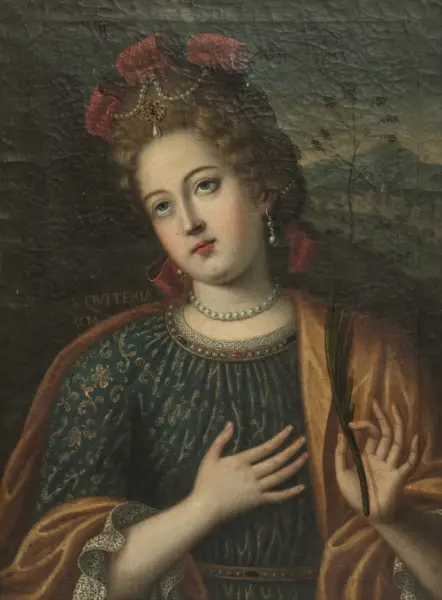
Quiteria is a virgin martyr whose cult is firmly attested even though nearly every circumstance of her life belongs to legend. The Roman Martyrology enters her under 22 May, and she ranks among the patron saints of Toledo, Spain. Portuguese tradition counts her the leader of the nine Nonuplet Sisters, born at Bracara Augusta — modern Braga — to a Roman official and his wife Calcia, ordered drowned as infants, saved by a disobedient maid, and raised as Christians. Refusing marriage, imprisoned in a tower, and escaped, the sisters fought a guerrilla campaign in the mountains against the Roman Empire until Quiteria was caught and beheaded. Another account has her flee a forced marriage and die at Aire-sur-l'Adour in Gascony, where her shrine church of Sainte-Quitterie still stands. She is invoked against rabies, for her legend tells how her voice alone held two rabid dogs at bay, and she is portrayed with a palm of martyrdom, a dog on a lead, and sometimes her head in her hands, fresh from the sea. Kuthenkuly, a village on the Tamil Nadu coast of southern India, claims her as patron of a pilgrimage shrine renowned for its Thursday devotion.
The Complete Life
Nine Daughters of Bracara
Portuguese tradition makes Quiteria one of nine daughters born at once in Bracara Augusta, the city now called Braga in Portugal's Minho region, to an important Roman military official and his wife Calcia. Ashamed at bearing nine daughters at one birth like some peasant woman, or fearful that her husband would treat the multiple delivery as evidence of unfaithfulness, the mother ordered a servant to drown the infants — in one telling her maid at a river, in another her servant Sila in the Miñor River. Disobeying, the maid passed the infants to women of the neighborhood, who raised the nine as followers of Christ. An older and simpler account names Lucius Catilius Serves, who governed Gallaecia and Lusitania for Rome, as her father, with Calcia for her mother. Her very name is ancient and ambiguous: one line of derivation links it to Kythere (or Kyteria), an Astarte title among the Phoenicians that signified “the red one”; another joins it to Cytherea, Aphrodite's epithet, taken from the island of Kythira where the goddess was born. Whatever pagan echoes the name carries, the girl who bore it was remembered above all as a virgin who gave her life rather than surrender her Christian faith.
§ Legend
Refusal, Flight, and Martyrdom
When the sisters reached adulthood they openly opposed the worship of the Roman gods and were hauled before their father, who recognized them as the daughters he had ordered drowned. Marriage he pressed upon them — Roman officers, other suitors; they would not comply, and he locked them in a tower. They broke out, freed every other prisoner the tower held, and took to the mountains, where they waged a guerrilla war against the Roman Empire. Quiteria was at length caught and beheaded. In a parallel strand of the story her father demanded that she marry and renounce Christianity; she fled, and his men tracked her to Aire-sur-l'Adour in Gascony; on that ground the sword fell. Liberata too died for the faith, in the forest of Montus, and her body rests in a sarcophagus of the 1300s within the fortified church of Saint Jean Baptiste at Mazères, some thirty-two kilometres from Quiteria's shrine at Aire-sur-l'Adour; Liberata is honored as patron saint of Sigüenza. Eumelia, unable to escape her pursuers, cast herself from a cliff in what is now the Peneda-Gerês National Park — a rock opened to receive her, and a hot spring sprang up on the spot called today Penedo da Santa, the Cliff of the Saint.
§ Quiteria and the Nonuplet sisters
Cult from Gascony to India
Quiteria is listed in the Roman Martyrology under 22 May and is honored among the patron saints of Toledo; in 1716 Pope Clement XI confirmed her canonization. An alternate Portuguese legend, the source of some of her most striking imagery, says that after decapitation she was thrown into the sea and emerged from the water carrying her head in her hands; because no written record supports the tale she is not counted among the cephalophores, yet artists represent her exactly so, alongside the palm of martyrdom and a dog on a lead. Her patronage against rabies springs from a legend in which the sheer force of her holy voice kept two rabid dogs at bay. Aire-sur-l'Adour maintains a church in her dedication, Sainte-Quitterie. Far from Iberia, the coastal village of Kuthenkuly in Tamil Nadu keeps her as its patron: her statue was first carried there by Thommai Poobalarayar, a native son who sought her intercession for an heir and built a chapel, and when his wife bore a son and a later plague spared the praying villagers, many miracles were reported. Their shrine became a large church in 1914, its centenary was kept solemnly in 2015, and a Tamil-language hagiography of the saint is preserved in the village. In 2018 the first festival in her honour was held at Tui, Galicia, after a proclamation by its bishop.
§ Veneration
Timeline
- 1716
Canonized by Pope Clement XI
§ Introduction
- 1914
The shrine of Saint Quiteria at Kuthenkuly, credited with deliverance from a deadly plague, was enlarged into a great church
§ Miracles
- 2015
The centenary of the Kuthenkuly church was celebrated in a grand manner
§ Miracles
- 2018
After a proclamation by the bishop, the first festival in her honour was held at Tui, Galicia
§ Alternate legend
The Record
- Patron of
- against rabies·Higueruela·Meca (Alenquer)·Kuthenkuly·one of the patron saints of Toledo, Spain
- Symbols
- palm of martyrdom·dog on a lead·with her head in her hands·emerging from the sea
- Canonization
- Canonized in 1716 by Pope Clement XI
Prayer
Bibliography
Show 7 sources
- Ἡ Ἁγία Κουϊτερία ἡ Μάρτυς. 22 Μαΐου. ΜΕΓΑΣ ΣΥΝΑΞΑΡΙΣΤΗΣ (in Greek)
- portcult.com. Archived February 19, 2007, at the Wayback Machine
- Giles, Ryan Dennis. The Laughter of the Saints: Parodies of Holiness in Late Medieval and Renaissance Spain. University of Toronto Press, 2009, p. 54 et seq. ISBN 9780802099525
- “Santa Quiteria”. ACI Prensa
- Ramón Ruiz Amadó and Teodoro Rodríguez y Fernández, “Sigüenza”, in The Catholic Encyclopedia, vol. 13 (New York: Robert Appleton Company, 1912)
- “We know the Temple”
- Herbermann, Charles, ed. (1913). “Sigüenza”. Catholic Encyclopedia. New York: Robert Appleton Company
Profile text adapted from the Wikipedia article, licensed CC BY-SA 4.0.
Pray with this saint every day
Save St. Quiteria to your favorites, read the full profile, and get feast-day reminders in the Saints app.
Get the Saints AppFree on the App Store for iPhone and iPad