
died c. 450·Feast October 26
St. Quodvultdeus
Bishop of Carthage and Church Father
Overview
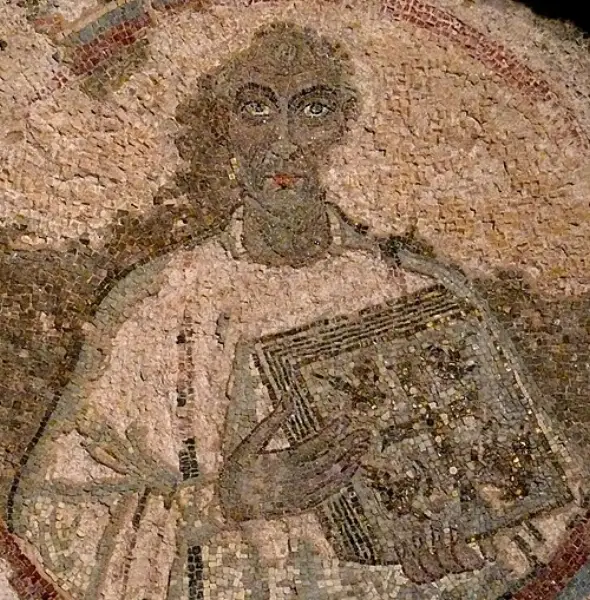
Quodvultdeus, a fifth-century bishop of Carthage honored among the Latin Church Fathers, bore a name that is Latin for “what God wills”. He can be shown living in Carthage around 407 and was ordained a deacon there in 421. His spiritual teacher was Augustine of Hippo, with whom he corresponded and who dedicated some of his writings to him. Quodvultdeus eventually occupied the episcopal throne of Carthage itself, holding that see when the Vandals under the Arian king Gaiseric overwhelmed Roman Africa. Carried into exile with other churchmen — tradition says aboard leaky ships — he landed at Naples around 439 and established himself in Italy, where he labored to convert dozens of Arian Goths to the Catholic faith. His writings, long anonymous, include the Liber promissionum et praedicatorum Dei and a body of sermons on the creed, on heresy, and on the trials of a church in barbarian times; since Germain Morin identified them in 1914, and Desiderius Franses confirmed the attribution in 1920, they have been recognized as the work of a preacher formed in Augustine's own school. He died around 450 at Neapolis, modern Naples, where a fifth-century mosaic burial portrait in the Catacombs of San Gennaro preserves his likeness.
The Complete Life
A Pupil of Augustine in Carthage
Quodvultdeus — the name is Latin for “what God wills” — belonged to the church of Carthage in Augustine's own generation. He can be shown living in that North African capital around 407, and in 421 he was ordained a deacon there. His spiritual teacher was Augustine of Hippo, with whom he corresponded; two of his letters to Augustine survive in the Augustinian corpus as Epistles 221 and 223, and Augustine dedicated some of his own writings to him in return. From so demanding a master Quodvultdeus absorbed a way of reading Scripture and preaching that echoed Augustine so faithfully that his own sermons circulated for centuries without his name attached. He eventually rose to the episcopal throne of Carthage, and both the Catholic and Eastern Orthodox churches rank him among the Church Fathers. His episcopate unfolded in the shadow of catastrophe: the Vandals under King Gaiseric, adherents of Arianism, were closing on Roman Africa, and the Catholic hierarchy of the proconsular province would soon be driven out wholesale. Quodvultdeus' sermons on barbaric times, De tempore barbarico, reflect the terror of that hour and show a shepherd preaching hope to a people watching their world collapse.
§ Introduction
Exile and a New Apostolate in Italy
When Gaiseric's Vandals stormed Carthage, Quodvultdeus was among the churchmen expelled from the city. Tradition relates that he and companions such as Gaudiosus of Naples were loaded aboard leaky ships and set adrift; the vessels nonetheless made landfall at Naples around 439, and there Quodvultdeus established himself, an exiled bishop cut off from the see he could no longer reach. Far from falling silent, he spent his Italian years in contest with the Arian faith of his conquerors, converting dozens of Arian Goths to the Catholic confession. His preaching from this period takes aim at every rival of Nicene Christianity: sermons against Jews, pagans and Arians, an exposé of five heresies, catechetical discourses on the creed in three parts, meditations on the four virtues of love, and reflections on the new song, the cataclysm, and the approach to grace. The catastrophe that uprooted him thus became the means of carrying African theological eloquence to Italy, sustaining uprooted Catholics and winning converts in the very circles the Arian occupation had seemed to close. He died at Neapolis — Naples — around 450, having turned defeat into a second apostolate.
§ Introduction
A Voice Recovered from Anonymity
None of Quodvultdeus' surviving works reached posterity under his own name. His Liber promissionum et praedicatorum Dei was assigned to Prosper of Aquitaine as early as the sixth century, while his sermons hid inside Augustinian collections. In 1914 the scholar Germain Morin first argued that twelve sermons transmitted under Augustine's name were in fact Quodvultdeus' own, and in 1920 Desiderius Franses showed the hypothesis to be highly plausible — a verdict that restored to view one of the few preachers formed directly in Augustine's school. Among the recovered pieces are the Sermon against Jews, Pagans and Arians, the discourses on the creed, the sermon on the new song, the sermon on the cataclysm, and two sermons on barbaric times. Critical editions and translations — René Braun's opera for the Corpus Christianorum and the Corpus Christianorum Series Latina, his French edition of the Book of Promises, and Thomas Macy Finn's English translation of the creedal homilies — have since made the corpus accessible to modern readers. At Naples the saint is still to be seen: among the mosaic burial portraits of the Galleria dei Vescovi in the Catacombs of San Gennaro, one face is his. He is kept on 26 October in the Roman calendar, 8 January in the calendar of Carthage, and 19 February in the calendar of Naples and among the Eastern Orthodox.
§ Writings
Timeline
- 407
Known to be living in Carthage
§ Introduction
- 421
Ordained a deacon at Carthage
§ Introduction
- 439
Exiled when Gaiseric's Vandals captured Carthage; set adrift on leaky ships that landed at Naples, where he established himself in Italy
§ Introduction
- 450
Died at Neapolis (Naples)
§ Introduction
- 1914
Germain Morin first proposed that twelve sermons circulating under Augustine's name were actually written by Quodvultdeus
§ Writings
- 1920
Desiderius Franses demonstrated the attribution of the sermons to Quodvultdeus to be highly plausible
§ Writings
The Record
- Major works
- Liber promissionum et praedicatorum Dei (Book of the Promises and Predictions of God)·Contra iudaeos, paganos et arrianos (Against Jews, Pagans and Arians)·Adversus quinque haereses (On Five Heresies)·De symbolo I, II and III (On the Creed)·De quattuor virtutibus caritatis (On the Four Virtues of Love)·De cantico novo (On the New Song)·De ultima quarta feria (On the Last Wednesday)·De cataclismo (On the Cataclysm)·De tempore barbarico I and II (On Barbaric Times)·De accedentibus ad gratiam I and II (On the Approach to Grace)·Two letters to Augustine (Epistles 221 and 223)
- Canonization
- Pre-congregation; venerated from antiquity in the Roman Catholic and Eastern Orthodox churches
Prayer
Bibliography
Show 6 sources
- Patron Saints Index: Saint Quodvultdeus. Archived April 5, 2008, at the Wayback Machine
- MacKie, Gillian (2003). Early Christian Chapels in the West. University of Toronto Press. p. 31. ISBN 978-0-802035042
- Morin, G. “Pour une future édition des opuscules de S. Quodvultdeus évêque de Carthage au Ve siècle”. Revue Bénédictine 31, 1914, p. 156–162
- Franses, D. Die Werke des hl. Quodvultdeus. Munich, 1920
- Finn, Thomas Macy (translation and commentary). Quodvultdeus of Carthage: The Creedal Homilies: conversion in fifth-century North Africa. New York: Newman Press, 2004, p. 137
- Drobner, Hubertus (1994). “Quodvultdeus”. In Bautz, Traugott (ed.). Biographisch-Bibliographisches Kirchenlexikon (BBKL) Vol. 7. Herzberg: Bautz. cols. 1137–1142. ISBN 3-88309-048-4
Profile text adapted from the Wikipedia article, licensed CC BY-SA 4.0.
Pray with this saint every day
Save St. Quodvultdeus to your favorites, read the full profile, and get feast-day reminders in the Saints app.
Get the Saints AppFree on the App Store for iPhone and iPad