
c. 780 – 856·Feast February 4
St. Rabanus Maurus
Carolingian Abbot of Fulda and Archbishop of Mainz
Overview
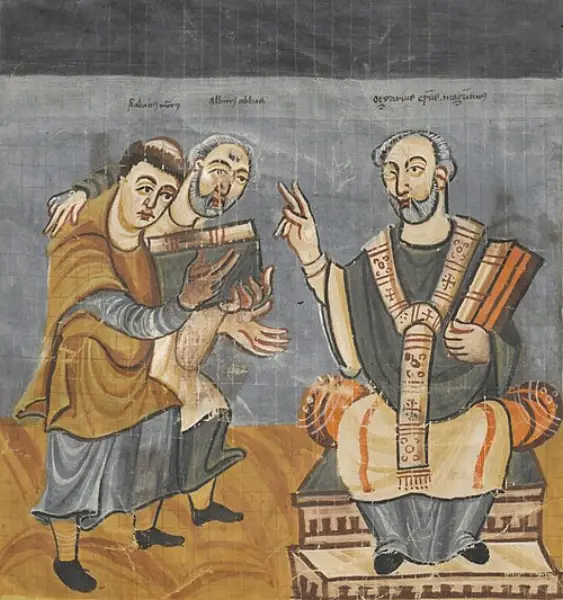
Rabanus Maurus Magnentius, born around 780 at Mainz and died on 4 February 856 at Winkel, was a Frankish monk of Saint Benedict's rule — at once theologian, poet, encyclopedist and writer on war — who rose to the archbishopric of Mainz in East Francia. Schooled at the Abbey of Fulda and sent from there to Tours, he studied under Alcuin, who gave him the surname Maurus in honor of Saint Maurus, the beloved disciple of Benedict, in recognition of his diligence and purity. Entrusted with the headship of the Fulda abbey school in 803, he built it into a European powerhouse of learning and manuscript-making whose alumni included Walafrid Strabo, Servatus Lupus of Ferrières and Otfrid of Weissenburg. He ruled the abbey itself from 822 until 842, resigned for a life of study and prayer, and in 847 was constrained to return to public life as archbishop of Mainz, dying in office nine years later. His encyclopaedia De rerum naturis, his treatise on clerical formation De institutione clericorum, his scriptural commentaries, and the intricate cross-poems of De laudibus sanctae crucis placed him in the front rank of Carolingian masters and authors. To his hymn Veni Creator Spiritus the Church still sings at Pentecost, ordinations and papal conclaves, and posterity titled him Praeceptor Germaniae, the teacher of Germany.
The Complete Life
From Mainz to the School of Alcuin
Rabanus was born to noble parents at Mainz, on the Rhine, though the precise date of his birth remains uncertain. He received his schooling at the Benedictine Abbey of Fulda in Hesse, where he embraced monastic life and was ordained a deacon in 801. His abbot, Ratgar, sent the promising young monk off in company with Haimo (afterward of Halberstadt) to finish his education at Tours, and there Rabanus sat at the feet of Alcuin, the most celebrated schoolmaster of the Carolingian renaissance. Alcuin, recognizing his pupil's diligence and purity of character, gave him the surname Maurus after Saint Maurus, the favorite disciple of Benedict of Nursia — a name by which he has been known ever since, usually joined to his own as Rabanus Maurus. The years at Tours placed him in direct succession to the scholarly program of Charlemagne's court circle, and he carried that inheritance back up the Rhine, where it would bear fruit in the classroom of Fulda and, through his pupils, across the whole German-speaking world. Even his physical habits as a young monk were remembered: Alban Butler, in his Lives of the Saints, preserves the detail that Rabanus kept a table without meat or wine.
§ Life
Master of the Fulda School
Back at Fulda, Rabanus received in 803 the principal charge of the abbey school, and under his leadership the school grew into one of Europe's outstanding seats of learning and manuscript production. Its pupils went forth to shape the intellectual life of the next generation: Walafrid Strabo, Servatus Lupus of Ferrières, and Otfrid of Weissenburg all passed through his classroom. Probably in these same years he assembled his selections from Priscian's grammar, a schoolbook that would circulate widely in the Middle Ages. In 814 he was ordained a priest; shortly afterwards, apparently because of a disagreement with Abbot Ratgar, he withdrew from Fulda for a time. A long-standing belief that this banishment occasioned a pilgrimage to Palestine rests on a misreading: the allusion in his commentary on Joshua is drawn from Origen's fourteenth homily on the book, and it was Origen, not Rabanus, who traveled there. Rabanus came home to Fulda in 817, when Eigil took office as the new abbot; at Eigil's death in 822 the monks' former schoolmaster stepped into the abbacy himself, a position he handled efficiently and successfully for two decades.
§ Life
Teaching Germany
Rabanus' apostolate was above all one of teaching, and his writings served the formation of clergy and laity alike. His De institutione clericorum set before Frankish clergy the teaching of Augustine and Gregory the Great on the preparation the priestly office demands, a manual of pastoral and intellectual formation drawn from the masters of the Latin tradition. His commentaries on Scripture ranged across nearly the whole canon, from Genesis and the historical books to the Psalms' wisdom companions, the prophets, Matthew, and the Epistles of Saint Paul including Hebrews, equipping preachers for the work of exposition. His encyclopaedia, an aid to reading Scripture in its typological, historical and mystical senses, laid the whole of readable knowledge at the service of the sacred page. Not even the defense of Christendom escaped his pen: his De procinctu romanae miliciae, a condensed and annotated rendering of Vegetius' De re militari, aimed to sharpen Frankish arms. Nor did he neglect the tongue of his own people — the Glossaria Latino-Theodisca hold a special place in the annals of German philology. In 847 the choice of the Mainz church fell on him as Otgar's successor, and his teaching office widened to the metropolitan see of Germany.
§ Works
The Poet of the Cross
The spirituality of Rabanus was ascetic, scriptural, and luminously devoted to the cross. Butler notes the abstemiousness of his table, meat and wine alike set aside, and in 842 he laid the abbacy down, wanting freer room for study and prayer, and withdrew to the nearby house of St Petersberg. His most original devotional work is the book of verse meditations on the cross, the De laudibus sanctae crucis (also known as In honorem sanctae crucis), compositions of great intricacy that set the cross before the reader in word, image and even number, and in the final poem show Rabanus himself kneeling before it — a portrait of the scholar-saint prostrate in adoration. His poetic gift served the Church's worship as well: he left the Church several hymns, and the crown of them is Veni Creator Spiritus, an invocation of the Holy Spirit sung at Pentecost, at ordinations and at the papal conclave, whose English dress varies — “our souls inspire,” “Creator blest,” “by whose aid.” Another of his hymns, Christe, sanctorum decus Angelorum, sung for the feast of Saint Michael and All Angels, names the archangels Gabriel and Raphael and survives in English in The Hymnal 1982, harmonized by Ralph Vaughan Williams. Centuries on, Mahler set the same hymn at the head of his Eighth Symphony.
§ Hymns
Archbishop and Death at Winkel
Rabanus had withdrawn from office to the quiet of St Petersberg, but in 847 the Church called him back, choosing him to follow Otgar on the archiepiscopal throne of Mainz, the metropolitan see of the German church, a dignity he held from 848 until his death. The old schoolmaster now bore the cares of a province in the fragmenting world of East Francia, yet the sources present no breach between the monk and the archbishop: the same energy that had governed Fulda governed Mainz. He died at Winkel on the Rhine on 4 February 856, at the age of seventy-five or seventy-six, closing a life that had spanned the reigns of Charlemagne's heirs and the whole flowering of the Carolingian renaissance at its Fulda center. His feast is kept on the day of his death, 4 February, and the most recent edition of the Roman Martyrology, that of 2004, qualifies him explicitly as a saint. The date of his birth may be uncertain, but the date of his death became the anchor of his memory in the calendars of the Church he served as monk, abbot, and archbishop.
§ Life
Praeceptor Germaniae
Posterity gave Rabanus the title Praeceptor Germaniae — the teacher of Germany — and the description is exact. Through the Fulda school he trained the scholars who carried Carolingian learning into the next century; through his encyclopedia and commentaries he fixed the pattern of medieval scriptural study; through his hymns he still speaks whenever the Church invokes the Holy Spirit. His Latin-German glossaries earned him a special place in the annals of German philology, and a runic alphabet recorded in the treatise De Inventione Litterarum has been ascribed to him — a mingling of the Elder Futhark with Anglo-Saxon signs, attested in manuscripts of the 700s and 800s, traditionally called the Marcomannic runes though it has no real connection with the Marcomanni; Wilhelm Grimm discussed these runes in 1821. The first nominally complete edition of his works appeared at Cologne in six volumes in 1627, and his Opera omnia occupy volumes 107 to 112 of Migne's Patrologia Latina. Modern critical editions have renewed access to his cross-poems, his Matthew commentary and his Martyrologium. In 2006, eleven and a half centuries after his death, Germany commemorated him, above all at Mainz and Fulda, with the rare loan from the Vatican of the manuscript Codex Vaticanus Reginensis latinus 124 and the publication of three book-length studies of his life and work.
§ Works
Timeline
- 780
Born c. 780 to noble parents at Mainz
§ Life
- 801
Ordained a deacon at the Benedictine Abbey of Fulda, where he was schooled and became a monk
§ Life
- 803
Entrusted with the principal charge of the Fulda abbey school, which rose under him to European preeminence
§ Life
- 814
Ordained a priest; withdrew for a time from Fulda after a disagreement with Abbot Ratgar
§ Life
- 817
Returned to Fulda upon the election of the new abbot Eigil
§ Life
- 822
Became abbot of Fulda at Eigil's death and administered the abbey efficiently and successfully
§ Life
- 842
Resigned the abbacy, wanting freer room for study and prayer, and withdrew to the nearby house of St Petersberg
§ Life
- 847
Constrained to return to public life, elected to succeed Otgar as Archbishop of Mainz
§ Life
- 4 Feb 856
Died at Winkel on the Rhine, aged seventy-five or seventy-six
§ Life
The Record
- Major works
- De rerum naturis (De universo libri xx), encyclopaedia·De laudibus sanctae crucis (In honorem sanctae crucis), cross-poems·De institutione clericorum, on the training of clergy·De sacris ordinibus·De disciplina ecclesiastica·Martyrologium·De procinctu romanae miliciae, abridgement of Vegetius for Frankish warfare·Glossaria Latino-Theodisca·Excerpt from the grammar of Priscian·Commentaries on scripture from Genesis to the Epistles of St Paul·Veni Creator Spiritus, hymn·Christe, sanctorum decus Angelorum, hymn
- Canonization
- Pre-congregation; qualified as a saint (sanctus) in the Roman Martyrology of 2004, with feast on 4 February
Prayer
Bibliography
Show 10 sources
- Hanson, Victor Davis (18 December 2007). Carnage and Culture: Landmark Battles in the Rise to Western Power. Knopf Doubleday Publishing Group. ISBN 978-0-307-42518-8
- Chisholm, Hugh, ed. (1911). “Hrabanus Maurus Magnentius”. Encyclopædia Britannica. Vol. 13 (11th ed.). Cambridge University Press. p. 842
- “Rabanus Maurus”, Hymnary
- Throop, Priscilla, ed. and tr., Hrabanus Maurus: De Universo, vol. 1, p. x
- The Hymnal 1940 Companion. New York: The Church Pension Fund (1949)
- “Veni Creator Spiritus | hymn | Britannica”. Encyclopedia Britannica
- No. 282 in The Hymnal 1982. Church Publishing Incorporated, New York
- Aaij, Michel (May 2009). “Continental Business: Rabanus Maurus, the Praeceptor Germaniae, on the 1150th Anniversary of his Death”. The Heroic Age: A Journal of Early Medieval Northwestern Europe (12). ISSN 1526-1867
- Grimm, William (1821). Ueber deutsche Runen, pp. 149–159
- Herbermann, Charles, ed. (1913). “Blessed Maurus Magnentius Rabanus”. Catholic Encyclopedia. New York: Robert Appleton Company
Profile text adapted from the Wikipedia article, licensed CC BY-SA 4.0.
Pray with this saint every day
Save St. Rabanus Maurus to your favorites, read the full profile, and get feast-day reminders in the Saints app.
Get the Saints AppFree on the App Store for iPhone and iPad