
6th – 7th century·Feast Second Sunday after Easter
St. Rabban Hormizd
Persian Monk and Founder of the Alqosh Monastery
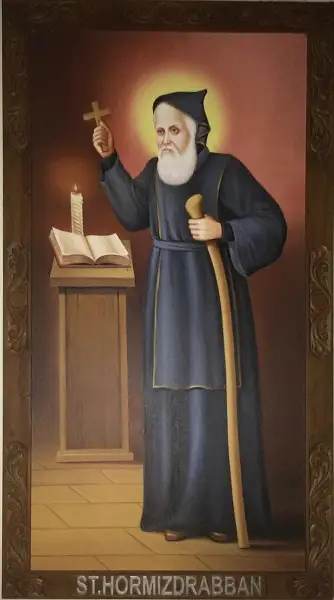
Overview
Rabban Mar Hormizd was a monk of the Church of the East whose life unfolded in the seventh century in the northern Mesopotamian lands now belonging to Iraq; the title rabban signifies monk in Syriac and teacher in Aramaic. His birth fell on the threshold between the 500s and 600s, at Beth Lapat in Persia, to a family of wealth or nobility. At eighteen he left home, intending to take up the monk's life in the Egyptian desert of Scetes; but three monks from Bar Idta, a house of the Church of the East, fell in with him on the road and prevailed upon him to enter their community, where he embraced a hard and stern discipline. Bar Idta kept him, within its walls or nearby, for thirty-nine years, and a stay of six or seven years with Abba Abraham of Risha followed. At sixty-five or sixty-six he departed, made his way out of the Marga country, and chose the mountain of Beth 'Edhrai above the town of Alqosh for his dwelling, where the people of the district offered to raise for him the monastery that still carries his name. In later ages the monastery of Alqosh became a seat of the Church of the East's patriarchs, and the saint returns each year on the second Sunday after Easter.
The Complete Life
From Beth Lapat to Bar Idta
The story of Hormizd's vocation reaches us through The Histories of Rabban Hormizd the Persian and Rabban Bar-Idta, set down by his disciple Simon and already current before the 1100s. That work gives his birthplace as Beth Lapat, the Persian city also known as Gundeshapur, and his family as rich or noble, his birth falling at the turn from the sixth century to the seventh. At eighteen he set out to travel toward Scetes, the desert of Egypt where the greatest monks of the tradition had struggled, intending to take up the ascetic life there. Egypt he never saw: three monks of Bar Idta, a house of the Church of the East, fell in with him along the road and prevailed upon him to enter their community, and he took their counsel. His life there was hard and stern. Bar Idta held him, at its heart or in its vicinity, for thirty-nine years, after which six or seven years passed in the monastery of Abba Abraham of Risha, deepening the discipline that had first called him eastward rather than to Egypt.
§ Life
The Mountain above Alqosh
At sixty-five or sixty-six Hormizd walked away from cloistered life, crossed out of the Marga country, and took up his dwelling on the mountain of Beth 'Edhrai above the town of Alqosh, in the northern Iraqi lands of today. Once he had dwelt there a little while, the people of the district came forward with an offer to build him a monastery — the house known ever after as the Rabban Hormizd Monastery. The next stretch of his life, his biographer records, was taken up with episodes pitting him against the miaphysite community of Mar Mattai, where the Catholicate of the Syriac Orthodox Church in Persia resided; the old monk of the Church of the East defended the confession of his own communion against its rivals from his mountain retreat. His foundation endured long after him: the Alqosh house counts among the significant monasteries of both the Chaldean Catholic Church and the Church of the East, and its past includes service as the seat of the Church of the East's patriarchs, making the aged settler on Beth 'Edhrai the founding father of one of the most consequential houses of Eastern monasticism.
§ Life
A Name Carried across the World
Rabban Hormizd's memory lives above all in the monastery of Alqosh, where his tomb remains an object of veneration, and in the calendars of the churches descended from the Church of the East — the Assyrian Church of the East, the Ancient Church of the East, the Chaldean Catholic Church, and the Syro-Malabar Catholic Church — which commemorate him on the second Sunday after Easter. His cult traveled with the faithful of those communions: the Mar Hormizd Syro-Malabar Cathedral at Angamaly in India was built by Mar Abraham, Metropolitan and Gate of All India, and the largest Assyrian church in Australia, St Hurmizd Cathedral at Greenfield Park, bears his name. The Book of Protection, a treasury of Syriac charm and blessing, depicts Mar Hormizd Rabban among its protecting figures, and the metrical life composed for him by Mar Sergius of Adiabene was translated alongside his histories by E. A. Wallis Budge in 1902. Few monks of the seventh century can claim descendants of this reach — a Persian novice who missed Egypt found, on an Iraqi mountain, a patrimony spanning three continents.
§ Gallery
The Record
- Major works
- Rabban Hormizd Monastery at Alqosh, later patriarchate of the Church of the East
- Canonization
- Pre-congregation; venerated from antiquity in the Church of the East and its descendant churches
Prayer
Bibliography
Show 5 sources
- Pathikulangara, Fr. Varghese CMI (2011). Divine Praises in Aramaic Tradition. Kottayam: Denha Services. p. 48. ISBN 978-93-81207-02-4
- “New Testament Aramaic”. Studylight.org. Retrieved 28 September 2016
- Gorgis, Fr. Noel. “Memorial of Rabban Hormizd”. Kaldaya.net. Archived from the original on April 24, 2008. Retrieved 2009-11-15
- Leroy, Jules; Collin, Peter (2004). Monks and Monasteries of the Near East. pp. 166–167. ISBN 978-1-59333-276-1
- Budge, Ernest Alfred Wallis, ed. (1902). The histories of Rabban Hormizd the Persian and Rabban Bar-Idta. London
Profile text adapted from the Wikipedia article, licensed CC BY-SA 4.0.
Pray with this saint every day
Save St. Rabban Hormizd to your favorites, read the full profile, and get feast-day reminders in the Saints app.
Get the Saints AppFree on the App Store for iPhone and iPad