
before 850 – 917·Feast November 29
St. Radboud of Utrecht
Scholar bishop of Utrecht in exile at Deventer
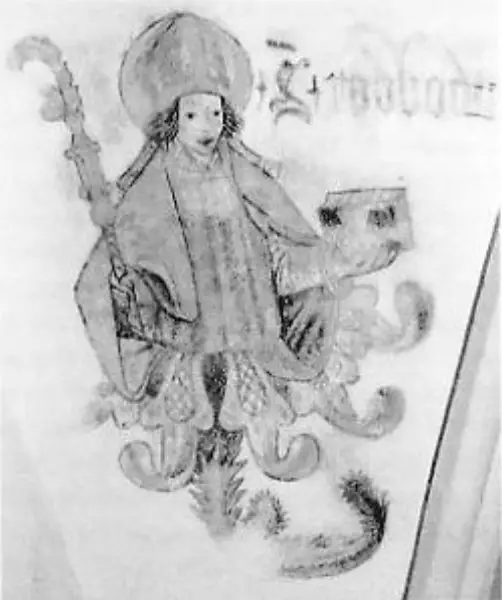
Overview
Radboud, sometimes rendered Radbod, led the diocese of Utrecht from 899 until his death in 917, governing a church whose ancient seat had been wrecked by Norse raids. Born to a noble Frankish family near Namur, with Frisian royal blood through his mother, a descendant of King Radboud, he was formed entirely by books: schooled first by his uncle Gunther, archbishop of Cologne, then at the court school of Charles the Bald, whose chaplain he became, and finally, it seems, as a Benedictine at Saint-Martin of Tours. Robbed of his cathedral city, he resided at Deventer and acted as the chief representative of East Frankish authority in the northern Low Countries. When Lorraine passed to the western kingdom in 911, his allegiance wavered between two monarchs. He journeyed to Rome around 914 to settle a dispute before Pope John X, catalogued the lost possessions of his see, and died at Ootmarsum in November 917 while on a mission through Drenthe, before his plans to reoccupy Utrecht could be realised.
The Complete Life
A Frankish Noble Formed by Study
Radboud was born around the middle of the ninth century into a noble Frankish family settled near Namur. His mother brought Frisian blood into the household: she descended from the Frisian king Radboud, who had died in 719, and the nephew would carry the name of his royal ancestor. His education began under the supervision of his maternal uncle Gunther, archbishop of Cologne, who directed the boy's studies from about 850 until Gunther's deposition from the see in 863. That interruption did not end his schooling. Radboud transferred to the court school of the west Frankish king Charles the Bald, where he distinguished himself sufficiently to become a royal chaplain. Contemporaries and later observers agree that study and learning claimed the greater part of his energies; he was a scholar by temperament before he was ever a prelate, and the habits of composition and reflection formed in these years would mark everything he later undertook as bishop.
§ Life
Monk, Then Bishop of a Ruined See
After the death of Charles the Bald in 877, Radboud is presumed to have embraced monastic life at the celebrated Benedictine convent of Saint-Martin in Tours. From the cloister he was raised to the episcopate: in 899, with the permission of Emperor Arnulf of Carinthia, he was elected bishop of Utrecht. It was an office heavy with difficulty, for Norse raids had destroyed the city of Utrecht itself, and no bishop could live there. Radboud therefore took up residence at Deventer in the Oversticht, following the example of one of his predecessors who had already settled there. From this displaced seat he governed the northern Netherlands as the foremost representative of East Frankish authority in the region, a duty that entangled him in politics as much as in pastoral care, and which he discharged for nearly two decades from a city that was never meant to be his cathedral home.
§ Life
Diplomacy Between Two Kingdoms
Radboud's episcopate was tested by the collapse of political certainties. In 911 the Duchy of Lorraine, within which the diocese of Utrecht lay, was transferred to the western Frankish kingdom, and the bishop found himself weighing loyalty to his former sovereign against connection with the new one. His oldest biographical notice criticises the involvement of bishops in East Frankish government, though later readers suspect the judgement says as much about the author as about Radboud. Whatever his private hesitations, he acted decisively where his church's interests demanded it. Around 914 or 915 he made the journey to Rome and laid before Pope John X a conflict, otherwise unrecorded, with Count Meginhard of Hamaland; after hearing both the bishop and Meginhard's representatives, the pope imposed a settlement. Radboud also began methodical preparations for restoring the episcopal seat at Utrecht, compiling an inventory of all the property the diocese had held before the Norman devastation, a record intended to ground its recovery.
§ Life
Death Before the Return
The bishop's careful plans were never realised. While on a mission journey through Drenthe, Radboud fell ill, and he died at Ootmarsum in November 917, with the restoration of Utrecht still unfinished. He had already named his own successor, Balderik, sparing the see a disputed election. His body was carried back to Deventer and buried in the Lebuinuskerk, the church of the town that had sheltered his episcopate; some accounts, cited by the historian Johan Picardt among others, hold that his remains were later divided, with parts of his remains interred in the church at Nijenstede. He had governed Utrecht for eighteen years, most of them spent away from the city of his title, and he died as he had lived as bishop: on the road, in the pastoral service of a scattered flock, trusting that the See of Peter and the record of his inventory would one day secure what the Northmen had taken.
§ Life
Writer, Patron, and Name of a University
A body of smaller works bears Radboud's name, though scholars harbour doubts about some attributions. Most are lives of saints, some composed in prose and others in verse: he wrote of the Anglo-Saxon missionary Boniface, treated Suitbert and Lebuinus in both a sermon and verse, and described Saint Amalberga and Bishop Servatius of Maastricht. His medieval cult never spread far beyond the diocese of Utrecht, and his feast is kept on 29 November. In modern times his patronage took a new institutional form: in 1905 the Saint Radboud Foundation came into being to further Catholic higher learning in the Netherlands, and in 1923 the Catholic University of Nijmegen began its work, joined in 1956 by the hospital now known as Radboudumc. On 1 September 2004 the university formally adopted the name Radboud University Nijmegen, so that the scholar-bishop of a ruined ninth-century see now lends his name to one of the country's principal centres of Catholic learning.
§ Patronage
Timeline
- 850
Began his studies under his uncle Gunther, Archbishop of Cologne, who mentored him until his deposition.
§ Life
- 863
Continued his education at the court school of King Charles the Bald after his uncle's deposition, later becoming a royal chaplain.
§ Life
- 877
Presumably entered the Benedictine convent of Saint-Martin at Tours following the death of Charles the Bald.
§ Life
- 899
Was elected bishop of Utrecht with the consent of Emperor Arnulf of Carinthia, taking up residence at Deventer because Norman destruction had left Utrecht uninhabitable.
§ Life
- 911
Faced a shift in allegiance when the Duchy of Lorraine, home to his diocese, passed to the western Frankish kingdom.
§ Life
- 914
Travelled to Rome and presented a dispute with Count Meginhard of Hamaland to Pope John X, who brokered a settlement after hearing both parties.
§ Life
- Nov 917
Fell ill during a mission journey in Drenthe and died at Ootmarsum before he could carry out his plan to restore the episcopal seat at Utrecht; he was buried in the Lebuinuskerk at Deventer.
§ Life
- 1923
The Catholic University of Nijmegen, named in his honour, opened its doors, followed by the associated Saint Radboud hospital.
§ Patronage
The Record
- Major works
- Prose life of Boniface·Lives of Suitbert and Lebuinus, in both sermon and verse·Life of Saint Amalberga (authorship doubted)·Life of Bishop Saint Servatius of Maastricht
- Patron of
- Catholic scientific practice in the Netherlands
- Canonization
- Pre-congregation saint; his medieval veneration remained limited to the Diocese of Utrecht
Prayer
Bibliography
Show 5 sources
- "De heilige Radboud van Utrecht", Russian Orthodox Church, The Hague.
- Radboud Universiteit.
- "Radboud of Utrecht", The Medieval Liturgy of the Low Countries.
- Hesselink-Zweers, D., "Hardenberg, an episcopal castle fortified city", Hardenberg Municipal Archives.
- Roman Martyrology.
Profile text adapted from the Wikipedia article, licensed CC BY-SA 4.0.
Pray with this saint every day
Save St. Radboud of Utrecht to your favorites, read the full profile, and get feast-day reminders in the Saints app.
Get the Saints AppFree on the App Store for iPhone and iPad