
c. 520 – 587·Feast August 13
St. Radegund
Thuringian princess, Frankish queen, and foundress of Poitiers
Overview
Radegund, a princess of Thuringia who became queen of the Franks and finally a nun, stands among the most vivid figures of sixth-century Gaul. Bertachar, her father, ranked among the three kings who divided Thuringia when she was born about 520; dynastic murder soon left her an orphan: her uncle Hermanfrid killed her father in battle, and after the Frankish conquest of 531 she was carried off by King Clotaire I. Raised at his villa of Athies in Picardy, she became one of his wives in 540, renowned at court for her almsgiving and childless amid a crowd of rivals. When Clotaire murdered her brother, the last royal Thuringian male, in about 545, Radegund fled the palace and obtained consecration as a deaconess from Medardus, bishop of Noyon. She founded the monastery of Sainte-Croix at Poitiers around 560, governed its life of prayer and learning, secured a relic of the True Cross from Emperor Justin II, and pursued an asceticism of legendary severity until her death on 13 August 587.
The Complete Life
A Princess Between Two Kingdoms
Radegund was born about 520 into the ruling house of Thuringia, the daughter of Bertachar, one of three brothers who shared its kingship. Her childhood was destroyed by the violence of her own kin: her uncle Hermanfrid slew Bertachar in battle and carried the orphaned girl into his household. Hermanfrid, having allied with the Frankish king Theuderic to defeat his remaining brother Baderic, then repudiated his promise to share the conquered realm. The betrayal invited retribution. In 531 Theuderic marched back into Thuringia alongside his brother Clotaire I; together the Frankish kings broke Hermanfrid's power and seized the realm. Radegund fell to Clotaire's share of the spoils, and the Frankish king carried the child back with him to Merovingian Gaul. For several years she was lodged at his villa of Athies in Picardy, a captive princess raised in the conqueror's world, until in 540, still young, she was given to Clotaire in marriage and entered the unstable hierarchy of his six wives and concubines.
§ Life
From Queen to Consecrated Deaconess
At the Frankish court Radegund won a reputation that had nothing to do with rank: she was noted above all for her almsgiving, and bore Clotaire no children while five rival women surrounded the king. The end of her marriage came by way of a family catastrophe. About 545 her brother stood as the last male heir of Thuringia's royal house, and Clotaire ordered his death. Radegund escaped the palace and put herself under the church's guardianship, winning over Medardus, bishop of Noyon, who consecrated her a deaconess. The step was decisive: a consecrated woman could no longer be a king's wife, and the queen of the Franks became instead a woman of the church. She turned decisively toward the monastic life she had apparently long desired, and the episodes of her captivity, marriage, and flight were later read by her admirers as the providential path by which God drew a royal victim into a holier sovereignty.
§ Life
Sainte-Croix and the Wood of the Cross
At Poitiers, around the year 560, Radegund founded the monastery of Sainte-Croix, named for the cross, where she gathered women into a disciplined common life and personally cared for the infirm; many believed her to possess the gift of healing. The community lived under the Rule for Virgins composed by Caesarius of Arles, which Radegund had received from her own niece Caesaria. The Rule obliged the nuns to read and write, to spend hours each day with scripture and the copying of manuscripts, and to practise traditional needlework and weaving; it also imposed strict enclosure so complete that the sisters could not even attend their foundress's funeral. The abbey's crowning treasure was a relic of the True Cross obtained from the Byzantine emperor Justin II. When Maroveus, bishop of Poitiers, refused to install it, Radegund appealed to King Sigebert I, who dispatched Eufronius of Tours to perform the ceremony. For the feast of its installation Venantius Fortunatus composed hymns, among them Vexilla Regis, still sung on Good Friday.
§ Life
The Extreme Ascetic
Radegund's sanctity expressed itself in a bodily discipline that startled even her own age, and she has been described as an extreme ascetic. She took no animal products of any kind, keeping to a diet of legumes and green vegetables and refusing fruit, fish, and eggs. Wine, mead, and beer she entirely abandoned; through Lent she went further, giving up bread, oil, and salt and drinking only a little water. Those who warned her that such rigours would ruin her health found her unmoved. Her penance extended to deliberate bodily suffering: iron rings, three of them, girded her neck and arms and tore the flesh beneath, and once she heated a brass cross and held it against her body. Contemporaries understood these severities not as self-destruction but as a queen's reparation, a body offered in place of the power she had renounced. In her, the courts of Thuringia and Gaul were answered by a cell where a former queen fed on the poorest food and carried the marks of the cross on her own skin.
§ Asceticism
Death on the Same Day as Her Friend
Radegund's later decades at Poitiers were brightened by friendship. The poet Venantius Fortunatus and the bishop and historian Gregory of Tours were both devoted to her and wrote extensively of her; she answered with Latin verse of her own addressed to Fortunatus, written on tablets since lost to history, and two substantial poems in her voice, De Excidio Thuringiae and Ad Artachin, are now credited to her by recent historians rather than to Fortunatus. She was also close to Junian of Maire, and tradition holds that the two died on the very same day, 13 August 587. Her funeral, three days after her death, was attended by both Fortunatus and Gregory. Burial was in what became the Church of St. Radegonde at Poitiers, where her tomb survives in the crypt and remains the heart of her devotion. The strict enclosure of her Rule had barred her nuns from attending, a poignant final mark of the discipline she had chosen for the house she loved.
§ Life
A Saint Remembered in Stone, Glass, and Verse
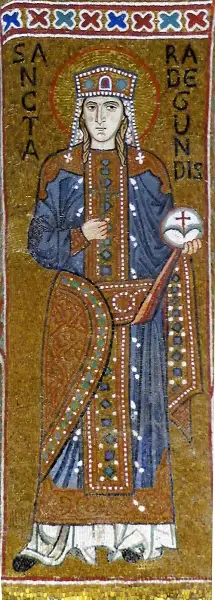
The nun Baudonivia composed another biography of Radegund after a rebellion at the abbey that Gregory of Tours described, and the twinned lives fixed her memory for the middle ages. Her cult spread widely: churches in France and England alike claim her as patroness, and parish churches in England dedicated to her number five, alongside chapels in Old St Paul's Cathedral and the cathedrals of Gloucester, Lichfield, and Exeter. a monastery at Dover, St Radegund's Abbey, rose in 1191 under her name, and Longleat Priory likewise took her as dedicatee; Jesus College, Cambridge, holds her as patron saint on the site of a twelfth-century priory that bore her name with that of Saint Mary. In the 1260s a glazing programme at Poitiers depicted scenes of her life, windows later shattered by Huguenots. In art she appears crowned and robed, with sceptre, crosier, and book, a field of oats, and tame wolves and wild beasts; many French villages called Sainte-Radegonde and Austrian municipalities honour her name.
§ Namesakes
Timeline
- 520
Was born to Bertachar, one of the three kings who ruled the Germanic land of Thuringia.
§ Life
- 531
Was taken into the hands of King Clotaire I after the Frankish conquest of Thuringia, and was sent to his villa of Athies in Picardy.
§ Life
- 540
Was married to Clotaire I, becoming one of his six wives or concubines.
§ Life
- 545
Fled the royal court after Clotaire murdered her brother, and persuaded Medardus, bishop of Noyon, to consecrate her a deaconess.
§ Life
- 560
Founded the monastery of Sainte-Croix at Poitiers, where she cared for the infirm.
§ Life
- 13 Aug 587
Died at the Abbey of the Holy Cross in Poitiers on the same day as her friend Junian of Maire.
§ Life
The Record
- Major works
- Abbey of the Holy Cross (Sainte-Croix), Poitiers·Latin poems written to Venantius Fortunatus on lost tablets·Poems De Excidio Thuringiae and Ad Artachin, written in her voice and now credited to her by recent historians
- Patron of
- Jesus College, Cambridge·several churches in France and England
- Symbols
- crowned, with royal robes and sceptre·mantle with fleurs-de-lys·tame wolves and wild beasts at her side·crosier and book·field of oats·white headdress·mantle with castles
- Canonization
- Pre-congregation saint; venerated since late antiquity, with her cult centred on her tomb at Poitiers
Prayer
Bibliography
Show 9 sources
- Husenbeth, Frederick Charles. Emblems of Saints: By which They are Distinguished in Works of Art, Longman, Green, Longman, and Roberts, 1860, p. 140.
- "St. Radegund", Jesus College, Cambridge.
- "Radegund of Thuringia", Epistolae, Columbia University.
- McNamara, Jo Ann et al, "St. Radigund", Sainted Women of the Dark Ages. Durham and London: Duke University Press, 1992, pp. 70-86.
- Effros, Bonnie (2002). Creating Community with Food and Drink in Merovingian Gaul. Palgrave Macmillan. pp. 49-50. ISBN 978-0-312-22736-4.
- Muir, Elizabeth Gillan (2019). Women's History of the Christian Church: Two Thousand Years of Female Leadership. University of Toronto Press. p. 46. ISBN 9781487593858.
- Mathisen, Ralph; Shanzer, Danuta (2017). Society and Culture in Late Antique Gaul: Revisiting the Sources. Taylor and Francis. p. 235. ISBN 9781351899215.
- Stevenson, Jane (2005). Women Latin Poets: language, gender, and authority, from antiquity to the eighteenth century. Oxford University Press, p. 88.
- Bond, Francis (1914). Dedications and patron saints of English churches: ecclesiastical symbolism; saints and their emblems, p. 328.
Profile text adapted from the Wikipedia article, licensed CC BY-SA 4.0.
Pray with this saint every day
Save St. Radegund to your favorites, read the full profile, and get feast-day reminders in the Saints app.
Get the Saints AppFree on the App Store for iPhone and iPad