
1878-1938·Feast June 6
St. Rafael Guízar y Valencia
Bishop of Xalapa, Confessor of the Cristero era
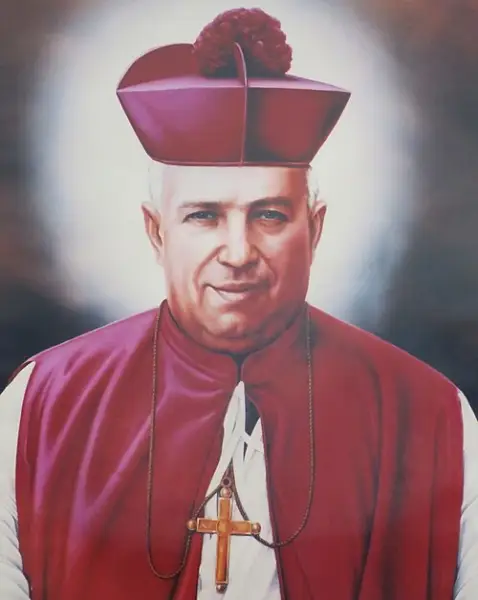
Overview
Rafael Guízar Valencia was born at Cotija in Michoacán on 16 April 1878, one of the eleven children of Prudencio and Natividad Guízar y Valencia, and lost his mother when he was nine. Schooled by Jesuits, he entered the Cotija seminary in 1891 and was ordained in 1901, becoming spiritual director of the Zamora seminary in 1905. When revolution brought persecution, he founded a religious newspaper in 1911 and then lived the next years as a hunted priest, disguising himself as a street vendor, a musician, even a homeopathic doctor, so that he could carry the sacraments in secret; twice he had to leave Mexico for the United States, and he passed 1916 in Guatemala and 1919 tending victims of the black plague. Elected Bishop of Veracruz in 1919 and consecrated in Havana on 30 November, he ran a clandestine seminary that shifted from hideout to hideout and spent nine years in exile, organizing relief after the great Veracruz earthquake of January 1920. Stricken in Córdoba in December 1937, he died in Mexico City on 6 June 1938; his tomb in Xalapa cathedral still draws pilgrims.
The Complete Life
Early Life
Rafael Guizar y Valencia was born on 16 April 1878 at Cotija in Michoacan, Mexico, the son of Prudencio and Natividad Guizar y Valencia, farmers of the Tierra Caliente. He was one of eleven children, several of whom entered religion, and he lost his mother when he was nine. Educated at a Catholic school where he came under Jesuit influence, he felt the call to the priesthood early and entered the seminary of Cotija in 1891, being ordained in 1901 in a Mexico still at peace but already heading toward the revolutionary storms that would consume his whole ministry. His temperament was missionary from the beginning, and his earliest priestly work was the popular mission circuit, the itinerant preaching of parish renewals that took him across his native west and center of the country.
§ Life
Conversion and Vocation
Guizar's vocation was sharpened by persecution into the specific form it kept for life. In 1905 he was made spiritual director of the seminary at Zamora, and in 1911 he founded a religious newspaper, an undertaking that immediately drew the hostile attention of the revolutionary factions then tearing Mexico apart. As the anti-clerical laws tightened, he took up the life of the hunted priest that would be his for a decade: he worked in disguise, as a street seller, as a musician, as a homeopathic practitioner, moving through the country and celebrating the sacraments in secret. At times he had to leave Mexico altogether, ministering to Mexican workers in the southern United States until 1915, and in 1916 to Guatemala. In 1919 he was named bishop of Veracruz, and he was consecrated in Havana on 30 November 1919, since conditions in his own diocese made a consecration there impossible.
§ Life
Mission and Ministry
As bishop of Xalapa, Guizar's work was dominated by two causes, the poor and the seminary. He took part in relief work after the earthquakes and epidemics of the early 1920s, nursing victims of the black plague in 1919 and 1920, and he spent his own substance on the destitute of his diocese, keeping nothing of the episcopal income. When the Calles laws closed the seminaries of Mexico, Guizar established a clandestine seminary that changed location constantly, in Mexico City and elsewhere, and kept alive the formation of priests for the whole church of Mexico in hiding; several dioceses' future clergy came out of that floating institution. He spent nine years in exile in the course of his episcopate, and his cathedral was fired on and his person threatened repeatedly through the Cristero years. His motto and his method were the same: to have, if necessary, everything and to need nothing.
§ Life
Spirituality and Teaching
Guizar's spirituality was episcopal and missionary, centered on the Eucharist and on the priesthood he spent himself to preserve. He taught that a bishop should be the father of the poor and the first to suffer, and he lived the teaching to the point of eccentricity by the standards of the Mexican hierarchy of his day, giving away his clothing and traveling third class or on foot. His devotion to the seminary was doctrinal as much as practical: the persecution of the Mexican church was, in his judgment, an attack on the priesthood, and the answer was to form priests faster than the state could suppress them. The tradition of his counsel that a bishop should die poor, and his practice of secreting the Blessed Sacrament in a suitcase as he moved between safe houses, convey the texture of a sanctity worked out under police surveillance rather than in a cloister.
§ Introduction
Trial and Final Years
After the Cristero war and the modus vivendi of 1929, Guizar returned to a diocese exhausted by the conflict and governed it through the last decade of his life amid continuing tension. His health, undermined by the years of flight, failed, and he died in Mexico City on 6 June 1938, at sixty. He had directed that he be buried in the seminary he had saved, beside his students, rather than in the cathedral, and his grave there became a place of pilgrimage for the priests of Mexico.
§ Introduction
Canonization
Guizar's cause was among the first of the Mexican persecution era to reach the altar. John Paul II beatified him at Saint Peter's Square on 29 January 1995, and canonized by Pope Benedict XVI on 15 October 2006. Of the saints of the Mexican church's persecution, most are martyrs; Guizar stands as the confessor, the bishop who survived the persecution and died in his bed after a life of hidden labor. His feast is kept on 6 June, and his shrine is the cathedral of Xalapa, where his remains are honored.
§ Introduction
Legacy
Guizar's legacy is the Mexican church's survival infrastructure, above all the clandestine seminary, whose alumni carried the church of Veracruz and beyond through the mid-century. He is remembered with the martyrs of the Cristero era as one of its confessors, the counterpart of the killed and the hanged, and his canonization completed the picture of that church's cost. In Veracruz his cult is strong among the poor, and the story of the bishop who dressed as a vendor and carried the Blessed Sacrament in a suitcase has entered the common inheritance of Mexican Catholic memory. For bishops he remains the type of the shepherd who keeps the seminary alive at any cost, a model invoked whenever the church's formation of priests is again under pressure.
§ Introduction
Timeline
- 16 Apr 1878
Born at Cotija, Michoacán, one of eleven children
§ Introduction
- 1891
Entered the seminary in Cotija
§ Life
- 1901
Ordained a priest
§ Life
- 1905
Became spiritual director of the seminary at Zamora
§ Life
- 1911
Started a religious newspaper in Mexico, drawing revolutionary persecution that shadowed him for life
§ Life
- 1915
Lived in hiding and in exile, spending periods in the southern United States
§ Life
- 1916
Moved on to Guatemala as the persecution continued
§ Life
- 1919
Tended victims of the black plague
§ Life
- 30 Nov 1919
Elected Bishop of Veracruz and consecrated in the cathedral of Saint Christopher in Havana
§ Life
- 1920
Organised relief with officials for towns wrecked by the January Veracruz earthquake
§ Life
- Dec 1937
Had a heart attack at Córdoba while on a mission
§ Life
- 6 Jun 1938
Died in Mexico City after years spent directing a clandestine seminary
§ Introduction
- 29 Jan 1995
Beatified by Pope John Paul II in Saint Peter's Square
§ Veneration
- Apr 2006
Benedict XVI confirmed a miracle worked through his intercession
§ Veneration
- 15 Oct 2006
Canonized by Pope Benedict XVI in Saint Peter's Square
§ Veneration
The Record
- Canonization
- Beatified by Pope John Paul II in Saint Peter's Square on 29 January 1995; canonized by Pope Benedict XVI in Saint Peter's Square on 15 October 2006
Prayer
Bibliography
Show 7 sources
- ↑ "St. Rafael Guizar Valencia - Saints & Angels" .
- ↑ "Newest K of C Saint a Model of Charity" . www.kofc.org . Retrieved 25 February 2020 .
- ↑ Sanchez Soto, Oswaldo Alejandro. "Rafael Guízar y Valencia", Arquidiócesis de Monterrey
- ↑ Flores, H. A.; Lorenzo, M. D.; Rodríguez, M.; Marcilhacy, D. (2019). "El sismo del 3 de enero de 1920. Reacciones y acciones del Estado, la Iglesia y la sociedad civil" [ The earthquake of January 3, 1920. Reactions and actions of the Sta
- ↑ "Rafael Guízar Valencia (1878-1938) - Biography" . Vatican News Service.
- ↑ Acta Apostolicae Sedis (PDF) . Vol. LXXXVII. 1995. pp. 834ff . Retrieved 15 May 2020 .
- ↑ "Pope Benedict XVI Names 4 to Sainthood" . New York Times . 16 October 2006 . Retrieved 15 May 2020 .
Profile text adapted from the Wikipedia article, licensed CC BY-SA 4.0.
Pray with this saint every day
Save St. Rafael Guízar y Valencia to your favorites, read the full profile, and get feast-day reminders in the Saints app.
Get the Saints AppFree on the App Store for iPhone and iPad