
1832 – 1914·Feast March 23
St. Rafqa Pietra Choboq Ar-Rayès
Lebanese Maronite nun who embraced blindness as sharing Christ's Passion
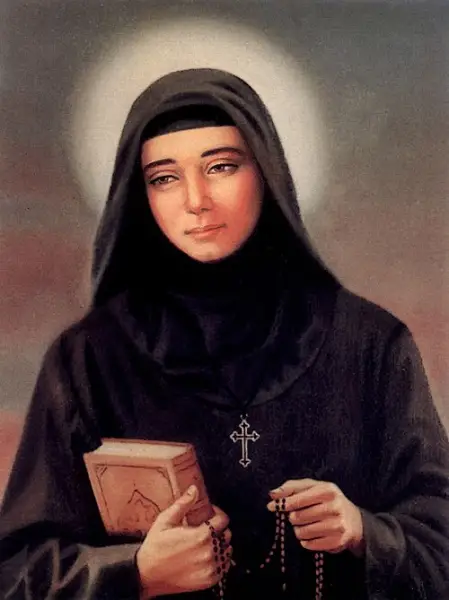
Overview
Rafqa Pietra Choboq Ar-Rayès, known to many as Saint Rafka or Saint Rebecca, was a Lebanese Maronite nun whose long life became an offering of suffering accepted for love of Christ. Born on 29 June 1832 at Himlaya in the Matn District and baptised Boutrossieh, she lost her mother at seven, worked as a servant in Damascus, and escaped an arranged marriage at fourteen by entering the convent of Our Lady of Liberation at Bikfaya. She joined the new Mariamette sisters as a founding candidate in 1853, received the habit in 1861, and taught in the congregation's schools until its merger in 1871, when she chose the cloistered life of the Baladita Order instead. At the Monastery of Saint Simon she professed perpetual vows in 1873 and took the name Rafqa. In 1885 she prayed to share in Christ's sufferings, and an agonising illness that followed cost her first her right eye, then her sight and the use of her limbs. She died at the Monastery of Saint Joseph in Jrebta on 23 March 1914, and was canonised by Pope John Paul II in 2001.
The Complete Life
The Orphan of Himlaya
The girl the world knew first as Boutrossieh was born on 29 June 1832, the feast of Saints Peter and Paul, at Himlaya in the Matn District of Mount Lebanon. Her father, Saber Mourad El Rayess, and her mother, Rafqa Gemayel, had only this one child, and the girl received at baptism the feminine form of Peter's name. Grief arrived early: Boutrossieh was seven when she lost her mother. In 1843, with her father's finances giving way, she was placed for service in Damascus and spent four years of childhood in another family's house, that of Assaad Al-Badawi. She came home in 1847 to a changed household, for her father had taken a second wife. As a young teenager she then found herself the object of competing marriage plans, her stepmother pressing her toward her own brother and her maternal aunt toward her son. Boutrossieh refused both suitors, and the discord that followed turned her thoughts decisively toward God.
§ Birth and youth
Refusing Marriage, Choosing the Cloister
The answer to Boutrossieh's dilemma came, as she told it, beside a village fountain. Overhearing her relatives argue over her future as she returned with her water jar, she asked God for help and resolved on the spot to become a nun, walking directly to the Convent of Our Lady of Liberation at Bikfaya. Her father and stepmother pursued her and tried to carry her home; she refused to go, and they left dismayed, never seeing her again. Family ties nonetheless shaped her future: a new institute for religious women, the Daughters of Mary of the Immaculate Conception, owed its existence to her kinsman Joseph Gemayel and his household, and a notebook entry dated 1 January 1853 lists Pierine, as her name was rendered in French, as the last of its first four candidates, then aged twenty-one. In 1861 she received the habit on the feast of Saint Joseph, and a year later, on the same feast, she bound herself by first temporary vows. Her early assignments ran from kitchen service at the Jesuit school in Ghazir to teaching at Byblos and founding a school at Maad.
§ Birth and youth
Teacher Through Years of Blood and Change
The Lebanon of Rafqa's thirties was drenched in violence. In 1860, while she was stationed at Ghazir, her superiors sent her to Deir al-Qamar to help the Jesuit mission in the Chouf; within two months the Druze massacres had claimed 7,771 lives; 360 villages lay in ruins, as did 560 churches, 28 schools, 42 convents. Amid the slaughter Rafqa concealed one child beneath the skirts of her habit while soldiers hunted him, and the horrors left her deeply shaken. Through these years she kept working and kept learning, studying Arabic, calligraphy, and mathematics in her free time while supervising workers at a spinning mill in Scerdanieh. In 1871 her congregation was merged into the Order of the Sacred Hearts of Jesus and Mary, and each sister had to choose a path. Rafqa chose enclosure over the classroom, praying in the church of Saint George at Maad before deciding for the Baladita Order, the Lebanese Maronite Order of Saint Anthony. Antoun Issa, the prominent citizen whose school she had founded at Maad, offered to pay her convent dowry and gave her a letter of recommendation for the archbishop.
§ Mariamette Sisters
The Prayer That Asked for Suffering
At the Monastery of Saint Simon al-Qarn, high in the mountains where winters were bitter, Rafqa professed her perpetual vows on 25 August 1873 and took the name of her mother, Rafqa, recalling the wife of Isaac. Her prayer turned startling in 1885. On the first Sunday of the Rosary she declined to join the other nuns on their walk and prayed alone in the church: in good health all her life, she asked her God why he had never visited her with sickness, and wondered aloud whether he had abandoned her. That night a violent pain spread above her eyes, and it never wholly left her. Examinations in Tripoli brought no remedy; an American doctor insisted her right eye must come out, and she refused anaesthesia, saying only, as the priest Estefan recounted, that she suffered in communion with Christ's Passion. Sight abandoned her, then strength in her limbs, yet she kept spinning wool, knitting stockings for her sisters, and singing the divine office, counting her anguish a share in the cross rather than a curse.
§ Illness
Blind, Paralysed, and Unconquered
Rafqa's last decades unfolded at a monastery she had helped to plant. In 1897 the Lebanese Maronite Order built the Monastery of Saint Joseph al Dahr at Jrabta, and she was among the six religious dispatched there under the leadership of Mother Ursula Doumit. By 1899 sight had left her entirely and paralysis had fixed her to her bed, her hands kept busy with knitted socks. Because the mountain winters were unendurable for her, she passed the cold seasons as a guest of the Daughters of Charity on the coast and in a house of her own order, until, unable to observe the Rule away from her cloister, she asked to be taken to the order's Mar Elias El Ras Monastery near Jeita. Near the end, when Mother Ursula asked whether she wished to see again, Rafqa prayed for a single hour of sight, and her request was granted. Death came on 23 March 1914, four minutes after she had been given the Last Rites together with the plenary indulgence. Buried first in the monastery cemetery, her remains were moved to the monastery chapel, where they rest today.
§ Monastery of Saint Joseph
From a Mountain Tomb to the Altars
The church's investigation of Rafqa's life began modestly, with local proceedings opened on 4 April 1929 and her declaration in due course as a Servant of God. The miracle judged decisive involved Elizabeth Ennakl, whose uterine cancer, it is said, vanished entirely in 1938 after prayer at Rafqa's tomb; the decree recognising this cure was issued on 9 June 1984, the eve of Pentecost, with Pope John Paul II present. On 16 November 1985 the same pope declared Rafqa Al Rayess blessed, and on 10 June 2001 he raised her to the altars of the universal church in a solemn Vatican ceremony. Her cult had already spread far beyond the Maronite valleys of her birth: relics honour her as far away as St. Raymond Maronite Cathedral in St. Louis, Missouri, and her liturgy has been published by the Vatican itself. She is invoked as a patron of lost parents and of the sick, titles earned not by one hour of her long life but by fifty years of labour and twenty-nine years of accepted pain.
§ Beatification and canonization
Timeline
- 29 Jun 1832
Was born at Himlaya in the Matn District on the feast of Saints Peter and Paul, an only child; her parents were Saber Mourad El Rayess and Rafqa Gemayel, and the baby received the baptismal name Boutrossieh.
§ Birth and youth
- 1843
Was sent by her father, whose money had failed, into domestic service in Damascus, where four years passed in the home of Assaad Al-Badawi.
§ Birth and youth
- 1847
Returned home from Damascus to find that her father had remarried.
§ Birth and youth
- 1 Jan 1853
Appeared in Gemayel's notebook, dated 1 January 1853, as the fourth and final name among the founding candidates of the Mariamettes (the Daughters of Mary of the Immaculate Conception), then aged twenty-one.
§ Birth and youth
- 1860
Was posted to Deir al-Qamar to aid the Jesuit mission, and there saved a child from soldiers during the massacres in which thousands died.
§ Mariamette Sisters
- 19 Mar 1861
Was clothed in the habit of her congregation on Saint Joseph's feast, after a year of postulancy.
§ Mariamette Sisters
- 19 Mar 1862
Made her first temporary religious vows on the feast of Saint Joseph, at the age of thirty.
§ Mariamette Sisters
- 12 Jul 1871
Chose the cloistered Baladita Order when her congregation was merged into another institute, and began her noviciate at the Monastery of Saint Simon al-Qarn in Aitou.
§ A nun of the Lebanese Maronite Order
- 25 Aug 1873
Professed perpetual vows of poverty, chastity, and obedience under the strict Rule of the Baladita Order, taking the name Rafqa from her mother.
§ A nun of the Lebanese Maronite Order
- 1885
Prayed in the church on the first Sunday of the Rosary to share in Christ's suffering, and that night felt violent pain spread above her eyes.
§ Illness
- 1897
Was among six nuns, led by Mother Ursula Doumit, sent to found the new Monastery of Saint Joseph al Dahr at Jrabta.
§ Monastery of Saint Joseph
- 1899
Was left completely blind and paralysed, confined to bed and passing her time knitting socks for the community.
§ Monastery of Saint Joseph
- 23 Mar 1914
Expired four minutes after the Last Rites and plenary indulgence had been given her; afterwards her remains were brought from the monastery cemetery into the chapel.
§ Monastery of Saint Joseph
- 4 Apr 1929
Saw the preliminary investigation of her cause begin at the local level, leading to her declaration as a Servant of God.
§ Beatification and canonization
- 9 Jun 1984
Had the decree approving the miracle of Elizabeth Ennakl, cured of uterine cancer at Rafqa's tomb in 1938, promulgated in the presence of Pope John Paul II.
§ Beatification and canonization
- 16 Nov 1985
Was declared Blessed by Pope John Paul II.
§ Beatification and canonization
- 10 Jun 2001
Was proclaimed a saint by Pope John Paul II at a solemn ceremony in Vatican City.
§ Beatification and canonization
In Their Own Words
One of the men said to me, 'Become a nun in the Baladita Order'. I woke up very happy ... and went to Antoun Issa, bursting with joy ... and I told him about my dream.
In communion with Christ's Passion.
The Record
- Major works
- School established at Maad in the Jbeil District·A founding community of the Monastery of Saint Joseph al Dahr, Jrabta
- Patron of
- lost parents·the sick
- Canonization
- Beatified by Pope John Paul II on 16 November 1985; canonized by Pope John Paul II on 10 June 2001 in Saint Peter's Basilica
Prayer
Bibliography
Show 10 sources
- "Rafqa Pietra Choboq Ar-Rayès", Vatican News Service.
- "Rafqa Pietra Choboq Ar-Rayès", Saints Resource, RCL Benziger.
- "Saint Rafqa", Maronite History Project.
- "Rafqa, Lebanese Maronite Saint", Maronite Eparchy of Australia.
- Church of the Holy Sepulchre in Jerusalem website, Saints page.
- "Saint Rafka", Eparchy of Saint Maron, Brooklyn, New York.
- "Saint Rafqa Pietra Choboq Ar-Rayès", St. Raymond Maronite Cathedral.
- Vatican website, Liturgy of Saint Rafqa.
- Index ac status causarum beatificationis servorum dei et canonizationis beatorum (in Latin). Typis polyglottis vaticanis, January 1953, p. 203.
- Vatican website, Canonization of 5 blesseds.
Profile text adapted from the Wikipedia article, licensed CC BY-SA 4.0.
Pray with this saint every day
Save St. Rafqa Pietra Choboq Ar-Rayès to your favorites, read the full profile, and get feast-day reminders in the Saints app.
Get the Saints AppFree on the App Store for iPhone and iPad