
died c. 1117·Feast unknown
St. Ragnhild of Tälje
Legendary queen and patron saint of Södertälje in Sweden
Overview
Ragnhild of Tälje is a saint whose veneration in late medieval Sweden centres on the church of Södertälje in Södermanland and the diocese of Strängnäs. A death year of 1117 is recorded for her, and later literary sources identify her as a queen of Sweden, wife of King Inge the Younger; some writers connected her father with Halsten, or speculated that she belonged to the early House of Bjälbo through a supposed father Alstan, son of Folke Filbyter. She is said to have founded the church at Södertälje and to lie buried there, and legend makes her a pilgrim to Rome and Jerusalem who was robbed and stripped by bandits yet miraculously clothed, a queen abandoned by her husband who turned to the care of the sick. Together with Saints Eskil and Botvid she is reckoned among the three figures instrumental in bringing Christianity to Södermanland around the year 1100. No source naming her can be dated earlier than the fifteenth century, and her cult was revived in the seventeenth through antiquarian interest in Swedish origins.
The Complete Life
A Queen of Contested Lineage
Everything about Ragnhild's origins reaches later writers through sources composed centuries after her supposed lifetime, and each claim carries an asterisk of doubt. Fifteenth-century texts describe her as a queen: her father, they say, was one Halsten, perhaps the king Halsten Stenkilsson though this cannot be settled, and her husband a King Inge, with the sources divided over whether Inge the Elder or the Younger is meant; either choice sits uneasily beside her being Halsten's daughter. Some historians floated a different genealogy, proposing that her father was Alstan, a son of the legendary Folke Filbyter, which would make her a member of the early House of Bjälbo from which later Swedish and Norwegian kings descended; other scholars have rejected the theory outright. The royal lists of Sweden's consorts admit her as Ragnhild Halstensdotter, wife of Inge the Younger, in the years 1105 to 1117. If she lived at all, it was in the late eleventh or early twelfth century, a transitional age when Christianity was still establishing itself across the Swedish provinces.
§ Ragnhild of Tälje
Pilgrim, Forsaken Wife, Nurse of the Sick
The medieval legend preserved of Ragnhild paints her life in the colours of romance and renunciation. Her cult image recounts a pilgrimage to Rome and Jerusalem in the course of which bandits seized her, undressed her, and left her naked, until angels sent her a magnificent cloak in place of what the robbers had taken. The same tradition records her marriage to King Inge and praises her conduct as queen, but tells that her husband left her. Rather than nursing the injury, the forsaken queen is said to have devoted herself to the care of the ill, turning the wreckage of her royal estate into a ministry of mercy. Another legend, composed for the court of King Sigismund by his librarian and court priest, presents her from a different angle: raised from childhood in the fear of God, married to Inge, living an angelic life upon the earth, and dying full of years, with 1120 given as the year of her death and Södertälje as her burial place.
§ Legacy
Foundress and Apostle of Södermanland
Tradition assigns to Ragnhild the founding of the church at Södertälje, in the province of Södermanland, and claims her body for the same ground. In the story of Sweden's conversion she occupies a distinguished place: for the introduction of Christianity to Södermanland in the decades surrounding the year 1100, she is supposed to have been one of three decisive figures, preceded by Saint Eskil and followed by Saint Botvid. The comparison is instructive, for the legends of Eskil and Botvid were written down in the twelfth century, near their heroes' own time, whereas nothing naming Ragnhild can be traced earlier than the fifteenth. Skeptics therefore hesitate, yet an epitaph in the church of Södertälje, probably of fifteenth-century date and later copied by the antiquarian Elias Palmskiöld, describes her as a queen, and observers have noted stylistic likenesses between it and the sarcophagus of Beorn, brother of Saint Botvid, in nearby Botkyrka, a resemblance that has been urged in support of the epitaph's authenticity.
§ Ragnhild of Tälje
The Epitaph of a Flower Without Thorn
The verse inscription said to mark Ragnhild's grave at Tälje preserves the medieval image of her better than any chronicle. It hails her as ruler of the Swedes, a flower without a thorn, a queen for the realm, and tells of her pilgrimage to Rome and Jerusalem undertaken to secure a graceful hope and to bear the victor's badge of the cross; through such service, it says, she sought the merciful laurel of Helen. The lines close with a direct appeal to her intercession for the people of Tälje. The antiquarian Peringskiöld adduced evidence that this epitaph had been transcribed faithfully through successive generations, describing her as a queen from the first. A date of 1117 stands as the year given for her death, though the later legend assigns 1120. Wall paintings of the fourteenth and fifteenth centuries at Börje and Viksta in Uppland and at Enånger in Hälsingland show her crowned figure, evidence that her cult had reached beyond Södermanland into the archdiocese of Uppsala.
§ Legacy
From Medieval Cult to City Seal
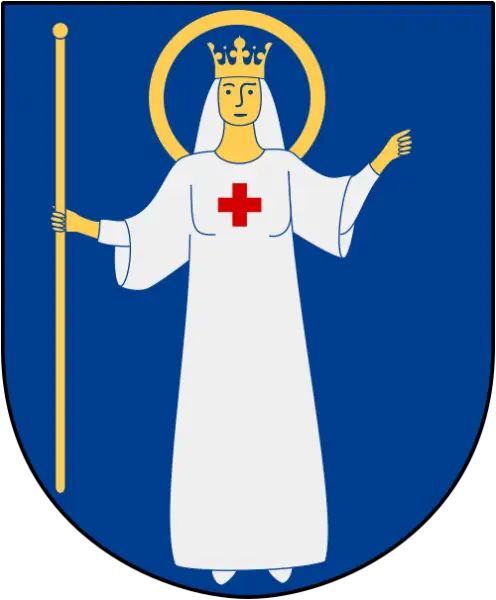
After the Protestant Reformation extinguished the old Swedish cults, Ragnhild's memory was revived in the seventeenth century by the general enthusiasm for national antiquities. The publication of Johannes Vastovius's Vitis aquilonia in 1623 prompted a new reading of the human figure on the city seal of Södertälje as a stylised likeness of the queen, and her image has stood for the town ever since, surviving in its heraldry to the present day. Scholarly attention returned with the seventeenth-century transcription of her epitaph and continued through modern reference works, which continue to list her among Sweden's medieval local saints with due caution. Södertälje's city hall of 1965 received the old memorial to Queen Ragnhild, a plaque composed in 1753 by the town's mayor, placing it in the courtroom of the new structure, a small ceremony that sums up her peculiar standing: a saint whom historians cannot verify and a city has never ceased to honour, patroness of Tälje and flower without thorn.
§ Legacy
Timeline
- 1100
Is reckoned, in the decades around this date, as one of three figures credited with the Christianisation of Södermanland, alongside Saints Eskil and Botvid.
§ Ragnhild of Tälje
- 1105
Is named among the queens of Sweden as wife of King Inge the Younger in the traditional royal roll.
§ Ragnhild of Tälje
- 1117
Died, according to the year given for her death, and is said to have been buried at Södertälje.
§ Ragnhild of Tälje
- 1120
A later legend composed for King Sigismund's court records her as having died of old age in this year and been buried in Södertälje.
§ Legacy
- 1450
First unambiguous mention of Ragnhild appears in the Little Rhyme Chronicles.
§ Legacy
- 1520
A reissue of the Eric Chronicle carried a newer preface naming her.
§ Legacy
- 1623
The publication of Johannes Vastovius's Vitis aquilonia led the human figure on the seal of Södertälje to be reinterpreted as a depiction of her.
§ Legacy
- 1965
The 1753 memorial to Queen Ragnhild, penned by the town's mayor, was installed in the courtroom of Södertälje's new city hall.
§ Legacy
In Their Own Words
Oh, pious Madame, the patron saint of Tälje residents, pray for us for the good, heavenly gifts of Christ.
The Record
- Major works
- The church of Södertälje, which she is said to have founded
- Patron of
- the residents of Tälje (Södertälje)
- Symbols
- queen's crown·the magnificent cloak said to have been sent by angels
- Canonization
- Pre-congregation local saint; her cult is attested in late medieval Sweden, with no early surviving sources
Prayer
Bibliography
Show 3 sources
- Fröjmark, Anders, "Ragnhild", Svenskt biografiskt lexikon (Swedish Biographical Dictionary), vol. 29 (1995-1997), pp. 613-615. (in Swedish)
- Anteqningar om Svenska quinnor at Projekt Runeberg (Notes on Swedish Women) (in Swedish).
- Alm, Henrik, Drottning Ragnhild och hennes gravskrift i Tälje, Libris #2490548, Strängnäs 1931.
Profile text adapted from the Wikipedia article, licensed CC BY-SA 4.0.
Pray with this saint every day
Save St. Ragnhild of Tälje to your favorites, read the full profile, and get feast-day reminders in the Saints app.
Get the Saints AppFree on the App Store for iPhone and iPad