
c. 1115/1117 – 1160·Feast June 17
St. Rainerius
Patron saint of Pisa and penitent pilgrim
Overview
Rainerius was born at Pisa around 1115 or 1117, the son of the well-to-do Pisan shipowner and merchant Gandulfo Scacceri and of Mingarda Buzzaccherini. In his youth he earned his living as a travelling musician, and later biographers emphasized the worldliness of those years. A turning point came when he met Alberto, a Corsican nobleman clothed in a goat's-hair garment who had joined the monastery of Saint Vitus in Pisa, where he was renowned for his work among the poor. Moved by his example, Rainerius resolved to take his faith seriously. In 1146 he went into trade to finance a pilgrimage to the Holy Land, growing wealthy from commerce in the ports he visited. There, according to his biographers, a vision convinced him that his riches were an obstacle to serving God. He gave away his wealth and for seven years stayed in the Holy Land, begging his bread as he visited the Holy Sepulchre, Mount Tabor, Hebron, and Bethlehem. His austerities were so severe that one biographer remarked God himself had to command him to eat. He returned to Pisa in 1153 and entered the monastery of Saint Andrew, later transferring to Saint Vitus. Renowned as a preacher and credited with expelling demons and working miracles, his own contemporaries venerated him as a saint. He died around 1160, and his body was borne in triumph to the cathedral and laid to rest there.
The Complete Life
A Merchant's Son Who Wandered
Rainerius was born at Pisa in about 1115 or 1117, the son of the well-to-do Pisan shipowner and merchant Gandulfo Scacceri and of Mingarda Buzzaccherini. He grew up in a seafaring republic whose wealth rested on commerce, and his early years followed the pattern of a comfortable merchant household. In his youth he made his living as a travelling musician, moving from place to place in pursuit of engagements, and the biographers who wrote after his death were careful to stress the worldliness of this period of his life. The change in his direction came through an encounter during his travels. He met Alberto, a Corsican nobleman whose appearance marked him out at once, for he was clothed in a garment of goat's hair. Alberto had entered the monastery of Saint Vitus in Pisa and had become renowned for his care for the poor. The contrast between the holy man's austerity and Rainerius's own unsettled way of life struck him deeply. The meeting impressed him so strongly that he became a devout Christian, and his life turned away from music and trade toward God.
§ Life
Wealth Renounced in the Holy Land
In 1146 Rainerius resolved to make a pilgrimage to the Holy Land, and he chose a practical way of paying for it: he set himself up as a merchant so that trade could fund his fare. The business carried him to many ports, and through his dealings with sailors he accumulated considerable wealth. His travels eventually brought him to the Holy Land itself, and there, according to the account of his life, he received a vision in which he came to see that his riches stood between him and the service of God. The recognition settled into a firm resolution. He determined to abandon his riches entirely and to live in complete poverty, and he stayed on in the Holy Land for seven years, keeping himself alive by begging while he visited the holy places. He prayed at the Holy Sepulchre in Jerusalem, on Mount Tabor, at Hebron, and at Bethlehem. His asceticism went to remarkable lengths; his later biographer observed that his fasting was so extreme that God himself had to command him to take food. Those seven years reshaped the merchant and musician into a penitent, and prepared him for the public ministry of his final decade.
§ Life
Preacher of His Native City
Rainerius returned to Pisa in 1153 after his long years in the East, and he did not withdraw into silence. He became a monk at Saint Andrew's in the city, and afterwards moved to the monastery of Saint Vitus, the community where the holy man Alberto had lived and served the poor. There his reputation grew rapidly. He became known throughout Pisa as a preacher, and the crowds regarded him with a veneration usually reserved for those formally canonized, honouring him as a saint while he still lived. Stories circulated of demons expelled at his command and of miracles worked in his company, and the fame of his holiness drew the city's attention to the penitent who had once been a musician and a merchant. His preaching was grounded in a life his hearers could recognize: a man of commerce who had renounced wealth, a traveller who had begged his way through the shrines of Jerusalem. That history gave his words weight among the merchants and sailors of Pisa. When he died, around 1160, the people of the city carried his body in triumph through the streets and laid it to rest in the Duomo.
§ Life
Honoured Before His Death
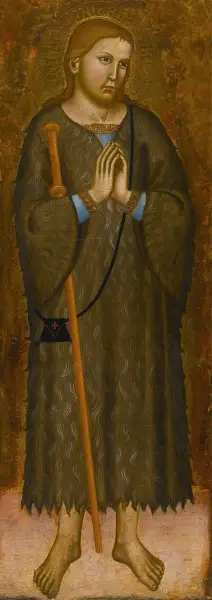
The final phase of Rainerius's life was passed at the monastery of Saint Vitus in Pisa, the city of his birth and of his father's shipping business. By then the change in him was complete in the eyes of his fellow citizens: the travelling musician and wealthy merchant of earlier years was now treated as a saint alive among them. He preached to the Pisans, and reports of demons expelled at his command and of miracles worked around him circulated through the city. Later tradition pictured him above all as a bearded hermit clothed in a hairshirt, an image drawn from the severe asceticism of his years in the Holy Land. He died around 1160. The esteem of Pisa showed itself at his death, when his body was borne in triumph through the streets to burial in the Duomo. Placing his remains in the cathedral bound the saint to the city permanently, and from that resting place his cult would spread outward in the centuries that followed.
§ Life
Recognition by Pope and City
The formal recognition of Rainerius belongs to the years shortly after his death, though its details rest on later accounts. According to stories recorded after the fact, he was canonized by Pope Alexander III, whose pontificate spanned the later twelfth century. More secure is the testimony of a Pisan canon named Benincasa, who in 1161 or 1162, within a very few years of the saint's death, wrote a long and invaluable vita of Rainerius. Benincasa presented the saint's whole life as a strict imitation of Christ, presenting Rainerius as a mirror of the Son of God through his strict following of the Lord's example, and he went so far as to claim for Rainerius and for all the baptized a share in what he called a royal priesthood in Christ. In 1632 the archbishop, clergy, and civic magistrates of Pisa together chose Rainerius as patron of the city and of its diocese, a civic act confirming a devotion already centuries old. His feast is kept on 17 June, and his principal shrine is the Duomo of Pisa.
§ Veneration
Pisa's Saint Across the Sea
Rainerius remained Pisa's own saint as the republic's fortunes rose and fell. With the growth of Pisan influence, his cult spread throughout the Mediterranean, carried along the same sea lanes his father's generation had sailed. His life became the subject of art as well as devotion: a cycle of frescoes by Antonio Veneziano in the Campo Santo recounted his story, a fresco by Andrea di Bonaiuto da Firenze in the same cemetery depicted a scene from his life, and Cecco di Pietro portrayed him in paint. In 1632 the archbishop, clergy, and magistrates of Pisa chose him as the city's patron, and in 1689 his remains were raised to an altar in the Duomo, where his shrine remains at the spiritual centre of the city. Artists have shown him as an aged hermit wearing a hairshirt and clutching beads, as a young pilgrim bearing the Pisan cross on a banner, lifted up by demons, or expiring in his rough garment. He is honoured as patron of Pisa and of travellers, and his name survives in many spellings across the languages of the sea.
§ Veneration
Timeline
- 1115
Born at Pisa to the Pisan shipowner and merchant Gandulfo Scacceri and to Mingarda Buzzaccherini.
§ Life
- 1146
Set himself up as a merchant to pay his fare to the Holy Land, growing wealthy through trade with sailors.
§ Life
- 1153
Returned to Pisa, joining first the monastery of Saint Andrew, and afterwards that of Saint Vitus.
§ Life
- 1160
Died at Pisa; his body was borne in triumph through the streets to burial in the Duomo.
§ Life
- 1161
Benincasa, a Pisan canon, wrote his long and invaluable vita of the saint.
§ Veneration
- 1632
Elected patron saint of the city and diocese of Pisa by the archbishop, local clergy, and Pisan magistrates.
§ Veneration
- 1689
His remains were enshrined at an altar of the Duomo of Pisa.
§ Veneration
In Their Own Words
a royal priesthood in Christ
The Record
- Patron of
- Pisa·travellers
- Symbols
- bearded hermit in a hairshirt holding a rosary·young pilgrim in a hairshirt carrying a banner with the Pisan cross·raised up by devils·dying in a hairshirt
- Canonization
- According to later accounts, canonized by Pope Alexander III; elected patron saint of Pisa and its diocese in 1632.
Prayer
Bibliography
Show 3 sources
- André Vauchez (1993) The Laity in the Middle Ages: Religious Beliefs and Devotional Practices, Daniel E. Bornstein, ed., and Margery J. Schneider, trans. (Notre Dame: University of Notre Dame Press)
- "St. Rainerius", FaithND, University of Notre Dame
- "St Rainier of Pisa", Independent Catholic News
Profile text adapted from the Wikipedia article, licensed CC BY-SA 4.0.
Pray with this saint every day
Save St. Rainerius to your favorites, read the full profile, and get feast-day reminders in the Saints app.
Get the Saints AppFree on the App Store for iPhone and iPad