
1550 – 1581·Feast December 1
St. Ralph Sherwin
Seminary priest and Tyburn martyr
Overview
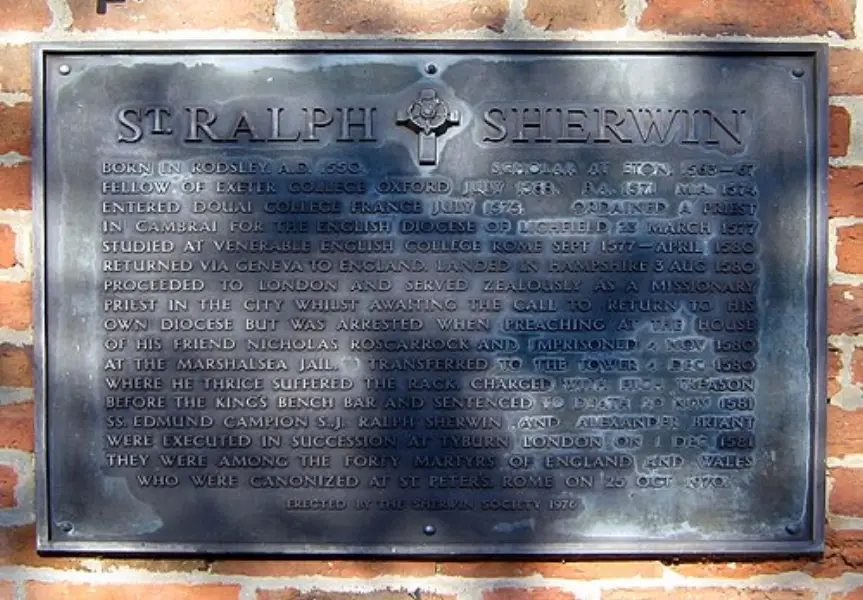
Ralph Sherwin was an English Roman Catholic priest, executed under Elizabeth I in 1581 and honoured since as a martyr and saint. Born at Rodsley in Derbyshire on 25 October 1550 to John and Constance Sherwin, he was educated at Eton College and nominated to a fellowship at Exeter College, Oxford, where he proved a talented classical scholar, taking his Bachelor of Arts in 1571 and his Master of Arts in 1574. The following year he converted to Roman Catholicism and left for the English College at Douai, where he was ordained a priest in 1577. He then spent nearly three years at the English College in Rome before setting out in April 1580 with thirteen companions for the English mission. Arrested in London that November while preaching, he was imprisoned in the Marshalsea and then the Tower, where the rack was twice used upon him. Offered a bishopric if he would conform, he refused. Convicted of treasonable conspiracy in November 1581 alongside Edmund Campion, he was hanged, drawn and quartered at Tyburn on 1 December 1581. Of the students sent out from the English College in Rome, he was the first to die a martyr's death.
The Complete Life
A Derbyshire Scholar at Oxford
Ralph Sherwin was born at Rodsley in Derbyshire on 25 October 1550, the son of John and Constance Sherwin, and was christened in the church of Longford. His gifts as a student appeared early and carried him to Eton College, and from there to Oxford. In 1568 Sir William Petre named him to one of the eight fellowships Petre had founded at Exeter College, an appointment probably helped by the influence of Sherwin's uncle, John Woodward, who had been rector of Ingatestone in Essex, where Petre lived. At Oxford he distinguished himself as a classical scholar, taking his Bachelor of Arts in 1571 and his Master of Arts on 2 July 1574. By the standards of Elizabethan England his path was a brilliant one, leading toward the academic and public advancement that learning could bring. Yet in the following year, 1575, he made the decision that changed everything: he converted to Roman Catholicism, at a time when that faith was proscribed in England, and set his course toward the seminaries of the continent rather than the preferments of the established church.
§ Early years and education
Douai, Rome, and Priesthood
After his conversion Sherwin soon made his way to the English College at Douai, the seminary formed to train priests for the forbidden Catholic mission in England. There the Bishop of Cambrai ordained him priest on 23 March 1577. That August, on the second day of the month, he left for Rome, where he spent nearly three years at the English College in the city, continuing his formation among men who shared his purpose. The college in Rome had been founded to supply labourers for a mission whose cost was measured in lives, and Sherwin and his fellow students knew the danger they were preparing to face. On 18 April 1580 he left Rome with thirteen companions, sent as missionaries to England. They travelled in disguise and scattered into a hostile country where the celebration of Mass was treason by law. He entered England in early August 1580 and began a ministry in different parts of the country that was soon described as successful, administering the sacraments and sustaining the Catholic remnant, though his work was destined to last only a few months before the authorities caught up with him.
§ Early years and education
Ministry, Prison, and the Rack
Sherwin's ministry on the English mission lasted only months. On 9 November 1580 the authorities caught him preaching at the London house of Nicholas Roscarrock and committed him to the Marshalsea prison. Even in confinement his work continued: among his fellow prisoners he converted many to the Catholic faith, turning his imprisonment into an extension of his mission. On 4 December he was moved to the Tower, where the interrogation turned violent: the rack was applied to him twice, and afterwards he was laid out in the snow; later he was placed in an isolation cell and left without food. In the midst of this treatment the crown is said to have made him a personal offer through Queen Elizabeth I: a bishopric, if he would convert to the established church. It was the same temptation that had faced every seminary priest, advancement and safety in exchange for conformity, and Sherwin refused it. He remained a prisoner through the following year while the government prepared its case against the missionaries, holding to the faith he had embraced at Oxford and sealed at Douai and Rome.
§ Prison and death
Trial and Tyburn
After a year in prison Sherwin was brought to trial with Edmund Campion, the most celebrated of the missionary priests, on a charge of treasonable conspiracy. The verdict was never in doubt. The verdict of guilty came in Westminster Hall on 20 November 1581, and eleven days on, he was drawn on a hurdle to Tyburn together with Alexander Briant and Edmund Campion, the three martyrs suffering together the sentence of hanging, drawing and quartering. Death at Tyburn was staged as a public warning, and the authorities expected the condemned to falter. Sherwin did not. On the scaffold he once more declared himself innocent, owned his Catholic faith openly, and prayed for the Queen under whose sentence he died. His last words were his repeated prayer, calling on the name of Jesus: "Iesu, Iesu, Iesu, esto mihi Iesus!" He was thirty-one years old, a priest of barely four years, and the first member of the English College in Rome to give his life on the English mission. The execution intended to terrify the mission instead furnished it with a pattern of constancy.
§ Prison and death
From Beatification to the Altar
Sherwin's cause moved forward centuries after his death, in step with the Church's recognition of the Elizabethan martyrs as a body. He was beatified by Pope Leo XIII on 29 December 1886, among the English and Welsh martyrs whose deaths under the Tudor and Stuart persecutions were being formally confirmed in that era. His canonization came on 25 October 1970, when Pope Paul VI raised him, with Edmund Campion, Alexander Briant, and thirty-seven others, to the altars in the company of the Forty Martyrs of England and Wales. The Forty were given a common feast day, observed on 4 May in England and 25 October in Wales. Sherwin also retains an individual feast, celebrated on 1 December, the anniversary of his martyrdom at Tyburn. In the calendar of the Church he thus belongs both to the company of the Forty and to the shorter roll of missionary priests whose executions in the early 1580s marked the first great wave of the persecution. His stained glass portrait in Derby records the devotion of the county where he was born.
§ Veneration
First Martyr of the Roman College
Sherwin's place in the history of the English mission rests on a grim primacy: he was the first alumnus of the English College in Rome to suffer martyrdom, and in the century that followed his death, from 1581 to 1681, more than forty further students of the college gave their lives for the same faith. The college that sent him out counted him the firstfruits of its harvest. His memory endured in Derbyshire and in Derby, the city of his birth and of his death sentence. A stained glass window at St. Mary's Roman Catholic Church in Bridge Gate, Derby, depicted the martyr, and a plaque was erected at his birthplace by the Shewin Society. A church in the Chellaston district of Derby, registered in January 1981, received his dedication, though it was demolished in 2018. In the Normanton area of Derby a football club founded in 1973 bears his name, serving the local community with his colours of purple and yellow. His iconography is fixed by his death: a banner with his last words, a noose about his neck, and the martyr's palm.
§ Veneration
Timeline
- 25 Oct 1550
Born at Rodsley, Derbyshire, to John and Constance Sherwin.
§ Early years and education
- 1568
Nominated by Sir William Petre to one of the fellowships he had founded at Exeter College, Oxford.
§ Early years and education
- 1571
Obtained his Bachelor of Arts degree at Oxford.
§ Early years and education
- 2 Jul 1574
Took his Master of Arts degree at Oxford.
§ Early years and education
- 1575
Converted to Roman Catholicism and soon left for the English College at Douai.
§ Early years and education
- 23 Mar 1577
Received priestly ordination from the Bishop of Cambrai at Douai.
§ Early years and education
- 2 Aug 1577
Left for Rome, where he stayed nearly three years at the English College.
§ Early years and education
- 18 Apr 1580
Left Rome for England with thirteen companions as a missionary.
§ Early years and education
- 9 Nov 1580
Arrested while preaching in the house of Nicholas Roscarrock in London and imprisoned in the Marshalsea.
§ Prison and death
- 4 Dec 1580
Moved to the Tower, where the rack was twice applied to him.
§ Prison and death
- 20 Nov 1581
Convicted in Westminster Hall with Edmund Campion of treasonable conspiracy.
§ Prison and death
- 1 Dec 1581
Executed by hanging, drawing and quartering at Tyburn with Alexander Briant and Edmund Campion.
§ Prison and death
- 29 Dec 1886
Beatified in Rome by Pope Leo XIII.
§ Veneration
- 25 Oct 1970
Canonized by Pope Paul VI in the company of the Forty Martyrs of England and Wales.
§ Veneration
In Their Own Words
Iesu, Iesu, Iesu, esto mihi Iesus!
professed his innocence, proclaimed his Catholic faith, and prayed for the Queen
The Record
- Symbols
- banner bearing his last words, "Jesu, Jesu, esto mihi Jesus!"·noose about his neck·martyr's palm
- Canonization
- Beatified 29 December 1886 by Pope Leo XIII; canonized 25 October 1970 by Pope Paul VI as one of the Forty Martyrs of England and Wales.
Prayer
Bibliography
Show 5 sources
- "The martyr who gave up worldly fame for the scaffold", Catholic Herald, 24 November 2010
- McNamara, Father Robert F. "St. Ralph Sherwin"
- "St Ralph Sherwin - December 1st", The Catholic Diocese of Nottingham
- Herbermann, Charles, ed. (1913). "Blessed Ralph Sherwin". Catholic Encyclopedia. New York: Robert Appleton Company.
- Acta Sancta Sedis Vol. XIX (1886-1887), pp. 347-350 (as Rodulphus Sherwin)
Profile text adapted from the Wikipedia article, licensed CC BY-SA 4.0.
Pray with this saint every day
Save St. Ralph Sherwin to your favorites, read the full profile, and get feast-day reminders in the Saints app.
Get the Saints AppFree on the App Store for iPhone and iPad