
died 675·Feast February 21
St. Randoald
Prior and martyr of Moutier-Grandval
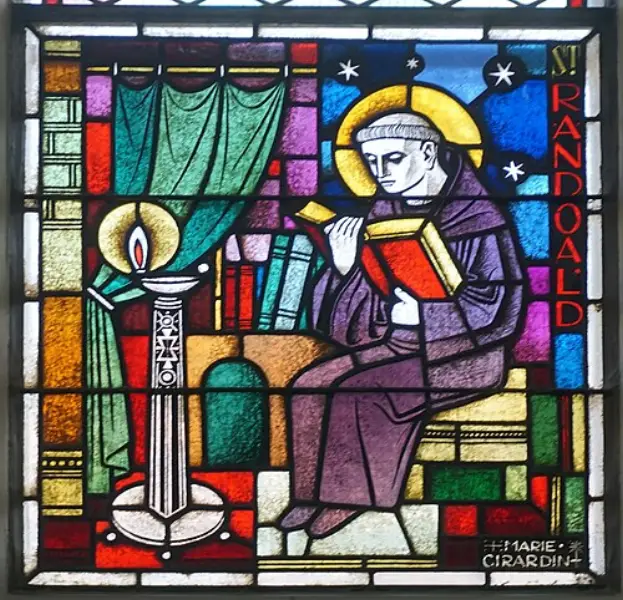
Overview
Randoald, also called Rancald or Randaut, was prior of the Benedictine Moutier-Grandval Abbey under Abbot Germanus of Granfelden, and died a martyr on 21 February 675. He is venerated as a saint in both the Roman Catholic Church and the Eastern Orthodox Church. His death is recounted in the Passio sancti Germani, composed about 695 at the bidding of two religious brothers who had known Randoald, by Bobolène, one of the priests of Luxeuil; it survives today in the library of the Abbey of Saint Gall. Randoald and Germanus were killed by partisans of Eticho, Duke of Alsace, whose attempts to bring the people of the Delémont country to heel the two monks had resisted on behalf of the region's poor. Having accompanied his abbot to a confrontation with the duke, Randoald was caught on the road back to the abbey and beheaded by one of the duke's soldiers, while Germanus was pierced with a spear. Their tomb became a centre of pilgrimage, and their relics rest today in the Church of Saint-Marcel in Delémont.
The Complete Life
Prior of Moutier-Grandval
Randoald served as prior of the Benedictine abbey of Moutier-Grandval, second in authority to its abbot, Germanus of Granfelden. The office of prior made him responsible for the daily ordering of the monastery's life, its observance and its works of charity, exercised under an abbot whose reputation for defending the poor of the region was already fixed in the memory of the Jura. Little is recorded of Randoald's origin or of the years before he entered the abbey; his story has come down through the account of his death rather than through a chronicle of his early life. The chief source for both monks is the Passio sancti Germani, composed about 695 by Bobolène, one of the priests of Luxeuil, at the bidding of two religious brothers, Chadoal and Aridius, who had known Randoald in the flesh. Because the writer drew on the testimony of men who had known him, the portrait, however brief, rests on living memory. The work survives in the Codex Sangallensis 551, kept in the library of the Abbey of Saint Gall, and it preserves the memory of a monastery whose prior and abbot died together on the same day.
§ Passio sancti Germani
Standing with the Poor
The conflict that cost Randoald his life grew out of the abbey's defence of the common people. Eticho, Duke of Alsace, was trying to bring the people of the Delémont country under his yoke, and the monks of Moutier-Grandval made themselves the champions of the region's poor against him. Randoald went with Abbot Germanus to the church of Saint Maurice at Courtételle, where the abbot confronted the duke over his ravaging of the district. It was a dangerous errand: to confront a Merovingian duke over his treatment of a population he intended to bring to heel required a confidence that came from lives ordered to another account. The two monks had just finished their negotiations with the duke and had left the meeting, returning toward Moutier-Grandval, when the sequel was set in motion. One of the duke's lieutenants set off in pursuit with a few men, overtook the monks on the road, and put them to death. The prior who had followed his abbot into the duke's presence followed him also into the martyrdom that flowed from it, killed for the same cause of protection they had offered the defenceless.
§ Death
Martyrdom on the Road
Randoald died on 21 February 675, near Moutier, together with his abbot. The killing was swift. The duke's lieutenant and his men caught up with the two monks on their way back from Courtételle, and the soldiers executed them where they stood. One of the soldiers cut off Randoald's head, while Germanus was pierced with a spear. The following night the religious of the region collected the bodies of the two martyrs and buried them, first at Saint-Ursanne and then at Moutier-Grandval, bringing the abbot and his prior back to the abbey they had served. Their deaths on the same day bound their two cults together from the beginning, and the Church has never separated them: Germanus and Randoald are commemorated jointly, their feast kept on 21 February, the anniversary of their deaths. The manner of their dying, cut down after a mission of mediation on behalf of the oppressed, fixed the character of their memory as martyrs of charity, monks who died not for refusing to sacrifice but for refusing to abandon the poor to a predatory power.
§ Death
A Cult Ancient and Undivided
Randoald was never formally canonized, for he belongs to the ages before the process existed: he is a pre-congregation saint, honoured as a martyr from the earliest memory of the Church in the region. His veneration crossed the divisions of later Christendom from the start. Both the Roman Catholic Church and the Eastern Orthodox Church number him among the saints, together with Germanus, whose name is inseparable from his. The grounds of the cult were the martyrdom itself and the wonders believed to flow from the martyrs' intercession. Miracles were reported at their tomb, which became a centre of pilgrimage drawing the faithful of the surrounding country. The permanence of the devotion across more than thirteen centuries, from the burial of the bodies by their own monks to the parishes that still keep their feast, marks a continuity rare even among ancient shrines. The two monks of Moutier-Grandval remain, in both East and West, the model of religious who died defending the Church's poor.
§ Veneration
Relics of the Jura Martyrs
The relics of Randoald and Germanus remained at the heart of the abbey they had served. In 1477 the remains of the martyrs were transferred beneath the high altar of Moutier-Grandval, an honour that gave pilgrims a shrine of fitting dignity. Devotion to the two spread through the diocese of Basel and the province of Besançon, and the tomb's reputation for miracles sustained the pilgrimage for centuries. When the Reformation swept the region, the treasures of the abbey were carried to safer ground: the relics were carried for safety to Saint-Marcel's church in Delémont, where they remain to this day, still venerated by the faithful. The memory of the martyrs is preserved also in the written testimony of their death, the Passio sancti Germani composed within living memory of the event and now housed in the library of Saint Gall. In art Randoald is shown in his monk's habit, bearing the martyr's palm, with the spear or the sword of his execution beside him. His feast, with Germanus, is kept on 21 February.
§ Veneration
Timeline
- 21 Feb 675
Martyred near Moutier together with Abbot Germanus by partisans of Eticho, Duke of Alsace.
§ Death
- 695
Bobolène, a priest of Luxeuil Abbey, wrote the Passio sancti Germani recounting his death.
§ Passio sancti Germani
- 1477
The remains of the martyrs were transferred under the high altar of Moutier-Grandval.
§ Veneration
The Record
- Symbols
- monk's habit·martyr's palm·spear
- Canonization
- Pre-congregation; venerated as a martyr in the Roman Catholic and Eastern Orthodox Churches since the early centuries.
Prayer
Bibliography
Show 7 sources
- Hutchison-Hall, John. "21st February: Germanus and Randoald". Orthodox Saints of the Pre-Schism See of Rome. Retrieved 14 April 2023.
- "Nos Saint-Patrons", Paroisse catholique romaine de Moutier
- Stékoffer, Sarah (1996). La crosse mérovingienne de Saint Germain, premier abbé de Moutier-Grandval (Suisse). Porrentruy: Office du patrimoine historique, Société jurassienne d'émulation. ISBN 2-88436-005-0
- "Saints Germain et Randoald, Martyrs", Bibliotheque Monastique
- Odden, Per Einar. "De hellige Germanus og Randoald av Grandval (~610-675)", Den katolske kirke
- Butler, Alban. The Lives of the Fathers, Martyrs, and Other Principal Saints, Volumes 1-3, D. & J. Sadlier, 1846, p. 440
- Randoald (saint), in Historisches Lexikon der Schweiz
Profile text adapted from the Wikipedia article, licensed CC BY-SA 4.0.
Pray with this saint every day
Save St. Randoald to your favorites, read the full profile, and get feast-day reminders in the Saints app.
Get the Saints AppFree on the App Store for iPhone and iPad