
1835 – 1907·Feast November 19
St. Raphael Kalinowski
Soldier, Siberian exile, and Carmelite
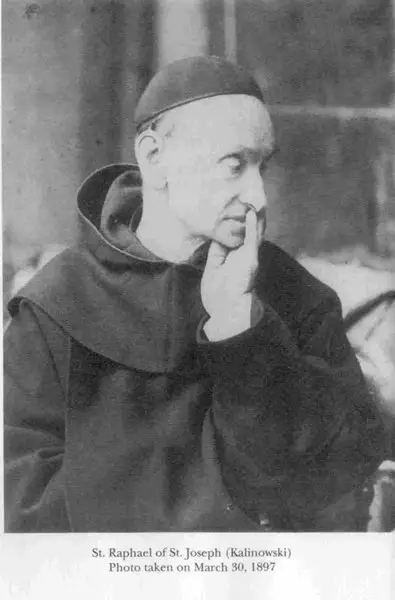
Overview
Raphael of Saint Joseph Kalinowski was born Józef Kalinowski on 1 September 1835 in Vilnius, then part of the Russian Empire, into a noble family. Schooled at Vilnius's Institute for Nobles, he took up military engineering in the Imperial Russian Army, helping to design the Odessa-Kiev-Kursk railway and rising to the rank of captain. When the January Uprising broke out in 1863 he resigned his commission rather than fight his own people, and served the insurgent authorities in Lithuania organizing their armed forces, though he never took part in the fighting himself and opposed the expansion of a struggle he judged hopeless. Arrested in March 1864, he was sentenced to death, a sentence commuted through his family's intervention to ten years of hard labour in the Siberian katorga. The nine-month march to the salt works outside Irkutsk, and the exile that followed, became the ground of his conversion; he returned in 1873 a devout Catholic and a spiritual leader to his fellow prisoners. Settling in Warsaw as tutor to Prince August Czartoryski, he entered the Discalced Carmelites in 1877, was ordained a priest in 1882, and won fame as confessor and theologian, as a translator, and as a planter of monastic houses. He died at Wadowice in 1907 in the odour of sanctity, and was canonized by John Paul II in 1991.
The Complete Life
A Noble Orphan of Vilnius
Józef Kalinowski was born in Vilnius on 1 September 1835 into a noble szlachta family bearing the Kalinowa coat of arms, the second son of Andrzej Kalinowski, a professor of mathematics at the Institute for Nobles. He came into the world after the failure of the November Uprising, in lands that the collapse had left under the Russian partition, and his childhood was shaped by loss from the first: his mother, Józefa Połońska, died a few months after his birth, leaving him and his older brother Wiktor motherless. His father remarried twice, first to Józefa's sister Wiktoria, who died in 1845, and then to Zofia Puttkamer, whose mother Maryla Wereszczak had been made famous by Adam Mickiewicz's verse. The household grew to eleven children across the three marriages. From the age of eight Józef attended the Institute for Nobles in Vilnius, where his father taught, and he graduated with honours in 1850. He went on to the Institute of Agriculture at Hory-Horki near Orsha, but Russian restrictions closed most further educational paths to a young Polish noble, and the army became the road open to him.
§ Childhood
Officer of an Occupying Army
In 1853 Kalinowski joined the Imperial Russian Army, winning a place at the Nicholayev Engineering Academy. Promoted Second Lieutenant in 1856, he taught mathematics as an associate professor, then served from 1858 to 1860 as an engineer on the Odessa-Kiev-Kursk railway. In 1862 he was made captain and stationed at Brest, yet his sympathies remained with the Poles. When patriotic and religious demonstrations swept the former Commonwealth in 1861 and 1862, he kept his distance from them, dismissing their tone as sentimental piety, and he was critical both of the demagogues of the underground and of any reliance on Western intervention. He judged that an uprising would only bring catastrophe. Knowing it was nevertheless coming, and fearing that the Brest Fortress would be turned to military use against the insurgents, he resolved to quit the army and go back to railway construction. When the January Uprising broke out he was at Brest-Litovsk, and only by chance escaped having to fight his own compatriots. His resignation was accepted on 17 May 1863. In Warsaw he passed the plans of Russian fortresses to the insurgent authorities, then went to Vilnius, where he took over the War Department of the Lithuanian Executive on the condition that he would conduct no revolutionary propaganda.
§ January Uprising
Siberia and a Second Calling
Once in Lithuania, Kalinowski saw plainly what the rising's leaders would not: the insurgent forces were few, undisciplined, dispersed, and badly armed, their commanders isolated, their weapon deliveries from East Prussia failing. He reported to the National Government that an armed rising in Lithuania was hopeless and opposed its expansion, refusing to sanction large-scale death sentences, and in December 1863 he asked that Warsaw be told the uprising had collapsed, ordering arms deliveries stopped to spare the population reprisal. Arrested in his parents' apartment on the night of 24-25 March 1864, he confessed his role to shield his comrades and took as much blame as possible. Condemned to death on 2 June, he saw the sentence commuted to ten years of hard labour in the katorga. He marched overland for nine months to the salt works of Usolye-Sibirskoye, outside Irkutsk. Very few survived such marches, but his faith held him up, and his fellow prisoners came to look to him as their spiritual head. Released in 1873, exiled from Lithuania, he made his way to Paris and then back to Warsaw in 1874, where he became tutor to the young Prince August Czartoryski, guiding the boy who would one day be beatified toward the priesthood.
§ Siberian exile
A Carmelite of Confession and Letters
In 1877 Kalinowski entered the Discalced Carmelites, admitted as a postulant at the priory in Linz and clothed with the religious name Raphael of St. Joseph. He professed solemn vows in 1881 at Czerna near Kraków, was ordained a priest there in 1882, and became prior of the convent in 1883. The rest of his life belonged to the order and to the ministry of the confessional, for which he became famous; Catholics and Russian Orthodox alike sought him out as a spiritual director. He founded houses across Poland and Ukraine, most prominently at Wadowice, where he was elected prior, and established convents of Discalced Carmelite nuns at Przemyśl in 1884 and Lvov in 1888. His pen served the Church as steadily as his ministry: he kept chronicles of the Carmelite houses at Vilnius, Warsaw, Leopolis, and Kraków, rendered into Polish the autobiography of Therese of Lisieux, and composed a life of Augustine Mary of the Blessed Sacrament, and from 1892 to 1907 worked to document the life of the seventeenth-century Carmelite nun Theresa Marchocka to assist her beatification cause. His conference notes and ascetical writings, gathered after his death, carried his teaching far beyond his own province.
§ Carmelite friar and priest
Death at Wadowice
Raphael Kalinowski died at Wadowice on 15 November 1907, of tuberculosis, in the odour of sanctity. He had spent the final decade of his life at the convent he had founded in that town, serving as its prior and continuing his work of spiritual direction and writing almost to the end. Providence framed the place of his death with a quiet irony that later generations noted: fourteen years after the Carmelite died there, Karol Wojtyła, the future Pope John Paul II, took his first breath in that same town, and the boyhood hero of the young Pole would one day be raised to the altars with those very hands. The pilgrims began to come to his grave almost at once, in such numbers that the earth of the convent cemetery could not hold them: visitors carried away handfuls of dirt until the nuns had to keep replacing it, and when his remains were moved to a tomb the faithful scratched at the plaster for a relic, so that at last the remains found their rest in a chapel at Czerna, where they remain. The reputation for holiness that filled his last years became, after his death, a devotion that no obstacle seemed able to quiet.
§ Carmelite friar and priest
Raised to the Altars
The Church's formal process moved with the deliberation the cause deserved. On 4 April 1943 the theologians gave their approval to his spiritual writings, and his cause formally began on 2 March 1952, when the title Servant of God was conferred on him. Pope John Paul II beatified him on 22 June 1983 in Kraków, before a crowd of more than two million gathered in the city that had received him as a novice more than a century before. On 17 November 1991, in St. Peter's Basilica, the same pope declared his boyhood hero a saint. The canonization carried a particular distinction within the Carmelite order: Raphael was the first friar of the Discalced Carmelites to be canonized since the order's co-founder John of the Cross had been raised to the altars in 1726. His liturgical memorial is celebrated on 20 November, and on 19 November within the Discalced Carmelite order itself. The exoneration of a man whom the Russian authorities had once feared to execute lest he be revered as a martyr was completed more than a century after his death, by the judgment of the universal Church.
§ Veneration
Patron of Exiles and Soldiers
Raphael Kalinowski's afterlife in Polish memory unites the causes he served in life. He is honoured as a patron of soldiers and officers of Poland, of Polish exiles in Siberia, and of Catholics in Siberia, and his intercession is sought by engineers and railway workers who follow the trade of his first career. For the Sybiracy, the hundreds of thousands of Poles deported to the East in the century after his death, the exiled engineer who trekked to Irkutsk and returned a saint is a figure of singular identification, proof that faith could survive even the katorga. Within Carmel he stands as a nineteenth-century renewal of the order's contemplative tradition, a founder of houses in Poland and Ukraine whose chronicles preserved the memory of the Polish province. His published memoirs, letters, and ascetical conferences made him a spiritual writer of lasting reputation, and his Polish translation of the Story of a Soul carried Therese of Lisieux's little way into a country that embraced it. Pilgrims still climb to the chapel at Czerna where his remains rest, the graveyard earth long since forgiven the handfuls carried away by the first devotees.
§ Veneration
Timeline
- 1 Sep 1835
Born Józef Kalinowski in Vilnius, second son of Andrzej Kalinowski and Józefa Połońska.
§ Childhood
- 1850
Graduated with honours from Vilnius's Institute for Nobles.
§ Childhood
- 1853
Joined the Imperial Russian Army, studying at the Nicholayev Engineering Academy.
§ Military career
- 1856
Promoted to Second Lieutenant in the Imperial Russian Army.
§ Military career
- 1858
Began work as an engineer helping to design the Odessa-Kiev-Kursk railway.
§ Military career
- 1862
Promoted to captain and stationed at Brest, while still sympathizing with the Poles.
§ Military career
- 17 May 1863
Received his resignation from the Russian army rather than fight the insurgents.
§ January Uprising
- 15 Aug 1863
Received the sacrament of penance for the first time in nine years, keeping a promise to his fourteen-year-old sister.
§ January Uprising
- Dec 1863
Asked the leaders of the rising to warn Warsaw that the insurrection in Lithuania was finished, and had arms deliveries stopped.
§ January Uprising
- 24 Mar 1864
Seized in his parents' flat and made the subject of an investigation.
§ January Uprising
- 9 Apr 1864
Testified before investigators, naming only those already arrested or gone from Lithuania.
§ January Uprising
- 2 Jun 1864
Death sentence passed by court-martial.
§ January Uprising
- 2 Jul 1864
Sentence commuted to ten years' hard labour, with deprivation of nobility and state privileges.
§ January Uprising
- 1864
Forced to march overland for nine months to the salt works of Usolye-Sibirskoye, outside Irkutsk.
§ Siberian exile
- 1873
Released from Siberia but exiled from Lithuania; moved to Paris.
§ Siberian exile
- 1874
Returned to Warsaw and became tutor to the sixteen-year-old Prince August Czartoryski.
§ Czartoryski tutor
- 1877
Received as a postulant at the Carmelite priory of Linz, taking the religious name Raphael of St. Joseph.
§ Carmelite friar and priest
- 1881
Professed solemn vows and settled in the monastery at Czerna near Kraków.
§ Carmelite friar and priest
- 1882
Ordained a priest at Czerna by Bishop Albin Dunajewski.
§ Carmelite friar and priest
- 1883
Became prior of the convent at Czerna.
§ Carmelite friar and priest
- 1884
Brought Discalced Carmelite nuns to Przemyśl, settling them in a convent there.
§ Carmelite friar and priest
- 1888
Settled Discalced Carmelite nuns in a convent at Lvov.
§ Carmelite friar and priest
- 15 Nov 1907
Died at Wadowice of tuberculosis in the odour of sanctity.
§ Carmelite friar and priest
- 1934
Informative process for his cause opened.
§ Veneration
- 4 Apr 1943
Theologians approved his spiritual writings.
§ Veneration
- 2 Mar 1952
Cause formally opened, granting him the title of Servant of God.
§ Veneration
- 22 Jun 1983
Beatified in Kraków by Pope John Paul II before a crowd of over two million.
§ Veneration
- 17 Nov 1991
Canonized by Pope John Paul II in St. Peter's Basilica.
§ Veneration
In Their Own Words
sentimental piety
The Record
- Major works
- Carmelite Chronicles of the convents of Vilnius, Warsaw, Leopolis, and Kraków·Polish translation of the autobiography of Therese of Lisieux, The Story of a Soul·Biography of Augustine Mary of the Blessed Sacrament·Czesc Matki Bozej w Karmelu Polskim (1905)·Wspomnienia 1805-1887 (Memoirs)·Listy (Letters)·Swietymi badzcie. Konferencje i teksty ascetyczne
- Patron of
- soldiers and officers of Poland·Polish exiles in Siberia·Catholics in Siberia·engineers·railway workers
- Canonization
- Beatified 22 June 1983 in Kraków by Pope John Paul II; canonized 17 November 1991 in St. Peter's Basilica by Pope John Paul II.
Prayer
Bibliography
Show 6 sources
- Adamska, Janina Immakulata (2003). Biorę życie takim, jakim ono jest. Rzecz o św. Rafale Kalinowskim. Kraków: Wydawnictwo Karmelitów Bosych. ISBN 83-7305-096-5.
- Bender, Ryszard (1977). Powstaniec-zakonnik. Warszawa: Instytut Wydawniczy „Pax”.
- Prokop, Krzysztof Rafał (2007). Św. Rafał Kalinowski. Wielcy ludzie Kościoła. Kraków: Wydawnictwo WAM. ISBN 978-83-7318-982-9.
- Stabińska, Jadwiga (2001). W nawróceniu i w ciszy. Święty Rafał Kalinowski. Kraków: Wydawnictwo Karmelitów Bosych. ISBN 83-7305-006-X.
- Praskiewicz, Szczepan, Saint Raphael Kalinowski: an Introduction to His Life and Spirituality, 1998, ICS Publications, ISBN 0-935216-53-7.
- Sokol, Stanley (1992). The Polish Biographical Dictionary. United States: Bolchazy-Carducci Publishers. ISBN 0-86516-245-X.
Profile text adapted from the Wikipedia article, licensed CC BY-SA 4.0.
Pray with this saint every day
Save St. Raphael Kalinowski to your favorites, read the full profile, and get feast-day reminders in the Saints app.
Get the Saints AppFree on the App Store for iPhone and iPad