
1860 – 1915·Feast February 27
St. Raphael of Brooklyn
First Eastern Orthodox bishop of America
Overview
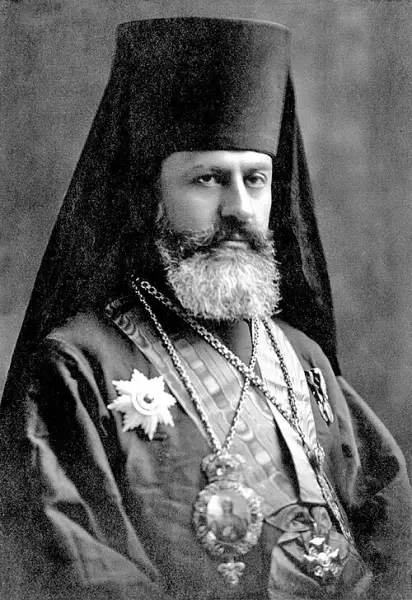
Raphael of Brooklyn, born Raphael Hawaweeny, served the Russian Orthodox Church as auxiliary bishop of Brooklyn and headed the Antiochian Syrian Christian mission, remembered as the first Eastern Orthodox bishop consecrated in America. He was born on 20 November 1860 in Beirut to Damascene Arab Orthodox parents who had fled the civil war in Damascus, and he was educated at the Damascus Patriarchal School, the Patriarchal Halki seminary in Constantinople, and the Theological Academy in Kiev. Expelled from the Greek Orthodox Church for pseudonymous polemics attacking the exclusivism by which its Greek clergy kept office to themselves, he was welcomed by the Russian Church, which appointed him a professor at the Kazan Theological Academy. In 1895 Tsar Nicholas II sent him to New York to shepherd the city's scattered Orthodox immigrants, above all the Arabic-speaking faithful. Elected vicar for the Syrian-Arab flock in 1903, he wandered the continent by foot, horse, donkey, and train, baptizing and marrying wherever letters from scattered Orthodox told him a flock waited. Consecrated bishop in New York in 1904, he founded thirty parishes, built more than thirty churches, established the cathedral in Brooklyn, assisted in founding St. Tikhon's Monastery, and launched the first Eastern Orthodox magazine, The Word. He died in Brooklyn on 27 February 1915.
The Complete Life
A Child of Exile
Raphael Hawaweeny was born on 20 November 1860 in Beirut, in the Sidon Eyalet of the Ottoman Empire, into a family already marked by flight. His parents were Damascene Syrian Arab Christians of the Antiochian Orthodox tradition, who had come to Beirut fleeing the 1860 civil war in Damascus, the convulsion that had devastated the Christian quarters of that city. He was thus a child of the displacement that would define his own later ministry, born in exile of parents who had lost their home. His education began at the Damascus Patriarchal School, which under the leadership of Joseph of Damascus had risen to be the Greek Orthodox world's foremost school of higher learning in the Levant. From there his studies carried him ever farther from his native Syria: he pursued Christian theology at the Patriarchal Halki seminary in Constantinople, and then at the Theological Academy in Kiev, in the Russian Empire. The young Arab Christian was formed in three worlds at once, the Arabic learning of Damascus, the Greek hierarchy of Constantinople, and the Russian piety of Kiev, an education that prepared him, as nothing else could have, for the polyglot Orthodoxy of America.
§ Life
The Price of a Pen
The first crisis of Raphael's vocation came from his own pen. Writing under a false name, he attacked in print the exclusivism by which the Greek clergy of his day kept the church's offices to themselves, a criticism of the system that reserved office by blood and language rather than by service. When the authorship was discovered, the Greek Orthodox Church expelled him. The exclusion proved a strange providence, for the Russian Orthodox Church welcomed what the Greek hierarchy had cast out. Raphael became a professor at the Kazan Theological Academy and was commissioned to write apologetic works against Islam, serving the Church that had received him with the scholarship that had cost him his place in another. His sympathies in these years attached themselves to the great missionary tradition of Russian Orthodoxy, represented by figures such as Innocent of Alaska, whose pattern of meeting scattered peoples in their own language he would follow across another continent. When the request came from Arabic-speaking Orthodox Christians in New York for a priest able to serve them in their mother tongue, and Tsar Nicholas II sent Father Raphael to New York City in 1895 to administer the local Orthodox community of Russians, Greeks, Romanians, and Arabs, the exile found his field.
§ Life
Vicar of a Continent
New York in 1895 held an Orthodox community of Russian, Greek, Romanian, and Arab immigrants, and Raphael answered for the Arabic speakers among them. From 1903, after his election as the Syria-Arabian Vicariot of America, he undertook the missionary journeys that became the stuff of his legend. He adopted a semi-nomadic life, travelling on foot, on horseback, on donkey-back, and aboard trains, in the company of freighthopping tramps and hobos, organizing his itinerary around letters that reached him from scattered Orthodox Christians across America, and riding in and out of cities to perform baptisms, marriages, and blessings wherever the faithful had gathered. Toward the end he extended the mission to Cuba and the Caribbean. In 1904 his consecration in New York City, at the hands of Archbishop Tikhon Bellavin and Bishop Innocent Pustynsky, made him the first Orthodox bishop ever raised to the episcopate on North American soil, and Brooklyn remained his see until he died. The harvest of those years was immense: he established what is now the St. Nicholas Antiochian Orthodox Cathedral in Brooklyn, set up thirty parishes, raised more than thirty churches, and helped bring St. Tikhon's Orthodox Monastery into being, planting the Eastern Orthodox Church permanently in the New World.
§ Life
Against Every Wall of Nation
Raphael's spirituality was missionary to its core, formed in the tradition of Joseph of Damascus and Innocent of Alaska, shepherds who carried the sacraments to the people rather than waiting for the people to come. His lifelong theme was the unity of the Church against the tribal instinct to divide it. His onslaughts on ethnophyletism, exclusivism, and Greek nepotism within Eastern Orthodoxy made him enemies in high places and cost him a position in his youth, but they made him the precursor of the Arab Orthodox Movement and the father of an American Orthodoxy that belonged to no single old-country faction. His longest quarrel was conducted with books rather than decrees: histories of the papal church, refutations of Pope Leo XIII's proclamation, studies of the Brotherhood of the Holy Sepulchre, and a brief history of the Christian Church flowed from his pen in Arabic. In 1905 he founded The Word, the official magazine of the Antiochian Archdiocese, publishing it in Arabic and thereby becoming the pioneer who brought the Eastern Orthodox Church into the age of mass media with the first magazine the Church had ever published. Through its pages, and through the many works he left untranslated and unpublished, he preached one Church for many peoples.
§ Life
Rest and Translation
Raphael died in Brooklyn on 27 February 1915, at the age of fifty-four, worn by two decades of ceaseless travel across a continent. He had been buried in New York, the city where he had landed as a missionary priest and served as bishop. There he rested until August 1988, when his remains were moved to the Antiochian Village Camp at Ligonier in Pennsylvania, land belonging to the Antiochian Archdiocese, together with the remains of several other bishops and clergy. The translation gathered the first bishop of American Orthodoxy to a resting place at the heart of the community he had founded, a camp where the children of his flock would encounter the Church he had planted for them. His death did not interrupt his jurisdiction so much as expand it: the thirty parishes and thirty churches he built became a full archdiocese, and the cathedral he founded in Brooklyn remains its mother church, standing in the tradition of the Little Syria neighbourhood of Manhattan where his shrine is honoured. The bishop who had journeyed among tramps and hobos had become, in death, the fixed point around which his Church gathered.
§ Glorification and honors
Glorified in Two Worlds
Raphael's glorification came from the two communions his life had joined. The governing synod of the Orthodox Church in America glorified him in its March 2000 session, and the service was celebrated at St. Tikhon's Monastery, the community he had helped to found, before thousands of the faithful. He is commemorated by the OCA on 27 February, the anniversary of his death, and his feast is kept as a vigil-rank commemoration. The Antiochian Orthodox Christian Archdiocese of North America honours him on the first Saturday of November, beside the feast that gathers Michael, Gabriel, Raphael, and every one of the bodiless powers of heaven, a commemoration likewise of vigil rank. The Church of his fathers completed the work in October 2023, when the Greek Orthodox Patriarchate of Antioch canonized him and added him, with All Saints of Antioch, to its calendar, healing in his person the exclusion his youthful polemics had once cost him. He is commemorated also in the Ukrainian Orthodox Church on 14 February and on 27 October, in the Synaxis of All Saints of the Kiev Theological Academy and Seminary where he studied, a saint honoured in every tradition that formed him.
§ Glorification and honors
Father of American Orthodoxy
Raphael of Brooklyn is remembered as the first Eastern Orthodox bishop of America, and the Church he organized out of immigrant fragments is his standing monument. He founded the cathedral that is now St. Nicholas Antiochian Orthodox Cathedral in Brooklyn, established thirty parishes, and built more than thirty churches across the continent he crossed by any means that moved. He assisted in founding St. Tikhon's Monastery, which became the cradle of Orthodox monasticism and of the Orthodox Church in America itself, the body that glorified him in 2000. The Word, the magazine he founded in Arabic in 1905, remains the official publication of the Antiochian Archdiocese, and his example as the first Orthodox editor made religious publishing part of the Church's mission in the New World. In 2015 the Antiochian Archdiocese, the Orthodox Church in America, and ROCOR joined in celebrating the centennial of his dormition, a centenary marked even by The New York Times as a celebration of Brooklyn's only saint. He is honoured as patron of America, venerated as a precursor of the Arab Orthodox Movement, and remembered wherever Orthodox Christians of many nations worship in one language of faith, the unity for which he spent his life.
§ Glorification and honors
Timeline
- 20 Nov 1860
Born Raphael Hawaweeny in Beirut to Damascene Orthodox parents who had fled the Syrian Civil War.
§ Life
- 1891
Published The Antiochian Patriarchal Metochion in Moscow and the Ascension and St. Hypatios Church.
§ Works
- 1893
Published Historical Glance at the Brotherhood of the Holy Sepulchre.
§ Works
- 1895
Sent by Tsar Nicholas II to New York City to administer the local Orthodox community.
§ Life
- 1898
Published his devotional book of true consolation and divine prayer.
§ Works
- 1903
Elected the Syria-Arabian Vicariot of America and began his semi-nomadic missionary journeys, extending his mission to Cuba and the Caribbean.
§ Life
- 1904
Became the first Orthodox bishop ever consecrated on North American soil, made bishop in New York by Archbishop Tikhon and Bishop Innocent.
§ Life
- 1905
Founded The Word, the official magazine of the Antiochian Archdiocese, published in Arabic.
§ Life
- 1913
Published The Great Euchologion.
§ Works
- 27 Feb 1915
Died in Brooklyn, New York City, at the age of fifty-four.
§ Life
- Aug 1988
His relics were translated from New York to the Antiochian Village Camp in Ligonier, Pennsylvania.
§ Glorification and honors
- Mar 2000
Glorified by the governing synod of the Orthodox Church in America.
§ Glorification and honors
- 2015
The Antiochian Archdiocese, the OCA, and ROCOR celebrated the centennial of his dormition.
§ Glorification and honors
- Oct 2023
Canonized by the Greek Orthodox Patriarchate of Antioch, which added him and All Saints of Antioch to its calendar.
§ Glorification and honors
The Record
- Major works
- The Antiochian Patriarchal Metochion in Moscow and the Ascension and St. Hypatios Church (1891)·Historical Glance at the Brotherhood of the Holy Sepulchre (1893)·A Historical view of the errors of the Papal Church (1895)·A Brief history of the Christian Church (1895)·A Refutation of the Proclamation of Pope Leo XIII (1895)·The book of true consolation and the divine prayers (1898)·The Resumé of the Church and the Cemetery projects (1903)·The Great Euchologion (1913)·Truths of the holy Tradition and their great axioms (Al-Kalimat, 1905-1915)·Rules for the second year (Al-Kalimat, 1905-1915)
- Patron of
- America
- Canonization
- Glorified in March 2000 by the Orthodox Church in America; canonized in October 2023 by the Patriarchate of Antioch.
Prayer
Bibliography
Show 6 sources
- "Thousands Attend Glorification of Saint Raphael, Bishop of Brooklyn, at Saint Tikhon's Monastery". Orthodox Church in America. June 19, 2000.
- "Antiochian Church Canonizes Two Saints, Adds St. Raphael and All Saints of Antioch to Calendar". OrthoChristian. October 20, 2023.
- Boullata, Issa J. (1995). The first one hundred years. Antakya Press. ISBN 9780962419027.
- Newman, Andy (November 5, 2015). "A Centennial Celebration for Brooklyn's Only Saint". The New York Times.
- "Christian Church to be Filled by a Damascus Preacher". The New York Times. September 15, 1895.
- "The Word Magazine". antiochian.org.
Profile text adapted from the Wikipedia article, licensed CC BY-SA 4.0.
Pray with this saint every day
Save St. Raphael of Brooklyn to your favorites, read the full profile, and get feast-day reminders in the Saints app.
Get the Saints AppFree on the App Store for iPhone and iPad