
c. 900 – 953·Feast May 17
St. Rasso
Bavarian count, pilgrim, and abbey founder
Overview
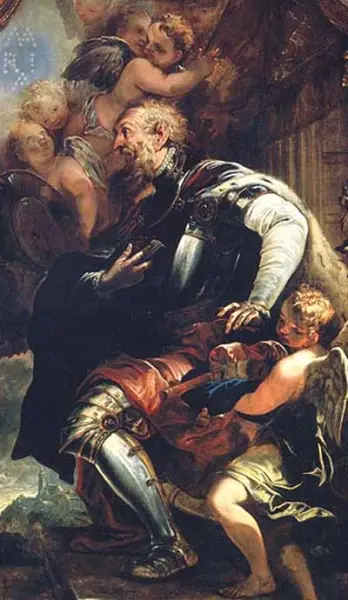
Rasso, also called Rasso of Grafrath or Ratho, was a Bavarian count and military leader of the tenth century, remembered as a pilgrim and a saint. He held the county of Dießen-Andechs and led the Bavarians against the invading Magyars in the fighting of the 950s. No contemporary life of Rasso has survived, and the legends that gathered around his cult in the late Middle Ages grew over a thin documentary base, but historians see no reason to doubt the existence of the count who fought the Hungarian raiders of his age. In middle age he exchanged the military life for pilgrimage, travelling to the Holy Land and to Rome, collecting relics on his journeys, and coming home to establish a Benedictine house at Wörth, renamed Grafrath in his honour. He died in 953. His healing shrine at Grafrath drew pilgrims through the Middle Ages and beyond, and the record of miracles worked there between 1444 and 1728 runs to more than twelve thousand entries. He is invoked especially against stomach pains in children.
The Complete Life
Count Against the Magyars
Rasso lived in a Bavaria under repeated assault. He was count of Dießen-Andechs, a lordship in the lands south of the Ammersee, and in the tenth century he led the Bavarians in war against the invading Magyars, the mounted raiders whose campaigns devastated the German lands in the first half of that century. His historical existence rests on firm ground even though no contemporary Vita has come down to us: historians of the period see no reason to doubt that a count named Rasso fought against the Magyars in the 950s, even as the legends of the late Middle Ages wove romance around his memory. The warriors of that age were rarely remembered for gentleness, but Rasso's soldiering gave way, in his middle years, to the pilgrim's calling. He journeyed to the Holy Land and to Rome, the two great goals of medieval pilgrimage, and in both places he gathered relics of the saints. With these treasures he returned home and founded a Benedictine abbey at Wörth, a house that after his death took his own name and became Grafrath, the count's hill, binding his memory to the place forever.
§ Veneration
A Giant Laid to Rest
Rasso died in 953, before the decisive defeat of the Magyar threat that came only two years later, so that his part in the long resistance belongs to the hardest years of the struggle. He was remembered among his people for the size of his frame as much as for his deeds. When his relics were exhumed in 1468, more than five centuries after his death, examination of the bones showed a man of about two meters, six feet six inches, in height; the popular imagination had credited him with being taller still, for the grave that had held him measured two and a half meters. Whatever the exact measure of the man, the count of Dießen-Andechs had left behind him in Bavaria a memory that outlasted his line's political fortunes. His abbey at Wörth carried his name into every following century, and his body, once recovered, became the centre of a pilgrimage that would fill the records of the later Middle Ages. The soldier who had faced the raiders of the plain of Hungary had become, in the devotion of his people, the guardian of their sick.
§ Veneration
A Saint of the Old Undivided Church
Rasso belongs to the company of the pre-congregation saints, honoured by the Church's constant devotion rather than by any papal canonization. No act of canonization exists for him, and the forms of his cult took shape long after his death, in the late Middle Ages, when the legends that clothed his memory were written down. The core of the devotion was always the healing shrine of St. Rasso at Grafrath, the pilgrimage church that stood beside the abbey he had founded. It received many visitors throughout the Middle Ages and afterwards, and its books preserve the measure of what pilgrims believed they had received: the record of miracles attributed to the saint between the years 1444 and 1728 contains 12,131 entries. The saints whose relics Rasso had carried home from Rome and the Holy Land rested at first in his own monastery at Wörth, and in 955, with the Magyar raids still burning, those relics were carried to Andechs Abbey for safekeeping away from the raiders. The feast of St. Rasso is kept on 17 May, with a second observance on 19 May at Grafrath and Andechs.
§ Veneration
The Pilgrims of Grafrath
The abbey Rasso founded at Wörth became Grafrath, and the pilgrimage church of St. Rasso beside it became one of the great healing shrines of southern Bavaria. Its visitors' record, kept across nearly three centuries and running to more than twelve thousand entries of marvels, testifies to a devotion that spanned the late medieval world and the centuries after the Reformation alike. The count's physical remains drew their own devotion: exhumed in 1468 and found to belong to a man of extraordinary height, they confirmed in the eyes of the faithful the popular memory of a giant of the wars against the Magyars. His relics and the relics he had collected travelled opposite roads, the saint's body remaining at Grafrath while the treasures he carried from Rome and Jerusalem were carried in 955 to the safety of Andechs Abbey, where they helped make the holy mountain of Andechs a treasury of relics for all Bavaria. In art he appears in military attire, the count and commander; in popular devotion he is the helper of children suffering stomach pains, the patron of a tenderness far from the battlefield. His two feast days, 17 and 19 May, keep his memory at Grafrath and Andechs.
§ Veneration
Timeline
- 900
Born in Bavaria around the turn of the tenth century.
§ Veneration
- 953
Died as count of Dießen-Andechs, having led the Bavarians against the invading Magyars.
§ Veneration
- 955
The relics he had brought from Rome and the Holy Land were transferred from Wörth to Andechs Abbey for safety from the Magyars.
§ Veneration
- 1468
His relics were exhumed and the body was found to measure about two meters tall.
§ Veneration
The Record
- Major works
- Benedictine abbey at Wörth, later named Grafrath
- Patron of
- invoked against stomach pains, especially in children
- Symbols
- military attire
- Canonization
- Pre-congregation; venerated from the late Middle Ages at Grafrath and Andechs.
Prayer
Bibliography
Show 3 sources
- "Rasso (Ratho) von Andechs", Ökumenisches Heiligenlexikon
- Bowlus, Charles R. The Battle of Lechfeld And Its Aftermath, August 955: The End. Ashgate Publishing, 2006, 143n.
- Ott, Michael. "Andechs." The Catholic Encyclopedia Vol. 16 (Index). New York: The Encyclopedia Press, 1914.
Profile text adapted from the Wikipedia article, licensed CC BY-SA 4.0.
Pray with this saint every day
Save St. Rasso to your favorites, read the full profile, and get feast-day reminders in the Saints app.
Get the Saints AppFree on the App Store for iPhone and iPad