
1204 – 1240·Feast August 31
St. Raymond Nonnatus
Mercedarian ransomer of captives and confessor
Overview
Raymond Nonnatus was a Mercedarian friar, priest, and missionary from Catalonia whose strange byname — Latin for "not born" — commemorates the manner of his entrance into the world: delivered by Caesarean section after his mother died in labor. Raised, by some accounts, as the son of a local count and, by others, of a shepherding family, he spent his boyhood minding sheep and praying at a rural chapel dedicated to St. Nicholas. His father eventually consented to his entrance into the Order of the Blessed Virgin Mary of Mercy at Barcelona, founded to ransom Christians held captive by the Moors, and Raymond was formed by the founder himself, St. Peter Nolasco. Ordained in 1222, he rose to become Master General of the Order and carried its mission to Valencia, Algiers, and Tunis, freeing hundreds of captives and, when his money failed, surrendering himself as a hostage in their place. Tradition holds that his lips were pierced with a heated iron by his captors and his mouth closed in a padlock so that he could preach no more. Ransomed in 1239, he died at the Castle of Cardona the following year. He is invoked as patron of childbirth, midwives, infants, and the falsely accused, and of the confidentiality of confession.
The Complete Life
A Birth Saved from Death
Raymond entered life through death. The traditions of the Mercedarian Order place his birth in 1204 at Portell, a village now absorbed into Sant Ramon in the Diocese of Urgell in Catalonia. His mother died in labor, and the child was taken from her womb by surgery — hence the Latin byname Nonnatus, "not born", which distinguishes him from the many other Raymonds of the age. Tradition is divided about his family. Some accounts make him the son of the local count — the very man, by that telling, whose hand carried out the operation that saved the boy's life; others place him in a household of shepherds. What the sources agree upon is that his father was a man of education who nursed great expectations, hoping to see the boy take his place at court in the Kingdom of Aragon. Yet when the child's heart inclined toward religious life, the father tried to turn him from it by putting him in charge of one of the family farms. Whatever his true rank, Raymond's childhood was spent outdoors among the sheep, and there his piety put down roots: he would often pray in an ancient rural chapel close at hand, dedicated to St. Nicholas — the very place to which, by a striking providence, his body would one day be carried for burial.
§ Life
The Habit of Mercy
The resistance of Raymond's father to his religious calling did not last. In time he gave his son permission to take the habit of the Mercedarians at Barcelona, the Order of the Blessed Virgin Mary of Mercy, which had been founded for one specific and perilous work: the ransom of Christian captives held by the Moors of North Africa. Raymond's formation fell to the founder of the Order himself, St. Peter Nolasco, under whose guidance he embraced both the common life and the members' extraordinary fourth vow, by which they offered themselves, in person and in place of money, as hostages for captives whose freedom could not otherwise be won. He received priestly ordination in 1222, and his gifts marked him out for responsibility: in time he became Master General of the whole Order. In an age when thousands of Christians captured on land and sea languished in the slave markets of Valencia, Algiers, and Tunis, the Mercedarian vocation joined contemplative life to the hazards of negotiation across hostile frontiers. Raymond proved faithful to both halves of that calling, bringing to the ransomer's dangerous trade the patience of the shepherd he had been in his boyhood and the obedience of the religious he had become.
§ Life
Ransoms and Captivity
Raymond set out to fulfill the purpose of his Order with conspicuous success. In Valencia he ransomed 140 Christians from slavery. Crossing to North Africa, he secured the freedom of another 250 captives in Algiers, and then pressed on to Tunis, where his money ran out while captives still waited. Faithful to the special fourth vow of the Mercedarians, he gave himself as a hostage in exchange for 28 captive Christians, placing his own body in bondage so that theirs might go free. His captivity became a martyrdom in fact if not in final form. Legend relates that the Moors, enraged by his untiring preaching of the Gospel, pierced his lips with a heated iron and locked a padlock through the wound to prevent him from speaking of Christ. Even silenced, he remained a prisoner of love for the souls around him until his Order gathered the means to redeem him in his turn. He was ransomed and returned to Spain in 1239, bearing in his body the marks of the price he had paid. Sixteenth-century writers added that Pope Gregory IX had named him Cardinal Deacon of Sant'Eustachio and that he died journeying to Rome, but modern scholarship has shown this to be a confusion with another man entirely; the cardinal's scarlet in his images is an honor he never in fact possessed.
§ Life
Silence, Ransom, and the Sins of the Tongue
The spirituality written into Raymond's life is one of substitutionary mercy. The fourth vow of his Order bound him to stand in the place of the captive, and he fulfilled it literally in Tunis, wagering his own liberty and life for twenty-eight strangers. His heroism was not only in what he did but in what he endured without speaking: the padlock said to have sealed his lips made his mutilated silence an image of restrained charity, the refusal to let even torment loosen words that God had not authorized. From that image grew a distinctive popular devotion. At his altars the faithful place small locks, each one representing a prayer request to end gossip, rumour, false testimony, and the other sins of the tongue; the visible padlock signals an interior work, a plea to God through Raymond's intercession that speech itself be converted and healed. His birth by Caesarean section, remembered in his very name, made him from early on the natural advocate of women in childbirth, and mothers have invoked him for the safe delivery of their children for centuries. In him the mysteries of guarded speech and perilous birth converge: a man who came into the world through a mother's dying, and who spent that borrowed life buying others back from bondage.
§ Veneration
Death and the Blind Mule
Raymond's death came at the Castle of Cardona, some sixty miles from Barcelona, in 1240, when he was about thirty-six; the sources divide between 26 August and 31 August for the day of his death, and the feast follows the latter date. His body at once became the object of competing claims. Tradition relates that the local count, the friars of his Order, and the townspeople all insisted on the right to bury him, and the dispute threatened to outlast the grief. To settle it, the body was laid on a blind mule, which was then set loose to go where it would. Untended and unguided, the animal made its way to the nearby country chapel where Raymond had prayed as a boy tending sheep — the little church of St. Nicholas of his childhood — and there the saint was laid to rest. The story belongs to a familiar medieval idiom of divine arbitration, but it binds the end of his life to its beginning with singular tenderness: the child delivered from death returned as a corpse to the field chapel of his first prayers. Many miracles were attributed to his intercession both before and after his death, and his tomb quickly became a goal of pilgrimage.
§ Life
Honors of the Church
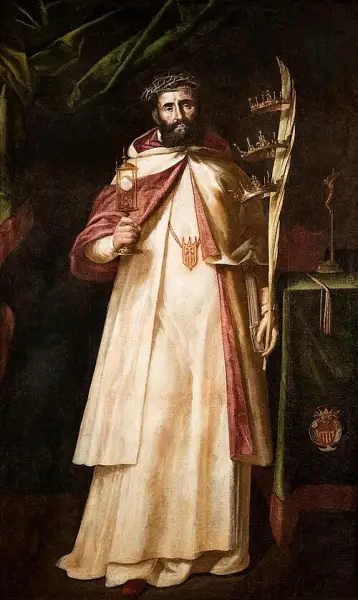
The cult of Raymond Nonnatus received formal confirmation from the papacy in the seventeenth century. He was beatified in Rome on 9 May 1626 by Pope Urban VIII, and raised to the altars as a saint in 1657 by Pope Alexander VII. From the first his feast was assigned to 31 August, the day of his death honored by the greater part of the tradition. The Church's calendar reform of 1969, judging his relatively minor historical weight, ceased to require his liturgical commemoration wherever the Roman Rite is celebrated; yet since the Roman Martyrology continues to record him on 31 August, the Eucharist and the Liturgy of the Hours may still be celebrated in his honor on that day, as they were in the pre-1970 General Roman Calendar kept by some traditionalist communities. In art he appears amid the freed captives in his friar's habit, a padlock sealing his lips, or as a Mercedarian wearing the scarlet mozzetta of a cardinal and holding a monstrance and the martyr's palm — the red garment recalling the cardinalate that historians have shown he never held, but which centuries of devotion considered fitting for a man who had given his life as a hostage for his brethren.
§ Introduction
Places and Peoples Under His Patronage
Raymond's name travels across the map of the Catholic world. Towns bear it on three continents: Saint-Raymond in Quebec, Canada; San Ramón de la Nueva Orán in Argentina; São Raimundo Nonato in Brazil, whose Roman Catholic Diocese is dedicated under his title; and San Ramón in Costa Rica. In Brazil the village of São Raimundo in São Bernardo took its name from a chapel raised in his honor by Antônio Pires Ferreira for his slaves. In the United States, parishes and a cathedral claim him: St. Raymond Parish in the Bronx in New York City, the Cathedral of St. Raymond Nonnatus in Joliet, Illinois, St. Raymond Parish in Raymond, Illinois, and St. Raymond Catholic Community in Downey, California, together with a parish in Juana Díaz, Puerto Rico; an altar in the Metropolitan Cathedral of Mexico City also bears his image. Because of the story of his own delivery, women awaiting childbirth were soon calling on him everywhere, and he remains patron of midwives, obstetricians, infants, and children. His reach extends even into popular culture: the convent called Nonnatus House in the BBC drama Call the Midwife, set in the East End of London, was named in his honor by the memoirist Jennifer Worth.
§ Veneration
Timeline
- 1204
Is born at Portell in Catalonia, delivered from his mother's womb after her death in labor
§ Life
- 1222
Is ordained a priest after taking the Mercedarian habit at Barcelona under St. Peter Nolasco
§ Life
- 1239
Is ransomed by his order after captivity among the Moors and returns to Spain
§ Life
- 1239
Is said by sixteenth-century writers to have been named Cardinal Deacon of Sant'Eustachio by Gregory IX, a claim modern scholarship rejects
§ Introduction
- 31 Aug 1240
Dies at the Castle of Cardona, sixty miles from Barcelona; accounts also give 26 August
§ Life
- 9 May 1626
Is beatified in Rome by Pope Urban VIII
§ Introduction
- 1657
Is canonized by Pope Alexander VII
§ Introduction
- 1969
The reform of the Church calendar makes his feast no longer obligatory in the Roman Rite, though it remains in the Martyrology
§ Veneration
The Record
- Patron of
- childbirth·expectant mothers·pregnant women·newborn babies·infants·children·obstetricians·midwives·against fever·the falsely accused·confidentiality of confession·Baitoa, Dominican Republic·Moncada, Tarlac
- Symbols
- Mercedarian friar's habit·cardinal's red mozzetta·monstrance·martyr's palm branch·padlock on his lips·ransomed slaves at his side
- Canonization
- Beatified 9 May 1626 by Pope Urban VIII; canonized in 1657 by Pope Alexander VII
Prayer
Bibliography
Show 8 sources
- Stracke, Richard (2015-10-20). "Raymond Nonnatus". Christian Iconography.
- "CATHOLIC ENCYCLOPEDIA: St. Raymond Nonnatus"
- "Saint Raymond Nonnatus". Order of the Blessed Virgin Mary of Mercy. Archived from the original on 8 January 2013. Retrieved 7 January 2013.
- Eubel, C. Hierarchia Catholica, vol. I, p. 6
- Lives of the Saints, For Every Day of the Year, edited by Rev. Hugo Hoever, S.O.Cist., Ph.D., New York: Catholic Book Publishing Co., June 1, 1955, p. 344
- Paravicini Bagliani, A. Cardinali di Curia e "familae" cardinalizia dal 1227 al 1254, Padova 1972, pt. II, pp. 534-535
- Martyrologium Romanum (Libreria Editrice Vaticana, 2001; ISBN 88-209-7210-7)
- Calendarium Romanum (Libreria Editrice Vaticana, 1969), p. 137
Profile text adapted from the Wikipedia article, licensed CC BY-SA 4.0.
Pray with this saint every day
Save St. Raymond Nonnatus to your favorites, read the full profile, and get feast-day reminders in the Saints app.
Get the Saints AppFree on the App Store for iPhone and iPad