
died 1126·Feast June 21
St. Raymond of Barbastro
Canon Regular and Bishop of Barbastro
Overview
Raymond William (Raimundo Guillermo), known as Raymond of Barbastro, was a French-born canon regular who became Bishop of Barbastro in the Kingdom of Aragon and one of the first saints of the reconquered frontier lands of Spain. A native of Durban in France, he entered the Canons Regular, the clergy who lived under a rule in community while serving pastoral office, and in 1104 was appointed to the see of Barbastro, a city that had passed from Muslim to Christian hands only a generation before and whose church still needed to be built up in men, worship, and order. He governed the diocese for more than two decades, and his name is preserved in the record of a solemn act of the Spanish church: the dedication of Sant Climent de Taüll on 10 December 1123 and, on the day that followed, of Santa Maria de Taüll — two of the Romanesque temples whose painted art would one day rank among the treasures of Catalonia. He died of natural causes at Barbastro in 1126, after twenty-two years as bishop. His sanctity was recognized with remarkable speed: he was canonized by Pope Innocent II in 1136, only ten years after his death. He is honored on 21 June as patron of the city of Barbastro and of the Roman Catholic Diocese of Barbastro-Monzón.
The Complete Life
From Durban to the Canons Regular
Raymond William, in Spanish records Raimundo Guillermo, was born at Durban in France, a fact that made him one of the many clergy from beyond the Pyrenees who lent their talents to the young churches of the Iberian kingdoms in the age of the reconquest. Of his childhood and education the sources say nothing; what they record is his entrance into the Canons Regular, the form of religious life in which clerics living in community bound themselves by a rule — in the tradition stemming from the teaching of St. Augustine — while remaining in pastoral service. The choice distinguished him from both the monk enclosed in the cloister and the secular canon living on his own revenues: he belonged to the reforming current of the eleventh and twelfth centuries, which sought to join the apostolic ministry of clergy to the discipline and poverty of religious life. In that environment a man of his ability would have been formed in liturgy, church administration, and the care of souls, the exact combination of gifts that the troubled and newly Christian diocese of Barbastro, on the frontier of Aragon, required of its bishop when the call came.
§ Introduction
A Bishop for a Frontier See
In 1104 Raymond was appointed Bishop of Barbastro, assuming the government of a see whose recent history made it one of the most delicate charges in Aragon. The city had been taken from Muslim rule only a few years before his birth's century turned, and its Christian church was young, its institutions still taking shape amid a population of mixed faiths and loyalties. To appoint a canon regular of French origin to such a see was to bring to the frontier the reformed clergy of the lands beyond the mountains: men trained in the canonical discipline that the great reforming popes had spread through Europe, suited to erecting the structures — chapters, parishes, liturgy, ecclesiastical courts — that a new diocese required. Raymond accepted the charge and remained in it for his whole life, never translated to a more prominent see, never abandoning the city of his title. He is not to be confused with Raymond of Roda, another French-born prelate of the neighboring Aragonese church whose nearly contemporary career has sometimes been tangled with his; the bishop of Barbastro kept faithfully to the city whose name he bears and whose patron he was to become.
§ Introduction
The Consecrations of Taüll
The most precisely dated act of Raymond's episcopate belongs not to Barbastro but to the mountains to the north. Sant Climent de Taüll received his consecration on 10 December 1123, and Santa Maria de Taüll on the day that followed, 11 December 1123. These two consecrations, recorded because of their importance to the churches themselves, fixed the solemn dedication of two Romanesque temples in the valleys south of the Pyrenees, buildings whose decoration would come to represent the summit of twelfth-century Catalan painting. The act of consecration was among a bishop's most sacred functions: it set a building apart forever for Christian worship, marked its altar, and gathered the surrounding people into a stable parish life. For Raymond, whose own diocese was still being organized on a frontier, to travel to consecrate churches in another territory was the ordinary collaboration of the Spanish episcopate in the generation when new Christian communities were being planted across the lands recovered from Muslim rule. The two days of December 1123 remain the clearest window into his active ministry, showing a bishop at the center of the Church's sacramental building-up of a Christian society.
§ Introduction
Twenty-Two Years and a Peaceful End
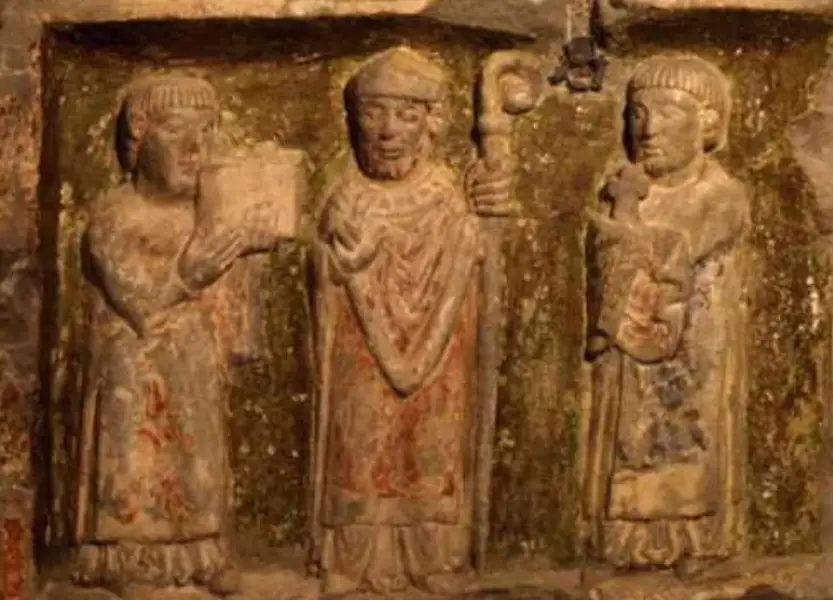
Raymond served as Bishop of Barbastro until his death in 1126, completing twenty-two years in the office to which he had been appointed in 1104. In an age when bishops died on campaign, in exile, or at the hands of the violent, his death by natural causes was itself the quiet crown of a faithful pastorate: he finished what he had undertaken, in the place where he had been called, and laid down his charge in peace. He died at Barbastro, the city of his see, and was buried there; the relief carved on the tomb of St. Raymond, Bishop of Barbastro, preserves for the modern visitor the image under which his flock remembered him. He had held the see through the decades in which the Christian kingdoms consolidated their hold on the Ebro lands, and the survival and growth of the diocese in that period was the work he left behind him. At his death his reputation for holiness was already established among the clergy and people he had served, and the ten years that followed saw that reputation carry him, with unusual speed, to the altars of the universal Church.
§ Introduction
A Saint Ten Years After Death
Raymond was canonized by Pope Innocent II in 1136, only a decade after his death — a strikingly rapid recognition even by the standards of the twelfth century, when papal canonization was still a young institution and the pope reserved judgment on new saints. The speed of the act testifies to the strength of the devotion that arose at his tomb in Barbastro and to the esteem in which the episcopate of Aragon held its departed brother. Innocent II, whose pontificate was spent defending the Church's reform against schism, found in the bishop of a frontier see a cause unmarred by controversy: a canon regular who had governed a difficult diocese for two decades, consecrated the churches of Taüll, and died in the peace of natural causes. Raymond's feast was assigned to 21 June, and his cult settled naturally upon the city and diocese he had served, which took him as their patron. Among the saints of the Spanish frontier he stands as a representative of the French clergy who carried the reformed canonical life across the Pyrenees and died as pastors of the churches they had come to serve.
§ Introduction
Patron of Barbastro-Monzón
Raymond's enduring legacy is corporate as much as personal: he is the patron of the city of Barbastro and of the Roman Catholic Diocese of Barbastro-Monzón, the diocese that descends from the see he governed. Every generation of the diocese's clergy and people has inherited his name in its litanies and its calendar, keeping his feast on 21 June. The two churches he consecrated at Taüll in December 1123 survived the centuries and stand today among the most celebrated monuments of Romanesque art in Spain, their consecration by the bishop of Barbastro recorded in their history; the artistic treasures associated with them are preserved and studied in the national collections of Romanesque art in Catalonia, so that the act of an obscure frontier bishop in the winter of 1123 remains part of the documented heritage of European art. His tomb relief at Barbastro kept his image before the faithful, and his story — French by birth, canon regular by profession, bishop by obedience, saint by the verdict of Innocent II — has remained the pattern of the foreign-born pastor who made a Spanish diocese his own and received its gratitude in return.
§ Introduction
Timeline
- 1104
Is appointed Bishop of Barbastro in Spain
§ Introduction
- 10 Dec 1123
Consecrates the church of Sant Climent de Taüll
§ Introduction
- 11 Dec 1123
Consecrates the church of Santa Maria de Taüll, a day after Sant Climent
§ Introduction
- 1126
Dies of natural causes at Barbastro after twenty-two years in office
§ Introduction
- 1136
Is canonized by Pope Innocent II
§ Introduction
The Record
- Patron of
- City of Barbastro·Roman Catholic Diocese of Barbastro-Monzón
- Canonization
- Canonized by Pope Innocent II in 1136
Prayer
Bibliography
Show 3 sources
- "St. Raymond of Barbastro". Catholic Online.
- "Saint Raymond of Barbastro". Patron Saint Index.
- Castiñeiras, Manuel A.; Camps i Sòria, Jordi; Duran-Porta, Joan (2008). Romanesque art in the MNAC collections. Barcelona: Museu Nacional d'Art de Catalunya: Lunwerg. pp. 70, 72. ISBN 978-84-9785-548-8.
Profile text adapted from the Wikipedia article, licensed CC BY-SA 4.0.
Pray with this saint every day
Save St. Raymond of Barbastro to your favorites, read the full profile, and get feast-day reminders in the Saints app.
Get the Saints AppFree on the App Store for iPhone and iPad