
c. 1175 – 1275·Feast January 7
St. Raymond of Peñafort
Dominican canon lawyer and Master General
Overview
Raymond of Peñafort, Dominican friar and master of canon law (c. 1175 – 6 January 1275), gave the Church a codification of church law shaped the Catholic Church for almost seven centuries. Born into a noble Catalan house connected with the royal line of Aragon, he took doctorates in civil law and in canon law alike at Bologna and taught there for years, occupying the university's chair of canon law. Drawn to the newly founded Order of Preachers, he received the Dominican habit at Barcelona at the age of forty-seven. His juridical gifts soon brought him to Rome, where Pope Gregory IX made him chaplain and grand penitentiary and entrusted him with the rearranging and codifying of canon law into the Decretals of Gregory IX, promulgated in 1234 as the sole authoritative collection for the schools. He also wrote the Summa de casibus poenitentiae for confessors and the Directorium inquisitoriale, and founded the first school of the Studia Linguarum in Tunis to train friars in Arabic. Elected Master of the Dominican Order in 1238, he resigned within two years under a resignation clause he himself had written into the new Constitutions, and devoted his last decades to the conversion of Muslims and Jews, advising kings and presiding over the Disputation of Barcelona. He died in Barcelona aged about one hundred.
The Complete Life
A Catalan Noble at the Schools of Law
The birth of Raymond of Peñafort took place about 1175 at Santa Margarida i els Monjos, a village of the Principality of Catalonia not far from Barcelona. His family was noble and connected to the royal house of Aragon, and his talents were directed early toward learning. Educated first in Barcelona, he went on to the University of Bologna, the great legal school of the age, where he took doctorates in both civil and canon law — a double distinction marking him as one of the foremost jurists of his generation. He taught canon law from 1195 until 1210, and in that year he moved permanently to Bologna, where he remained until 1222, occupying for three of those years the university's chair of canon law. Bologna was then the capital of juridical science and also the cradle of a new force in the Church: the Order of Preachers, founded by St. Dominic barely a generation before. There Raymond came to know the Dominicans and felt their pull, above all through the sermons of Blessed Reginald, prior of the Bologna Dominicans. His Italian years joined three things that would define his life: mastery of the canons, contact with the friars, and a reputation that would soon reach the pope himself.
§ Life
The Habit at Forty-Seven
When Raymond received the habit of the Order of Preachers in 1222, he was forty-seven years old, an age at which most men of his standing contemplated honors rather than beginnings. He had returned from Italy to Barcelona, and it was in the Dominican convent of that city that he made his profession, exchanging a career of lectures and prospects for the friars' life of poverty, study, and preaching. A tradition of later centuries also credited him with a share, alongside King James I of Aragon and St. Peter Nolasco, in founding the Order of Our Lady of Mercy, the Mercedarians, who ransomed Christian captives from the Moors; but the chronology makes this impossible, for in 1218, the traditional date of that foundation, Raymond was still at Bologna, from which he would not come back to Barcelona until 1222, and the king was then only ten years old. The story arose in the fifteenth century to give the young order a past as glorious as those of the Franciscans or the Dominicans. Raymond's real vocation was Dominican: the marriage of rigorous learning with the salvation of souls, pursued first as a religious among religious and only afterwards on the stage of the universal Church.
§ Mercedarians
Penitentiary, Codifier, and Founder of Schools
Raymond's pastoral genius first appeared in his writing for confessors. His Summa de casibus poenitentiae was more than a table of sins and penances: it laid out the doctrines and laws of the Church bearing on each case brought to the confessional, and it won acceptance as an authoritative work on its subject. In 1229 he became theologian and penitentiary to John of Abbeville, Cardinal Archbishop of Sabina, and in 1230 Pope Gregory IX summoned him to Rome as chaplain and grand penitentiary. Knowing his reputation in the juridical sciences, the pope set him to the work for which he is best remembered: gathering the canon laws scattered through a century of papal decretal letters since Gratian's Decretum into one authoritative collection. The result, promulgated in September 1234 by a bull addressed to the masters of Paris and Bologna, decreed that Raymond's compilation alone should be used in the schools; the Decretals of Gregory IX remained the standard of Church law for nearly seven hundred years, until the code of 1917. Raymond's missionary zeal matched his legal labors. After the Dominican General Chapter at Paris affirmed in 1236 the need to study Semitic languages, he established the first school of the Studia Linguarum in Tunis, known as the Studium arabicum, to train friars for the liberation of Christian captives in Islamic lands. He would go on to encourage Thomas Aquinas to write his summa against the Gentiles, to institute the teaching of Arabic and Hebrew in houses of the order, and to found priories in Murcia and Tunis.
§ Gregorian Decretals
Justice Tempered by Compassion
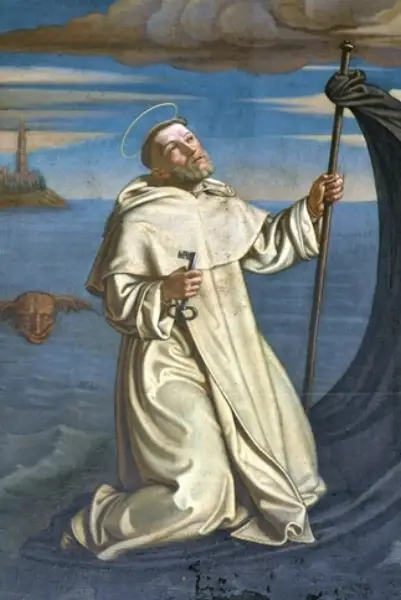
Raymond's spirituality was that of a lawyer who believed law exists for souls. As confessor to King James I of Aragon he showed the courage of the office, reproving the king for the mistress he had brought with him to Mallorca and, when his admonitions failed, preparing to leave the island altogether. Barred from every ship, Raymond went down to the shore, spread his cappa — the long black cloak of the Dominicans — upon the water, rigged one end to his walking staff as a mast, and, making the sign of the cross, sailed away on the cloth before the astonished eyes of sailors, reaching Barcelona, the legend says, 160 miles distant in six hours. The king, awed by the miracle, mended his ways, and the flying cloak became the saint's emblem in art. The same spirit governed his advice on graver matters: though never himself an inquisitor, he was often consulted on the legal questions raised by how the inquisitions were being practiced across the king's lands; and the profound sense of justice and equity, joined to a Dominican's compassion, kept him clear of the excesses that marked the formative years of the inquisitions elsewhere. He even approved conjugal visits for imprisoned men, lest their wives be exposed to the danger of adultery — a detail of pastoral prudence striking in a canonist of the thirteenth century.
§ Most famous miracle
Mastery Declined and Death at One Hundred
Once past his sixtieth year Raymond withdrew into a reclusive life at Barcelona, yet seclusion could not hold him. Within the year he was appointed Archbishop of Tarragona, the ecclesiastical capital of Catalonia and the Crown of Aragon, and he declined the dignity. He had returned to Barcelona by 1236, and could not long remain in seclusion: in 1238 the General Chapter elected him Master of the Order of Preachers. He set out immediately on foot to visit the houses of friars and nuns throughout the order, and amid these journeys he drafted a new set of Constitutions in which he inserted a clause permitting the Master to resign. When the General Chapter of 1240 adopted the Constitutions, he availed himself of his own provision and laid down the office within two years, handing it on to his successor. Freed of office, he applied himself with fresh energy to the ministry of conversion, especially among the Moors, and took part in founding the Church on the newly won island of Mallorca. His final great public act came in July 1263, when he headed the theologians at the Disputation of Barcelona between Rabbi Moshe ben Nahman of Girona and the Dominican Paulus Christiani, granting the rabbi, in agreement with the king, complete freedom of speech. He died at Barcelona on 6 January 1275, about one hundred years old, and was buried in the Cathedral of Santa Eulalia.
§ Later life
From Beatification to the Calendar
Raymond's cult moved swiftly along the Roman road to the altars. He was beatified in 1542 by Pope Paul III, and canonized on 29 April 1601 by Pope Clement VIII. His feast was inserted into the General Roman Calendar in 1671, assigned to 23 January, where it was kept for nearly three centuries. In the liturgical reform of 1969 the observance was transferred to 7 January, the day after his death, so that the saint of the precise calendar now dies and is commemorated across the turning of two days. He is honored as patron of canon lawyers specifically and of lawyers in general, a patronage that follows naturally from the work that absorbed his life: the gathering of the Church's scattered canons into a single authoritative code. His remains lie in the Cathedral of the Holy Cross and Saint Eulalia in Barcelona, where his tomb is a site of devotion, and his memory is kept by the friars whose Constitutions he shaped and by jurists of the Church who inherit, whether they know it or not, the book he compiled under Gregory IX. Few saints have left the institutional life of the Church so permanently marked by their own hand.
§ Feast day
A Law That Lasted Seven Centuries
The measure of Raymond's legacy is endurance. The Decretals of Gregory IX, which he arranged and codified, remained a standard of canon law for almost seven hundred years, from its promulgation to the schools of Paris and Bologna in 1234 until the fully codified law of 1917 abrogated it — no other private compilation has governed the life of the Church so long. The Summa de casibus poenitentiae shaped the formation of confessors for generations, and the Directorium inquisitoriale of 1242 stands among the first manuals written for the use of inquisitors, even as its author's own record shows a jurist steering the machinery of heresy proceedings away from cruelty. In the Dominican order, the Constitutions he drafted governed the friars and introduced the principle that even the Master of the whole order might resign — a provision he was the first to exercise. His institutions for the study of Arabic and Hebrew anticipated the Church's engagement with Islamic and Jewish scholarship, and his encouragement drew from Thomas Aquinas one of the great works of Christian apologetic. His name endures in institutions too: at the University of Santo Tomas in Manila, a building bearing the saint's name houses the College of Commerce and Business Administration as well as the Faculty of Arts and Letters, carrying the canonist's name into the education of new generations.
§ Influence and legacy
Timeline
- 1175
Is born into a noble family tied to the royal house of Aragon at Santa Margarida i els Monjos, a village near Barcelona
§ Life
- 1195
Begins teaching canon law, a post he holds for fifteen years
§ Life
- 1210
Moves to Bologna, where he will later hold the university's chair of canon law for three years
§ Life
- 1222
Returns from Italy and receives the Dominican habit at the convent of Barcelona at the age of forty-seven
§ Life
- 1229
Is appointed theologian and penitentiary to John of Abbeville, Cardinal Archbishop of Sabina
§ Introduction
- 1230
Is summoned to Rome by Gregory IX, who appoints him chaplain and grand penitentiary
§ Introduction
- Sep 1234
Gregory IX promulgates Raymond's collection of canon law, the Decretals, by bull sent to the masters and scholars of Paris and Bologna
§ Gregorian Decretals
- 1236
Returns to Barcelona after the General Chapter in Paris affirms the study of Semitic languages; founds the first Studia Linguarum school in Tunis
§ Later life
- 1238
Is elected Master of the Order of Preachers by the General Chapter and sets out on foot to visit the houses of friars and nuns
§ Later life
- 1240
The General Chapter adopts his new Constitutions of the Order, which contain a resignation clause for the Master
§ Later life
- 1242
Composes the Directorium inquisitoriale, one of the first manuals for the use of inquisitors
§ Introduction
- 20 Jul 1263
Presides over the Disputation of Barcelona between Rabbi Moshe ben Nahman and the Dominican Paulus Christiani, held in the royal palace and other venues through 31 July
§ Disputation of Barcelona
- 6 Jan 1275
Dies in Barcelona at about the age of one hundred and is buried in the Cathedral of Santa Eulalia
§ Introduction
- 1542
Is beatified in Rome by Pope Paul III
§ Introduction
- 29 Apr 1601
Is canonized in Rome by Pope Clement VIII
§ Introduction
- 1671
His feast is inserted into the General Roman Calendar for 23 January
§ Feast day
- 1969
His feast is moved to 7 January, the day after his death
§ Feast day
The Record
- Major works
- Decretals of Gregory IX·Summa de casibus poenitentiae·Directorium inquisitoriale·Constitutions of the Order of Preachers
- Patron of
- canon lawyers·lawyers of all kinds·Barcelona·Kingdom of Navarre
- Symbols
- skimming across the sea on his cape, used as both boat and sail
- Canonization
- Beatified 1542 by Pope Paul III; canonized 29 April 1601 by Pope Clement VIII
Prayer
Bibliography
Show 10 sources
- Stracke, Richard (2015-10-20). "Saint Raymond of Penyafort: The Iconography". Christian Iconography.
- Grau Torras, Sergi (2022). "El directori inquisitorial de Pere d'Albalat i Ramon de Penyafort: estudi, edició i traducció". Universitat de València.
- Foley, Leonard. "St. Raymond of Penyafort". Franciscan Media. Retrieved 7 January 2013.
- "The Feast Day of Saint Raymond of Penafort", Dominican Laity of the Province of St. Joseph, Lancaster, Pennsylvania
- O'Kane, Michael. "St. Raymond of Peñafort." The Catholic Encyclopedia. Vol. 12. New York: Robert Appleton Company, 1911.
- Lindberg, David C. (1978). Science in the Middle Ages. University of Chicago Press. p. 77. ISBN 9780226482330.
- McAbe, Ina Baghdiantz (2008). Orientalism in Early Modern France. Oxford: Berg Publishing. p. 29. ISBN 978-1-84520-374-0.
- Ghezzi, Bert. "Saint Raymond of Penyafort", Voices of the Saints, Loyola Press
- Smith, Damian J., Crusade, Heresy and Inquisition in the Lands of the Crown of Aragon, Brill, 2010. ISBN 9789004182899.
- "Calendarium Romanum" (Libreria Editrice Vaticana, 1969), pp. 85 and 114
Profile text adapted from the Wikipedia article, licensed CC BY-SA 4.0.
Pray with this saint every day
Save St. Raymond of Peñafort to your favorites, read the full profile, and get feast-day reminders in the Saints app.
Get the Saints AppFree on the App Store for iPhone and iPad