
died c. 457·Feast August 16
St. Razhden the Protomartyr
Persian-born martyr of the Georgian Church
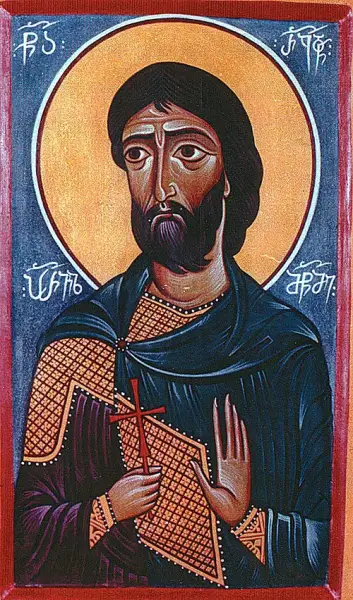
Overview
Razhden was a fifth-century Persian nobleman whose life crossed the frontier between the Sasanian and Georgian worlds. Entrusted with the care of Balendukht, a daughter of the Persian king, he accompanied the princess to Iberia when she married King Vakhtang I, and there he embraced the Christian faith and entered the king's service, where he distinguished himself as a soldier. During the war between Vakhtang and the Sasanids he fell into Persian hands and, when he would not renounce Christ, he was tortured and put to death around the year 457 at Tsromi. The earliest account of his martyrdom survives in the History of King Vakhtang Gorgasali, a medieval Georgian chronicle attributed to Juansher Juansheriani. In the 1720s the Georgian catholicos Besarion Orbelishvili recast the brief chronicle notice into a full hagiographic passion, recounting how Razhden freely returned to captivity after being allowed to visit his family and how he was crucified with criminals and pierced by arrows. The Georgian Orthodox Church numbers him among its saints as Razhden the Protomartyr, keeping his feast on August 16. King Vakhtang honored his burial place with the church of Nikozi and raised another church in his memory at Ujarma.
The Complete Life
A Persian Nobleman in a Foreign Court
Razhden came from the Persian nobility, a man of rank born within the Sasanian Empire whose name, of Iranian theophoric origin, may be read as meaning a happy religion, a composition in which the old word for creed or religion is joined to a root suggesting day, light, or happiness. The circumstances that carried him out of Persia belonged to the diplomacy of royal marriage. Balendukht, child of the Persian king, was bestowed as a bride to Vakhtang I of Iberia, and Razhden was appointed her guardian and tutor, the mamamdzudzu who had charge of her welfare on the journey and at the Georgian court. In this capacity he crossed the Caucasus into Iberia in the train of the princess, leaving behind the land and the religion of his fathers. The chronicle that preserves his story, the History of King Vakhtang Gorgasali, composed in the eighth or eleventh century and traditionally credited to Juansher Juansheriani, presents this transfer of allegiance as the doorway through which the Persian courtier entered Georgian history. Nothing more is recorded of his family or his early years in Persia, but his standing was evidently high enough to entrust him with a royal bride, and his abilities were soon to show themselves in a different kind of service.
§ History
Conversion and Service under King Vakhtang
Once settled in Iberia, Razhden converted to Christianity and entered the service of King Vakhtang, the restless ruler whose wars against the Sasanids dominate the chronicle that preserves his memory. The change of faith was no private sentiment. It bound the former Persian courtier to the Christian kingdom as a soldier, and he proved himself an able one, taking his place among the fighting men of a king who resisted Persian domination. The medieval source relates his later death precisely as a martyrdom within that struggle, the war of the Sassanids against Vakhtang, so that his military career and his witness to the faith cannot be separated: the same loyalty that made him a valued captain of the Georgian king made him a traitor in Persian eyes once his conscience belonged to Christ. In this his path followed the classic pattern of the warrior martyr, in which bodily courage in battle becomes spiritual courage under interrogation. The record is brief, but it shows a man who changed allegiance completely, exchanging religion, sovereign, and homeland, and who served his adopted king with a competence that the chronicler thought worth recording alongside the manner of his death.
§ History
Captivity, Torture, and Death at Tsromi
During the war between Vakhtang and the Sasanids, Razhden was taken captive by the Persians, and his faith became the charge against him. The fuller passion composed by Catholicos Besarion Orbelishvili in the 1720s, expanding the terse chronicle notice, relates that the king of the Persians pressed the prisoner in person to denounce his Christian faith. For a brief interval, through the mediation of Georgian nobles, Razhden was released to bid farewell to his family, and he chose of his own will to return to captivity, an act the hagiographer presents as a free surrender to martyrdom. He was then handed over to a Persian commander at Tsromi, in Iberia, where the sentence was carried out: he perished on a cross among five criminals, his body pierced with arrows. The chronicle's plainer account records that torture ended his life because he would not deny Christianity, and dates his death to about the year 457, on the third of August. The place of his suffering became the place of his burial, and there, at Tsromi, his body was laid in the earth of the country he had made his own.
§ Hagiography
Enrollment among the Saints
The Georgian Orthodox Church canonized Razhden and gave him a title that marks his singular rank in its calendar: Razhden the Protomartyr, the first martyr of the Georgian Church, honored under the name razhden pirvelmotsame. His feast is kept on August 16, corresponding to August 3 on the old calendar, the date associated with his death at Tsromi around 457. Veneration took architectural form within a generation of his death, for King Vakhtang built the church of Nikozi over the site of his burial and installed a bishop there, and the same royal chronicler records a second church raised in the saint's honor in the suburb of Ujarma. The liturgical memory of the saint was also served by poets: Besarion Orbelishvili, who recast the medieval narrative as a passion in the 1720s, composed a canon in his honor, and in the 1760s Catholicos Anton I included a rewritten account of his martyrdom in his collection of Georgian martyrdoms. Through these texts the protomartyr of the Georgians remained a living presence in the Church's worship long after the details of his life had faded from record.
§ History
Remembering the Protomartyr
The memory of Razhden reached the modern world through a chain of texts rather than a continuous cult. Its foundation is the notice in the History of King Vakhtang Gorgasali, a medieval Georgian historical compilation credited to Juansher Juansheriani, which records his death as a martyr in the Sasanid war. In the 1720s Besarion Orbelishvili transformed this brief narrative into hagiography, supplying the details of the Persian king's pressure, the farewell to family, the voluntary return to captivity, and the crucifixion at Tsromi, and composing a canon in the saint's honor. Anton I added a rewritten passion to his eighteenth-century collection of Georgian martyrdoms. Scholarly attention followed: Mikhail Sabinin gathered the sources into his account of the saint's life in the Paradise of Georgia, published at St. Petersburg in 1882, and in 1914 the Bollandist Paul Peeters translated the passion into Latin in the Analecta Bollandiana, carrying the Georgian protomartyr into the broader communion of hagiographic scholarship. Modern students of Georgian historiography, notably Stephen Rapp and Robert Thomson, cite him as a witness to the violent collision of Sasanid Persia and Christian Iberia, while the church of Nikozi, built over his grave, remains the enduring monument of his cult.
§ Hagiography
Timeline
- 3 Aug 457
Executed at Tsromi in Iberia after torture for refusing to deny Christianity.
§ History
- 1720
Catholicos Besarion Orbelishvili transforms the medieval chronicle notice into a full hagiographic passion.
§ The church of Nikozi
- 1760
Catholicos Anton I adds a retold passion of Razhden within his anthology of Georgian martyr accounts.
§ The church of Nikozi
- 1882
Mikhail Sabinin publishes his account of the saint's life in the Paradise of Georgia at St. Petersburg.
§ The church of Nikozi
- 1914
Paul Peeters publishes a Latin translation of Razhden's passion in the Analecta Bollandiana.
§ The church of Nikozi
In Their Own Words
its second component, -dēn, comes from Mid. Pers. dēn "creed, religion," while the first one is perhaps Ir. rōž/rōz "day, light, happiness," i.e., *Rōždēn- "happy religion."
The Record
- Patron of
- Protomartyr of the Georgian Church
- Symbols
- cross·arrows
- Canonization
- Canonized by the Georgian Orthodox Church as the Protomartyr of the Georgian Church
Prayer
Bibliography
Show 6 sources
- Machitadze, Archpriest Zakaria (2006), "St. Razhden, Protomartyr of the Georgian Church (†457)", in The Lives of the Georgian Saints. pravoslavie.ru.
- Rapp, Stephen H. (2003), Studies in Medieval Georgian Historiography: Early Texts And Eurasian Contexts, p. 226. Peeters Publishers, ISBN 90-429-1318-5.
- Thomson, Robert W. (1996), Rewriting Caucasian History, pp. 217, 220. Oxford University Press, ISBN 0-19-826373-2.
- Chkeidze, Thea (2001). "GEORGIA v. LINGUISTIC CONTACTS WITH IRANIAN LANGUAGES". Encyclopaedia Iranica, Vol. X, Fasc. 5. pp. 486–490.
- Khoperia, Lela (2010). Razhden the Protomartyr. Georgian Historical Figures, Georgian National Center of Manuscripts.
- Peeters, Paul (1914), "Mensis augusti die III. Passio et certamen sancti megalomartyris Razden, qui tempore magni regis Vakhtang a Persis passus est in Hiberiae pago Dsromi". Analecta Bollandiana 33: 305–317.
Profile text adapted from the Wikipedia article, licensed CC BY-SA 4.0.
Pray with this saint every day
Save St. Razhden the Protomartyr to your favorites, read the full profile, and get feast-day reminders in the Saints app.
Get the Saints AppFree on the App Store for iPhone and iPad