
d. 251 (or 286)·Feast September 7
St. Regina of Autun
Virgin martyr of Alesia, patroness of shepherdesses
Overview
Regina, in French Sainte Reine, was a third-century virgin martyr whose story belongs to the earliest generations of Gallic Christianity. Born at Autun to a pagan father named Clement, she lost her mother at the moment of her birth, and her father placed the infant with a Christian nurse, who baptized her. Reared in the faith by this arrangement, she kept her father's sheep and gave herself to prayer, communing with God and meditating on the lives of the saints. At fifteen she attracted the attention of the proconsul Olybrius, who sought her as his bride. Because she would not renounce her faith to marry him, she was tortured and at last beheaded at Alesia, within the diocese of Autun, a place afterwards called Alise-Sainte-Reine in her honor. Tradition dates her martyrdom either to the persecution of Decius around 251 or to the reign of Maximian around 286. Her memory was preserved in many martyrologies, her relics were solemnly transferred to Flavigny Abbey in 864, and the village that bears her name keeps an annual August procession and performance of the Mystery of Sainte Reine, a custom reaching back to the ninth century.
The Complete Life
A Christian Nurture in a Pagan House
Regina was born at Autun in the third century, child of a pagan father named Clement. Her mother perished at the very hour of her birth, leaving the child motherless in a household without the faith. Clement, though a pagan, placed his infant daughter with a Christian nurse, and it was this woman who baptized her and brought her up in the Christian religion. The arrangement determined the whole course of the child's life: outside her father's house she received the sacrament and the teaching of the Church, while within it she remained her father's daughter. As she grew she helped by tending the sheep, a task that left her long hours among the fields and flocks of the Autun countryside. She was not idle in spirit during those hours. Prayer was her constant commerce with God, and she pondered the deeds of the saints, forming her own desires on the examples of those who had suffered for Christ. Thus the girl who had been given to a Christian nurse by a father who did not believe became, by that providential placement, a wholly consecrated soul, poor in goods but rich in the practice of prayer and in the memory of the martyrs who had gone before her.
§ Veneration
The Refusal of Olybrius
The crisis of Regina's life came when she was fifteen years old. The proconsul Olybrius sought her hand, and she was betrothed to him, an alliance that would have joined the daughter of a humble pagan of Autun to one of the most powerful officials of the Roman administration in Gaul. The prospect of such a marriage, however, carried a condition the young woman could not accept: to become the proconsul's wife she was required to renounce her Christian faith. She refused. The betrothal dissolved into prosecution, and the magistrate whose suit she had declined became her persecutor. In her refusal, the resolution formed during her years of prayer among the sheepfolds showed itself at once. She had meditated on the lives of the saints, and now she was called to join their number; she had communed with God in the fields, and now that communion was to be tested in a courtroom and a prison. The account of her passio makes the choice turn entirely on the faith: it was not the marriage as such she rejected but the apostasy it demanded, and for that refusal, and nothing else, she was handed over to torture.
§ Veneration
Torture and Beheading at Alesia
Because Regina would not renounce her faith to marry the proconsul Olybrius, she was put to torture, and when the torments failed to break her constancy her head was struck off at Alesia, within the diocese of Autun. Tradition has never fixed the year with certainty: her martyrdom is placed either during the persecution of Decius, around the year 251, or under Maximian, around 286, both of them times when the profession of Christianity in Gaul could cost a believer her life. In the memory of the Church she is honored as a virgin and martyr, and iconography depicts her in two aspects: undergoing the torments of her passion, or comforted in her cell by the sight of a dove settling on a luminous cross, the sign that her sufferings were received and that the strength to endure them was given. The place of her execution did not forget her. Alesia itself came to be called Alise-Sainte-Reine, bearing the name of the young shepherdess who died there, and the village remains to this day the center of her remembrance in the land of her birth.
§ Veneration
A Martyr of the Ancient Church
Regina belongs to the company of martyrs canonized by the acclaim of the Church before any formal process existed; her sanctity was recognized by her inclusion in the martyrologies, the registers in which the dates and places of the martyrs' witness were handed down for liturgical commemoration. She is honored in many martyrologies, and her feast is celebrated on September 7 throughout the Latin Church, while in the Archdiocese of Paderborn in Germany her memory is kept on June 20, a double observance that shows how far her cult traveled from the soil of Burgundy. In the past a procession walked in her honor through the streets of Dijon, a civic testimony that her cult was not confined to rural shrines. Her relics, the tangible focus of her veneration, were transferred to Flavigny Abbey in the year 864, a solemn translation that ensured the saint's remains would be honored at a great religious house near the place of her martyrdom. The history of this translation was itself the subject of a ninth-century account, evidence that the movement of her relics was an event significant enough to be recorded in its own literary genre, and that the faithful of the region wished to know precisely how their patroness had come to rest where they venerated her.
§ Veneration
The Living Memory of Sainte Reine
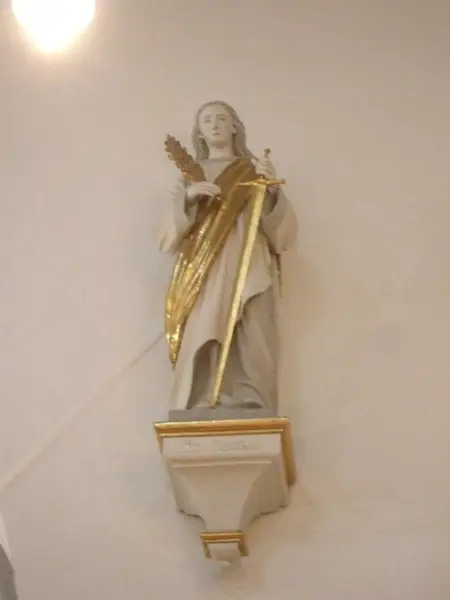
Few saints of ancient Gaul have left so visible a mark on a landscape as Regina. The village of Alise-Sainte-Reine, the Alesia of her martyrdom, commemorates her each August: the faithful walk from Flavigny to Sainte-Reine, and afterward the Mystery of Sainte Reine is staged, a drama that retells her passion staged in her honor. The tradition is held to date back to the year 866, and it has endured across more than a millennium to become a cultural event of the whole region, drawing the surrounding countryside into an annual act of remembrance. Nor is this the only geography she commands: many places across France bear the name Sainte-Reine from her, villages and sites scattered and sites that carry her name across the country. In the Church's life she remains a patron of the humble and the afflicted, invoked against poverty and impoverishment, honored as the protector of shepherdesses in memory of the flocks she tended, and appealed to by torture victims, who find in her endurance under the torments of Olybrius a companion in their own trials. Her statue watches over churches dedicated to her, including one at Drensteinfurt, where she stands as the girl of Autun who would not trade her faith for a crown.
§ Veneration
Timeline
- 251
Beheaded at Alesia after torture; tradition alternatively places her martyrdom around 286 under Maximian.
§ Veneration
- 864
Her relics are transferred to Flavigny Abbey.
§ Veneration
- 866
The annual August procession and mystery play at Alise-Sainte-Reine is traditionally held to date from this year.
§ Veneration
The Record
- Patron of
- against poverty·against impoverishment·shepherdesses·torture victims
- Symbols
- experiencing the torments of martyrdom·receiving consolation in prison by a vision of a dove on a luminous cross
- Canonization
- Pre-congregation virgin martyr, honored in many martyrologies since late antiquity
Prayer
Bibliography
Show 6 sources
- Archdiocese of Regina – Ask a Sister.
- Masters, Ed. "Saint Regina, Martyr", Regina Magazine.
- Butler, Alban. "St. Regina, or Reine, Virgin and Martyr", The Lives of the Saints. 1866.
- Walsh, Michael J., A New Dictionary of Saints, Liturgical Press, 2007, p. 511, ISBN 9780814631867.
- Semk, Christopher. Playing the Martyr: Theater and Theology in Early Modern France, Bucknell University Press, 2017, p. 9, ISBN 9781611488043.
- Wood, James, ed. (1907). "Regina, St.". The Nuttall Encyclopædia. London and New York: Frederick Warne.
Profile text adapted from the Wikipedia article, licensed CC BY-SA 4.0.
Pray with this saint every day
Save St. Regina of Autun to your favorites, read the full profile, and get feast-day reminders in the Saints app.
Get the Saints AppFree on the App Store for iPhone and iPad