
4th century·Feast October 17
St. Regulus
Carrier of St Andrew's Relics to Scotland
Overview
Regulus, known in Scots as Saint Rule and in Old Irish as Ríagal, is remembered as the monk or bishop of Patras who, according to legend, carried the relics of the Apostle Andrew from Greece to Scotland. The surviving accounts agree on little about his life, but the story they tell became one of the founding legends of the Scottish church. In the year 345, so the tradition runs, an angel warned him in a dream that the emperor Constantine meant to remove Saint Andrew's bones from Patras to Constantinople, and Regulus was commanded to carry as many of them as he could to the western edge of the world and there raise a church in the apostle's honor. Accompanied by consecrated virgins, among them Saint Triduana, he sailed until he was shipwrecked — or directed by the angel to land — on the shores of Fife at the Pictish settlement of Kilrymont, the future St Andrews. There he deposited relics of the apostle: three fingers of the right hand, an upper arm bone, a kneecap, and a tooth. The church of St Regulus at St Andrews, raised around 1070 to house the relics, and the spread of the saint's fame in the wars of Scottish independence made the legend a pillar of Scotland's religious and national identity.
The Complete Life
A Monk or Bishop of Patras
The earliest accounts disagree about nearly every particular of Regulus's life, including whether he was a simple monk or the bishop of his city, but all place him at Patras, the Greek port on the Gulf of Corinth where the Apostle Andrew was said to have been crucified and buried. Patras then formed part of the Roman Empire, and its shrine of the apostle drew the devotion of the whole Christian east. In such a place the guardianship of relics was no small office, and the legend presents Regulus as a man charged with precisely that trust. Whether monk or bishop, he stood within the clergy responsible for the apostle's tomb in the middle of the fourth century. The several versions of his story differ in their details — later retellings even multiplied the dangers, adding that Constantine was on the point of invading Patras itself — but the figure at their center is constant: a Greek churchman whose life was overturned by a dream, and who accepted without argument a commission that would carry him from the warm waters of the Peloponnese to the cold shore of the Pictish north. Whatever the history behind the tale, the Regulus of the tradition is a man defined by a single act of obedient custody.
§ Biography
The Voyage to the Ends of the Earth
The angel's message, as the legend tells it, came in a visionary dream in the year 345. The emperor Constantine had resolved to translate the relics of Saint Andrew from Patras to his new capital at Constantinople; for their safekeeping, Regulus was to take as many of the bones as he could carry to the western ends of the earth and there found a church in the apostle's name. He obeyed. Sailing with him went a company of consecrated virgins, among whom the tradition numbers Saint Triduana, herself afterward honored in Scotland. The voyagers were carried, by shipwreck in one telling and by the angel's explicit command in another, to the coast of Fife, to the spot called Kilrymont, a settlement of the Picts that would one day be known as St Andrews. There the stories place them at the court of the Pictish king Óengus I, who welcomed the stranger and his treasure — though the king remembered by history reigned in the eighth century, a sign of how the legend gathered and rearranged its material over the centuries. The relics Regulus was said to have deposited were specific and bodily: three fingers of the apostle's right hand, one of the upper arm bones, a single kneecap, and a tooth. On that ground, the tradition holds, the apostle's cult took root in Scotland.
§ Biography
The Apostle of Scotland
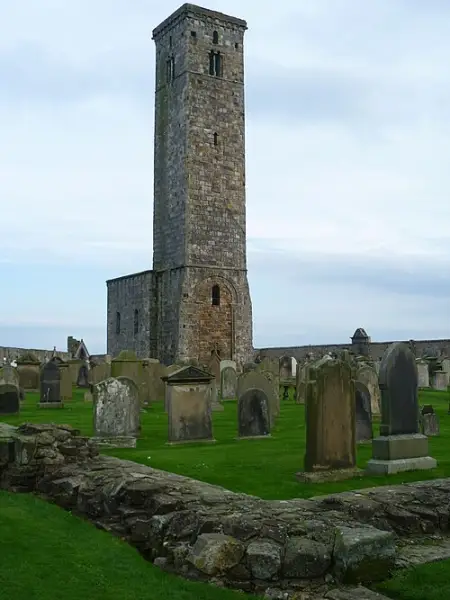
The consequences of the Regulus legend reached far beyond the shrine at Kilrymont. Around 1070, Robert I — then prior at St Andrews — raised the church of St Regulus to shelter the relics the Greek visitor was believed to have brought, and its great tower — rising 33 metres, known to the town as St Rule's tower — stood for centuries as a beacon for the pilgrims who streamed toward the apostle's shrine. In the later Middle Ages the story acquired a political weight its first tellers can scarcely have imagined. Scottish kings, nobles, and churchmen promoted it from the twelfth century onward at a time when Scottish independence trembled under English pressure and the Scottish church was fighting a claim to primacy from the archbishop of York. The tale of Andrew's fourth-century choice of Scotland gave the Scots a patron apostle, an identity distinct from England, and a foundation date for their church centuries older than those of England or Ireland. During the wars of independence the legend helped persuade Pope Boniface VIII to issue the bull of 1299 demanding that Edward I cease his war. It shaped the saltire on Scotland's flag and the standing of the archdiocese of St Andrews; at the university to this day, St Regulus Hall keeps the carrier's name alive.
§ Legacy
Timeline
- 345
Warned in a visionary dream by an angel that Constantine would remove Saint Andrew's relics from Patras, Regulus was commanded to carry them to the ends of the western world.
§ Biography
- 345
He set out on his voyage with a company of consecrated virgins, among them Saint Triduana, bearing the apostle's bones for safekeeping.
§ Biography
- 345
Shipwrecked, or halted by the angel's word, on the Fife coast at Kilrymont, he was welcomed by the Pictish king Óengus I and deposited the relics of Saint Andrew there.
§ Biography
- 1070
Robert I, Prior of St Andrews, built St Regulus Church to house the relics Regulus was said to have brought; its 33-metre tower, St Rule's tower, became a landmark for pilgrims.
§ Legacy
- 1299
During the wars of Scottish independence the Regulus legend was used to persuade Pope Boniface VIII to issue a bull demanding that Edward I of England end his war against Scotland.
§ Legacy
The Record
- Major works
- The foundation of a church dedicated to St Andrew at Kilrymont (St Andrews)
- Patron of
- the city and church of St Andrews·the Scottish church's apostolic claims
- Symbols
- a bishop bearing a reliquary·a ship·the relics of Saint Andrew
- Canonization
- Pre-congregation; a legendary figure whose cult is attested in the Aberdeen Breviary and by the medieval church of St Andrews
Prayer
Bibliography
Show 4 sources
- "Different versions of Rule legend". Archived from the original on 24 May 2008. Retrieved 15 February 2013.
- "Scottish churches - st rules". Retrieved 15 February 2013.
- "Historic scotland guide" (PDF). Retrieved 15 February 2013.
- "National archives on St Regulus". Archived from the original on 16 September 2013. Retrieved 16 February 2013.
Profile text adapted from the Wikipedia article, licensed CC BY-SA 4.0.
Pray with this saint every day
Save St. Regulus to your favorites, read the full profile, and get feast-day reminders in the Saints app.
Get the Saints AppFree on the App Store for iPhone and iPad