
c. 630 – c. 680·Feast July 16
St. Reineldis
Recluse and martyr of Saintes in Brabant
Overview
Reineldis, born around 630 and martyred around 680, was a saint of the seventh century whose blood, by tradition, gave the Belgian town of Saintes its name. She was born into one of the great Christian families of the Low Countries, the daughter of Duke Witger of Lotharingia and of Saint Amalberga of Maubeuge, and grew up among holy siblings: her brother Emebert was a priest of the diocese of Cambrai, and Pharaildis, Gudula, and Ermelinde were likewise numbered among the saints. Her mother withdrew from the world into religious life at Maubeuge Abbey. Reineldis herself undertook the arduous pilgrimage to the Holy Land, a journey recorded in her vita, written at Lobbes Abbey between 1048 and 1051, which states that she visited Jerusalem. On her return she settled at Saintes near Hal in Brabant, where she built herself a cell and lived as a recluse, devoting herself, as other sources relate, to charitable works. When raiders invaded the country and the people fled, she kept her place at the altar beside deacon Grimoald and her servant Gondulf. The raiders forced their way in the chapel, dragged her from the altar by her hair, and beheaded her on July 16, together with her two companions. She is venerated at Saintes as the town's patron saint.
The Complete Life
Born into a Holy Household
Reineldis was born around the year 630 at a place called Condacum, identified by scholars either with Condé-sur-l'Escaut or with Kontich. Her birth placed her at the center of one of the most remarkable Christian families of seventh-century Lotharingia. Her father was Duke Witger of Lotharingia, a nobleman of the highest rank, and her mother was Amalberga of Maubeuge, herself honored as a saint, who in time withdrew from her family into the religious life at Maubeuge Abbey. Holiness marked the children as it marked the mother. Reineldis's brother Emebert served as a priest in the diocese of Cambrai and was venerated as a saint in his turn, and her sisters were Pharaildis, Gudula, and Ermelinde, names that the Church of the Low Countries also keeps among its saints. The girl thus grew up with the example of consecrated parents and saintly siblings before her eyes, in a household where the faith of Christ was both inheritance and vocation. From such a family came the woman who would one day walk as a pilgrim to Jerusalem and die as a martyr at a Brabantine altar.
§ Life
Pilgrim and Recluse
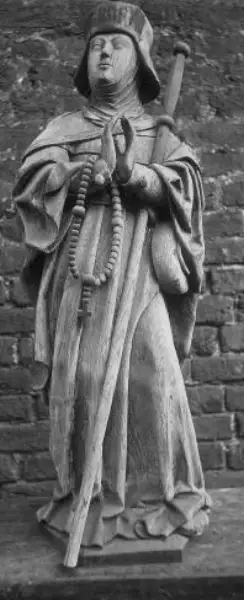
The defining act of Reineldis's mature life was a pilgrimage to the Holy Land. Her vita, composed at Lobbes Abbey between 1048 and 1051, records the fact and states plainly that she visited Jerusalem, a journey of extraordinary difficulty for a woman of the seventh century and a testimony to the depth of her devotion to the places of Christ's life and passion. Her artists remembered her for it: she is portrayed as a pilgrim because of that journey, staff in hand. Having returned home from the Holy Land, she did not resume a life in the world. Sources relate that she built herself a cell at Saintes, near Hal in Brabant, though another tradition sets this dwelling at Xanten, and within it she lived enclosed as a recluse, cut off from the society she had left behind. Other accounts picture her rather as giving herself to works of charity at Saintes, caring for the needs of the living rather than withdrawing from them. The two testimonies, whichever is preferred, agree in the essentials: after Jerusalem, Reineldis gave what remained of her life to God at Saintes, in hidden prayer or in active mercy.
§ Life
Martyrdom at the Altar
The death of Reineldis came with the invasion of the country by the Frisians or the Huns, wild heathen raiders whose coming emptied the countryside. All the people fled, but the recluse of Saintes stayed behind, alone but for the deacon Grimoald and her servant Gondulf. When the raiders reached the chapel, those gathered at the altar waited there for death instead of fleeing to safety. The heathens forced the church doors, wrenched Reineldis away from the altar she would not leave, and hauled her across the church floor by her hair. There, on July 16, around the year 680, she was beheaded at Saintes, together with the deacon Grimoaldus and Gondulphus, who died at her side. Her clinging to the altar as she was dragged became the image by which later generations knew her, for iconographers depict her dragged by the hair as well as with the sword of her beheading. She had gone as a pilgrim to the places where the first martyrs died, and she ended her days as a martyr herself, killed at the very altar where she had made her last prayer.
§ Life
The Saint of Saintes
Reineldis was honored as a martyr from the generation that buried her, and her cult took root in the town of her death, which tradition says owes its very name to her: Saintes, the town of the saint. She is venerated there primarily as the patron saint of the place, and her feast is kept on July 16, the day of her martyrdom. Her relics remain the treasure of the parish, for the church of Saintes has borne the dedication of Sainte-Renelde from medieval times and still guards the relics of the saint through the centuries; its great bell tower was raised in the sixteenth century above the church of the martyr. Her reliquary is kept at Hal, near the Saintes of her cell and her passion, so that two towns of Brabant share the care of her remains. The memory of her holiness also flowed into the earth: a well at Saintes known as Sainte Renelde's well has long been believed to cure diseases of the eyes, and to this association the saint owes her particular patronage against eye ailments, together with her invocation for the healing of open wounds, the wounds the raiders' cruelty inflicted.
§ Veneration
Memory in Stone, Water, and Paint
The legend of Reineldis has left its traces across the landscape of Brabant and in the history of its art. Her vita, written at Lobbes Abbey between 1048 and 1051, fixed the outline of the pilgrim and martyr for later centuries and secured her place in the Acta Sanctorum, where her passion was printed among the acts of the saints of July. In art she appears under several aspects: with the sword that beheaded her, dragged by the hair from the altar as the barbarians tore her away, or as a pilgrim with a staff in memory of the Holy Land. Around 1530 the painter known as the Master of Elsloo portrayed her as a pilgrim to Jerusalem, a vision of the noblewoman who crossed the world for the sake of the holy places. At Saintes itself the memory is written in stone and water: the Saint Reineldis church, standing since the sixteenth century, and the Saint Reineldis fountain, erected in 1861, keep her name before the town, while Sainte Renelde's well still draws those who seek the healing of their eyes from the saint who died beside the altar of her Lord.
§ Veneration
Timeline
- 630
Born at Condacum, a place identified variously with Condé-sur-l'Escaut or with Kontich.
§ Life
- 16 Jul 680
Dragged from the altar and beheaded at Saintes with deacon Grimoald and her servant Gondulf.
§ Life
- 1048
Her vita, recording her pilgrimage to Jerusalem, is written at Lobbes Abbey between 1048 and 1051.
§ Life
- 1530
The Master of Elsloo paints Saint Reineldis as a pilgrim to the Holy Land.
§ Iconography
- 1861
The Saint Reineldis fountain is erected at Saintes.
§ Iconography
The Record
- Major works
- recluse's cell at Saintes
- Patron of
- against open wounds·against eye diseases·patron saint of Saintes
- Symbols
- sword·pilgrim's staff·dragged by the hair
- Canonization
- Pre-congregation martyr, venerated at Saintes since the early middle ages
Prayer
Bibliography
Show 6 sources
- Katholic Norway website, Saint Emebert of Cambrai-Arras.
- The Lives of the Saints by Rev. S. Baring-Gould, page 116, Gutenberg website.
- Vita Reineldis, Acta Sanctorum, Julii IV, 173–178.
- Rabenstein, Katherine (July 1998). "Reineldis". Saints O' the Day for July 16.
- "Tubize". Communes of Brabant Wallon. Expatriate Online: Your Bookmark to Belgium.
- Husenbeth, Frederick Charles. Emblems of Saints: By which They are Distinguished in Works of Art, Longman, Green, Longman, and Roberts, 1860, p. 140.
Profile text adapted from the Wikipedia article, licensed CC BY-SA 4.0.
Pray with this saint every day
Save St. Reineldis to your favorites, read the full profile, and get feast-day reminders in the Saints app.
Get the Saints AppFree on the App Store for iPhone and iPad