
died ca. 960·Feast January 7
St. Reinold
Benedictine monk and martyr of Cologne
Overview
Reinold, honored also as Reinoldus or Reinhold of Cologne, was a Benedictine monk of the tenth century who died a martyr at the hands of his fellow workmen around the year 960. Romance made him a prince: he was reputed to descend directly from Charlemagne, counted as the fourth son celebrated in the romantic poem Duke Aymon, William Caxton's rendering of the old French chanson de geste Les Quatre Fils Aymon, whose hero Renaud de Montauban dies in an almost identical manner. The monk of history took up religious life at the Benedictine monastery of Pantaleon in Cologne, where he was set over a building project then underway in the abbey. He labored alongside the stonemasons and at times outdid them at their own craft, and this excellence provoked the deadly resentment of the very men with whom he worked: they beat him to death with hammers and committed his body to a pool near the Rhine. The remains were afterwards found through divine means, and the martyr became the patron saint of stonemasons, the patron of the city of Dortmund, where the church of St. Reinold stands dedicated to his name. He is venerated by Roman Catholics and Lutherans alike, with his feast on January 7.
The Complete Life
A Prince's Legend, a Monk's Habit
The memory of Reinold joins two very different worlds: the cloister of tenth-century Cologne and the heroic romance of the Carolingian age. Tradition gave him a lineage drawn from legend, tracing his line straight back to Charlemagne and naming him the fourth son of the romantic poem Duke Aymon, Caxton's translation of the long French chanson de geste Les Quatre Fils Aymon; in that poem the hero Renaud de Montauban dies in an almost identical manner, and the echo between the romance and the saint's martyrdom has fascinated readers since Caxton printed the story in 1489. The monk of history is simpler to see. Reinold made his entry into religious life at the Benedictine monastery of Pantaleon in Cologne, among the great religious houses of that city, and was there appointed to direct a building project underway in the abbey. He did not direct the works from a distance: he often joined the stonemasons in their labor, and at times he surpassed them in their own craft. The aristocrat of legend thus lived in fact as a working religious, his hands busy with the stone of his monastery's church.
§ References
Murdered by His Fellow Workmen
The excellence that made Reinold valuable to his abbey made him fatal company for the masons with whom he worked. The account of his death describes the event as unsavoury: the stonemasons among whom he labored, at times outdone by the monk who should have been only their overseer, rose against him and murdered him. He was beaten to death with hammers, the tools of the trade he had mastered, and his body was deposited in a pool near the Rhine, hidden where his killers hoped it would never be found. But the body was later found through divine means, and the discovery of the martyr's remains turned the crime into the seed of a cult. The manner of his death fixed his patronage forever: because the monk-builder died at the hands of masons, the Church came to invoke Reinold as the patron saint of stonemasons, turning the envy of his killers into an intercession for the very craft in which he died. His martyrdom is dated to around the year 960, and his memory as a martyr has endured for more than a millennium.
§ References
Patron of Dortmund and of Masons
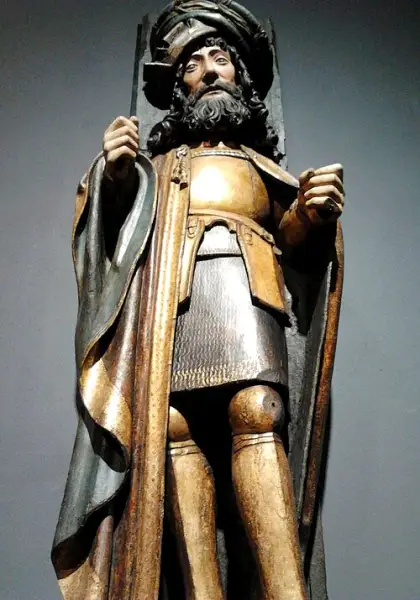
The veneration of Reinold took root most deeply in Westphalia, in the city of Dortmund, of which he became the patron saint. The church of St. Reinold in Dortmund stands dedicated to his name, bearing the martyr at the heart of the city's religious and civic identity. In the calendar his feast is kept on January 7, and his figure is recognized in art by the arms of a warrior, in body armor and holding a shield, a reminder of the descent from Charlemagne that legend assigned him even as history remembered him in a monk's habit. Unusually for a saint of the early German church, his cult crosses the confessional divisions of the Reformation: he is venerated in the Roman Catholic Church and honored also in the Lutheran Church, which retained the memory of local saints bound up with the civic life of its cities. For the guilds of his craft he remains the exemplar of the honest workman whose skill provoked hatred and whose fidelity was crowned by martyrdom, the mason of Pantaleon who built with his hands and finished his building with his blood.
§ References
Timeline
- 960
Beaten to death with hammers by stonemasons and his body deposited in a pool near the Rhine.
§ References
- 1489
William Caxton's English version of the romance of Aymon's four sons appears in print, the poem that names Reinold among them.
§ Notes
The Record
- Patron of
- stonemasons·patron saint of the city of Dortmund
- Symbols
- body armor·holding a shield
- Canonization
- Pre-congregation martyr venerated by Catholics and Lutherans
Prayer
Bibliography
Show 2 sources
- "St. Reinold". Catholic Online.
- "The right plesaunt and goodly historie of the foure sonnes of Aymon", Caxton, 1489. Corpus of Middle English Prose and Text.
Profile text adapted from the Wikipedia article, licensed CC BY-SA 4.0.
Pray with this saint every day
Save St. Reinold to your favorites, read the full profile, and get feast-day reminders in the Saints app.
Get the Saints AppFree on the App Store for iPhone and iPad