
c. 600 – 664·Feast September 3
St. Remaclus
Missionary Bishop and Abbot of Stavelot-Malmedy
Overview
Remaclus was a Benedictine missionary bishop of the Merovingian kingdom of Austrasia, remembered chiefly as the father of the great double abbey of Stavelot-Malmedy. Reared at the ducal court of Aquitaine and formed in sacred learning by Sulpitius the Pious, bishop of Bourges, he took the monastic habit at Luxeuil in 625 and in due course was ordained a priest. When Eligius established Solignac Abbey around 631 he sent for monks from Luxeuil and set Remaclus over the new house as its first abbot; under his government the community won fame for its silversmiths. Raised further to the abbacy of Cougnon, he won the confidence of King Sigebert III of Austrasia, whose adviser he became, and persuaded the king to plant the monasteries of Malmedy and Stavelot in the Ardennes. In 650, when Amandus laid down the bishopric of Maastricht to return to the missions, Remaclus was chosen to govern the troubled see in his place. For about twelve years he shepherded a diocese in which earlier bishops had met violent deaths, spread monastic life through the region, and trained holy disciples, among them Trudo, Babolen, Theodard, and Lambert. Weary of office, he withdrew to Stavelot about 662 and died there in 664; his relics rest in the church of St Sebastian in that town.
The Complete Life
A Noble Youth of Aquitaine
Remaclus grew to manhood at the ducal court of Aquitaine, a household of rank and influence in the Frankish south. There he received the education of a young man of standing, but the decisive figure of his youth was Sulpitius the Pious, bishop of Bourges, under whom he studied. Formation at the hands of such a churchman set the courtier's son on a different path from the one his birth had marked out. The schools of Bourges stood close to the great monastic currents of the seventh century, and the rigor of Luxeuil, the most demanding observance of the age, reached far into Aquitaine and Burgundy. In 625 Remaclus left the world of the dukes for the cloister, taking the habit at Luxeuil, where the community prayed and worked under a rule of unflinching severity. There he was found worthy of priesthood, and there he acquired the formation that would make him, in time, a founder of monasteries and a bishop. His later gentleness toward a violent diocese suggests a man long practiced in self-denial, formed first as a disciple before he was ever asked to be a father to others.
§ Life
Monk of Luxeuil, Abbot of Solignac
Around 631 Eligius, the goldsmith-saint and royal adviser, founded the abbey of Solignac and called for monks from Luxeuil to populate it. Among those who answered was Remaclus, and Eligius appointed him the house's first abbot. The new foundation followed the usage of Luxeuil, and it flourished quickly: Audoin, who recorded the enterprise, wrote of its rapid rise to importance. Solignac became especially celebrated for its workshop of silversmiths, a craft Remaclus's own founder had mastered, and the abbey's artistic and spiritual output made it a fixture of monastic Gaul. His success there marked him for further responsibility, and Cougnon Abbey, in the duchy of Luxembourg, was soon entrusted to him as well. Ruling two houses rooted him in the monastic civilization of the Ardennes and the Meuse country, and it brought him to the attention of the court of Austrasia. The abbot who could make a young community prosper was exactly the man a young king would want at hand, and Remaclus's vocation now widened from the government of monks to the shaping of a whole frontier region of the Church.
§ Life
Founder, Counselor, Bishop
Remaclus served as an adviser to Sigebert III of Austrasia, and the king proved willing to hear him on the great work of his life. At his urging the king founded the twin houses of Malmedy (648) and Stavelot (650) deep in the Ardennes forest over which Remaclus ruled as abbot. Then, in 650, Amandus, the aging bishop of Maastricht, resigned his see to resume missionary preaching, and Remaclus was appointed in his place. He brought with him Hadelin, abbot of Visé, as a companion in the work. The diocese was no easy charge: its inhabitants had murdered some of his predecessors. Yet Remaclus pacified and evangelized the region, spreading monasticism through the Meuse country as no one before him had done. He became the spiritual teacher of a whole generation of saints, among them Trudo, Babolen, Theodard, and Lambert, the last of whom would himself die a martyr's death in the same turbulent territory. Under his government the Ardennes frontier, until then a graveyard of bishops, began to be known instead as a garden of monasteries and disciples. The man who had governed monks now governed a diocese, but the method was the same: gather disciples, build houses of prayer, and let the example of a lived faith do what force could not.
§ Life
The Wolf and the Springs
The affection of the people among whom Remaclus worked expressed itself in legends that say as much about his character as any chronicle. Popular tradition gave him a wolf for a companion, and told how the saint would drive off the devil, who wanted to destroy the churches newly raised in the forest country. With his staff, it was said, he discovered springs whose waters the faithful have ever since esteemed as healing. The imagery is plain enough: the wolf stands for the taming of a wild region and a wild temper of the times, the vanquished devil for the peril that hung over young foundations, and the springs for the hidden sources of grace a holy pastor opens for his people. His real spirituality showed itself in the men he formed. Trudo, Babolen, Theodard, and Lambert learned from him a monastic Christianity hardy enough to survive in a lawless land, and the double monastery he governed became the school from which the Ardennes was renewed. The calm with which he met a diocese that had killed his predecessors was the fruit of a life ordered entirely toward God.
§ Life
Laying Down the Staff
Remaclus bore the burden of the see of Maastricht for twelve years. When he judged the work done, he resigned the bishopric in favor of Theodard, his own student and the abbot who succeeded him at Stavelot-Malmedy, and withdrew about 662 to the monastery he loved best. The retirement was no idleness: at Stavelot he remained the father of the monks, the living link between the houses he had founded and the region they served. He died at Stavelot in 664, and the community that buried him soon honored him among its saints. His relics lie in the church of St Sebastian in the town, where they have drawn pilgrims for well over a thousand years. Of all his choices, the last may have been the most instructive: the man who had declined nothing when duty called also knew how to set office down when his work was accomplished, leaving a successor trained in his own school to carry the mission forward. The quiet close of so active a career did not go unremarked. The monks who buried him regarded their founder's death as the seal on a life of labor, and the diocese he had tamed remembered the bishop who had left it in peace rather than in strife. Villages that had known his preaching kept his name; the monasteries kept his rule and his memory; and within a short time his grave at Stavelot was a place of prayer for the people of the Ardennes, who came to him after death as they had come to him in life, seeking a father's help.
§ Life
Memory in the Ardennes and Beyond
Remaclus's feast is kept on September 3, and with it endures a charming piece of country folklore: if rain falls on that day, it is taken as a good sign, because as much grain will sprout from the earth as raindrops fall upon the field. His cult spread through the Ardennes, the Eifel, and the Moselle valley, where a number of churches are dedicated to him, among them the parish church of Cochem in Germany; dedications also stand in the Belgian, Luxembourg, and French Ardennes. The abbeys of Stavelot-Malmedy themselves survived as princes of the Empire until the French Revolution swept them away, but the memory of their founder outlived the institutions. In 1950 the Priory of St Remaclus was established at Wavreumont, between Stavelot and Malmedy, restoring monastic life to the hills where he had planted it thirteen centuries before. Few missionaries of the Merovingian age can show so continuous a local remembrance: the wolf, the springs, the rain of September, and the monasteries of the Ardennes all keep his name alive. What began as local gratitude at his grave became a geography of devotion: dedications multiplied along the Meuse and the Moselle, in the uplands of the Eifel, and across the Ardennes on both sides of the modern borders, wherever monastic culture he had planted bore further fruit. His cult also traveled with the devotion of the region's people to the towns where they settled, so that his name is found on churches far from any place he is known to have visited.
§ Life
Timeline
- 625
Enters monastic life as a Benedictine at Luxeuil Abbey, where he is later ordained a priest
§ Life
- 631
Sent from Luxeuil by Eligius to Solignac Abbey, of which he becomes the first abbot
§ Life
- 648
Persuades King Sigebert III of Austrasia to establish the double monastery of Malmedy
§ Life
- 650
The monastery of Stavelot is founded, and Remaclus serves as abbot of Stavelot-Malmedy
§ Life
- 650
Appointed Bishop of Maastricht in place of Amandus, who resigns the see for missionary work
§ Life
- 662
Resigns the bishopric in favor of his student Theodard and retires to Stavelot
§ Life
- 664
Dies at Stavelot, where his relics later rest in the church of St Sebastian
§ Life
The Record
- Major works
- Solignac Abbey, of which he was the first abbot·Malmedy Abbey, co-founded in 648·Stavelot Abbey, co-founded in 650
- Patron of
- Parish churches dedicated to him in the Eifel, Moselle, Belgian, Luxembourg, and French Ardennes regions
- Symbols
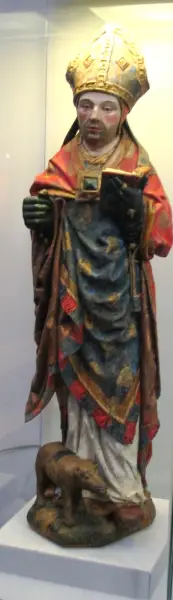
- Accompanied by a wolf·Abbot's staff, with which he is said to have found healing springs
- Canonization
- Pre-congregation; venerated since the early Middle Ages at Stavelot and Malmedy
Prayer
Bibliography
Show 5 sources
- Havard, Henry. Histoire de l'orfèvrerie française. Paris: Librairies-imprimeries réunies, 1896, p. 69
- Butler, Alban. "St. Amandus, Bishop and Confessor", The Lives of the Saints, Vol. III, 1866
- Watkins, Basil. "Theodard of Maastricht", The Book of Saints, Bloomsbury Publishing, 2015
- Butler, Alban. "Saint Remaclus, Bishop of Maestricht, Confessor". Lives of the Fathers, Martyrs, and Principal Saints, 1866. CatholicSaints.Info, 27 August 2014
- Monks of Ramsgate. "Remaclus". Book of Saints, 1921. CatholicSaints.Info, 2 September 2016
Profile text adapted from the Wikipedia article, licensed CC BY-SA 4.0.
Pray with this saint every day
Save St. Remaclus to your favorites, read the full profile, and get feast-day reminders in the Saints app.
Get the Saints AppFree on the App Store for iPhone and iPad