
c. 437 – 533·Feast January 13 (October 1, translation of relics)
St. Remigius
Apostle of the Franks, Bishop of Reims
Overview
Remigius, known in French as Remy or Rémi, governed the see of Reims for some seventy years and earned the title Apostle of the Franks. Born around 437 into the highest ranks of Gallo-Roman society — traditionally the son of Emilius, count of Laon, and of Saint Celine — he studied at Reims and was chosen its bishop at only twenty-one, still a layman, on the strength of his learning and holiness. His friendship with Clovis, king of the Franks, marked the turning point of Frankish history: after Clovis's victory over the Alamanni, the king asked Remigius to baptize him, and on December 25, 496 the bishop received Clovis into the church at Reims, with some 3,000 Franks baptized alongside him according to Gregory of Tours. From Clovis the bishop received tracts of land on which he established and endowed churches, erecting sees at Tournai, Cambrai, Thérouanne, Arras, and Laon, and consecrating Medardus for Noyon in 530. He held a synod at Reims in 517 at which he won over a bishop of Arian sympathies. He died at Reims on January 13, 533, aged ninety-five or ninety-six, leaving four letters, an enduring cult, and a place as one of the principal architects of Christian Gaul.
The Complete Life
Born to the Gallo-Roman Elite
Remigius came into the world around the year 437, in the closing decades of the Western Roman Empire, at Cerny-en-Laonnois near Laon in Picardy. Tradition sets his family at the very summit of Gallo-Roman society: his father is said to have been Emilius, count of Laon — a figure not otherwise attested in the records — and his mother the woman honored as Saint Celine. A brother, Principius, would become Bishop of Soissons, the city Clovis conquered in 487. The family belonged to a cultivated senatorial class that supplied the late Roman church with many of its bishops, men trained in rhetoric and law who brought to their episcopal office the manners of the governing order. Remigius was sent to study at Reims, the metropolis of northern Gaul, and there distinguished himself so quickly by learning and sanctity, reinforced by the weight of his family's name, that the church of the city chose him as its bishop when he was only twenty-one years old and had not yet even received baptism. The choice, extraordinary on its face, reflects a world in which social rank and spiritual reputation converged: the aristocracy of Gaul had become the nursery of its episcopate, and Remigius would spend the rest of his long life proving the wisdom of the trust placed in him.
§ Life
Bishop of Reims
Elected while still a layman, Remigius occupied the see of Reims from 459 until his death in 533, an episcopate of nearly three-quarters of a century. His relations with the Frankish court were close from the first. The tale of the restitution of the church plate — above all the Vase of Soissons, taken from the church of Soissons and restored through the bishop's intercession — shows the standing he enjoyed with Clovis, king of the Franks, even before the king's conversion. Clovis, still a pagan, showered benefits on Remigius and the Christians of Reims, and the bishop worked patiently for the king's soul with the help of Vedast and of Clotilde, the Burgundian princess Clovis had taken as his wife. The correspondence of the age catches the circle in which Remigius moved: his brother Principius at Soissons exchanged letters with the poet-diplomat Sidonius Apollinaris, whose pages preserve the courtly literary Gallo-Roman style that all three men shared. Though he never attended any of the church councils of his time, his authority among bishops and people alike was extraordinary, and the sees of northern Gaul looked to Reims as their mother. The young aristocrat chosen for his family's standing grew into the elder statesman of the Gallic church.
§ Life
The Baptism of Clovis
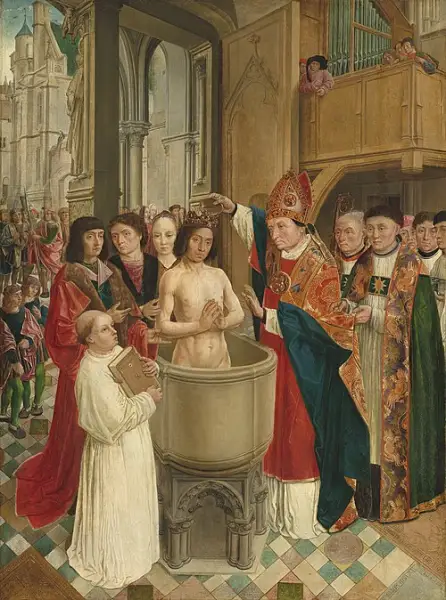
On December 25, 496, in the cathedral city of Reims, Remigius performed the act for which history remembers him: the baptism of Clovis I, king of the Franks. Clovis had asked for baptism in the wake of his triumph over the Alamanni at Tolbiac, and the rite was celebrated before a great company of Franks and Alamanni. Gregory of Tours records that about 3,000 of the king's followers were baptized with him. The consequences reached far beyond one ceremony. Clovis's conversion brought Nicene Christianity to a Germanic people for the first time at scale — most Germanic kingdoms of the age had accepted the Arian creed — and under the king's patronage a great number of churches rose across the formerly pagan lands of the Frankish realm. Remigius harvested the field that opened before him. Clovis granted him wide stretches of territory, on which the bishop established and endowed churches and erected new bishoprics: Tournai, Cambrai, Arras, where he installed St. Vedast, and Thérouanne, whose first bishop he ordained in person in 499. He gave the church of Laon to his niece's husband Gunband. The apostle of the Franks thus built, in a single generation, the skeleton of the medieval French church.
§ Life
The Old Bishop and His Trials
Remigius's last decades were not without controversy. At the synod he convened at Reims in 517, a heated dispute ended in triumph when he persuaded a bishop of Arian views back to the Catholic faith — a small emblem of the larger conquest of Nicene orthodoxy in the Frankish lands. But his own judgment was questioned in the affair of Claudius, a priest Remigius had consecrated whose offenses drew the rebukes of his episcopal brethren, who held the man deserving of degradation. The old bishop had condoned him, and for this he was called to account. His written reply to his colleagues survives and remains, by the judgment of the tradition, able and convincing — a specimen of the rhetorical art in which his class and training excelled. He labored on: in 530 he consecrated Medardus as Bishop of Noyon, still extending the episcopal map of the Frankish church into his tenth decade. He died at Rheims on January 13, 533, aged ninety-five or ninety-six, having governed the see for about seventy-four years. The Frankish nobles had made him numerous donations, the chroniclers of Gallia Christiana record, all of which he presented to the cathedral of Reims, his church to the last.
§ Life
Apostle of the Franks
The memory of Remigius took deep root in the church of France. His feast has been kept on January 13, the day of his death, recorded in the Roman Martyrology, with a second observance on October 1 commemorating the translation of his relics; the Church of England and the Episcopal Church also honor him on October 1. His remains, first kept in the Cathedral of Reims, were sent by Hincmar to Épernay for safety during the Viking invasions and translated in 1099 to the Abbey of Saint-Rémy at Reims; there they rested until the French Revolution, when his tomb was deliberately desecrated on October 7, 1793 by a Commissioner of the Convention precisely because of its link with royal patronage — an unwitting tribute to the bond his baptism of Clovis had forged between altar and throne. It was after his time, with Bishop Hincmar of Reims, that the legend arose of the ampulla of holy oil employed when the kings of France were anointed at Reims, binding his memory to the French monarchy forever. Across Europe churches still bear his dedication, from Simpelveld in the Netherlands and Haacht in Belgium to the villages of Norfolk and a parish in Russia, Ohio — the quiet geography of a cult that has followed the Frankish apostle for fifteen centuries.
§ Legacy
Timeline
- 437
Born, by tradition, at Cerny-en-Laonnois near Laon in Picardy, into the topmost rank of Gallo-Roman society.
§ Life
- 459
Chosen Bishop of Reims at the age of about twenty-one while still a layman, on the reputation of his learning and sanctity.
§ Life
- 25 Dec 496
Baptized Clovis I, King of the Franks, at Reims before a great assembly of Franks and Alamanni; Gregory of Tours records about 3,000 Franks baptized with the king.
§ Life
- 499
Personally ordained the first bishop of Thérouanne, one of the new sees he erected across the Frankish lands along with Tournai, Cambrai, Arras, and Laon.
§ Life
- 517
Presided over a synod at Reims at which, after heated debate, he brought a bishop of Arian views to the Catholic faith.
§ Life
- 530
Consecrated Medardus as Bishop of Noyon, extending the episcopal structure of the Frankish church.
§ Life
- 13 Jan 533
Died at Rheims in Champagne, in the Kingdom of the Franks, at the age of ninety-five or ninety-six, after roughly seventy-four years as bishop.
§ Life
- 1099
His relics, which Hincmar had sent to Épernay for safety during the Viking invasions, were translated to the Abbey of Saint-Rémy at Reims.
§ Life
- 7 Oct 1793
His tomb at Reims was deliberately desecrated amid the French Revolution by a Commissioner of the Convention, on account of its link with royal patronage.
§ Life
The Record
- Major works
- Four letters preserved in the Epistulae Austrasicae, including his defense in the Claudius affair and two letters to Clovis·Declamations, admired by Sidonius Apollinaris but now lost
- Patron of
- France
- Symbols
- dove·book·lamp
- Canonization
- Pre-congregation; his cult is ancient and he appears in the Roman Martyrology under January 13
Prayer
Bibliography
Show 9 sources
- Great Synaxaristes: Ὁ Ἅγιος Ρεμίγιος Ἐπίσκοπος Ρημῶν. 13 Ιανουαρίου. ΜΕΓΑΣ ΣΥΝΑΞΑΡΙΣΤΗΣ.
- "January 13". The Roman Martyrology.
- Dedieu-Barthe, Joseph Germain Eugène (1911). "St. Remigius". In Herbermann, Charles (ed.). Catholic Encyclopedia. Vol. 12. New York: Robert Appleton Company.
- Jacobus de Voragine, The Golden Legend, 1 October: "St. Remigius."
- Philip Schaff, "The New Schaff-Herzog Encyclopedia of Religious Knowledge," entry by A. Hauck.
- Chisholm, Hugh, ed. (1911). "Remigius, St". Encyclopædia Britannica. Vol. 23 (11th ed.). Cambridge University Press.
- Chronicle of the French Revolution. ISBN 0-582-05194-0.
- "The Calendar". The Church of England. Retrieved 2021-04-08.
- Lesser Feasts and Fasts 2018. Church Publishing, Inc. 2019-12-17. ISBN 978-1-64065-235-4.
Profile text adapted from the Wikipedia article, licensed CC BY-SA 4.0.
Pray with this saint every day
Save St. Remigius to your favorites, read the full profile, and get feast-day reminders in the Saints app.
Get the Saints AppFree on the App Store for iPhone and iPad