
died 772·Feast January 19
St. Remigius of Rouen
Carolingian Prince and Archbishop of Rouen
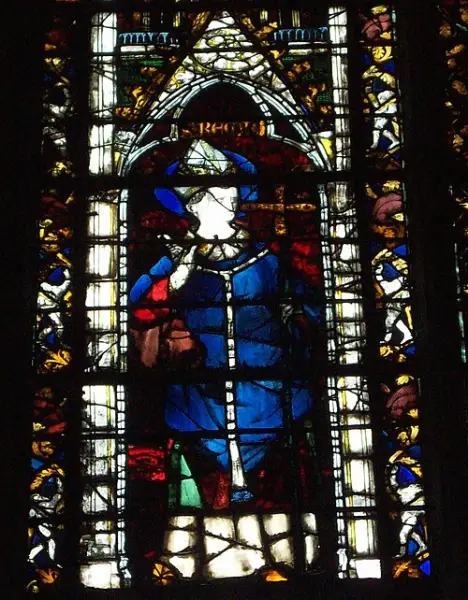
Overview
Remigius, sometimes called Remi, was an illegitimate son of Charles Martel by an unknown mistress, and one of the striking figures of the early Carolingian church. Educated at the court of his father alongside his brothers Bernard and Hieronymus, he was denied with them any share of the family patrimony, which passed wholly to Charles's legitimate sons. A royal career of another kind opened instead. In 737 he rode out with his half-brother Pepin the Short to strengthen his father's grip on Burgundy, and in 755 he was raised to the archbishopric of Rouen, becoming its third metropolitan in the Carolingian line. Five years later he crossed the Alps with Pepin and his brothers to mediate between Pope Paul I and the Lombard king Desiderius, and on his return he brought back a master from the Schola Cantorum of Rome to teach his clergy the Roman chants. Through this work he helped implant the Roman rite and plainchant in the Gallic church. Death came in 772. Three centuries afterward, in 1090, his remains were moved to the abbey church of Saint-Ouen at Rouen, though the reliquary vanished amid the disorders of the Reformation era in 1562; his feast is kept on January 19.
The Complete Life
A Son of the Palace
Remigius entered the world on the wrong side of the blanket, an illegitimate son of Charles Martel, the mayor of the palace who preserved Frankish Christendom at Poitiers, by an unknown mistress. Whatever embarrassment his birth caused, the old records show that Charles acknowledged and raised the boy: Remigius was educated at court together with his brothers Bernard and Hieronymus, in the school of arms and letters that formed the Carolingian nobility. When Charles partitioned his lands among his legitimate sons Pepin the Short and Carloman, however, the bastards of the house received nothing. This exclusion from the patrimony, far from breaking him, seems to have directed his energy toward the one career in which birth mattered less than capacity and royal confidence. Carolingian practice regularly drew such kinsmen into the episcopate, where a king's half-brother could serve as a trusted agent of royal policy in a great city. For Remigius that service began early: in 737, still a young man, he was dispatched with his half-brother Pepin into Burgundy to help tighten Charles's control of a region that had resisted the Mayors of the Palace, and he learned there the mixture of firmness and negotiation that would mark his whole life.
§ Life
Archbishop of Rouen
In 755, the year after Pepin became king of the Franks, Remigius was elevated to the archbishopric of Rouen, the third occupant of the see in the new order. The choice bound a member of the royal family to the chief church of lower Seine country, and Remigius repaid the confidence with nearly two decades of governance. An archbishop of the age was a public figure: judge, landlord, diplomat, and pastor at once, responsible for a province whose Christian institutions were still being knit together after the disorders of the previous century. Remigius brought to the work precisely the formation his exclusion had given him, a man at home in the palace yet dependent on the Church for his entire standing. Rouen was among the oldest and most honorable sees of Gaul, and its archbishop ranked high in the Gallican hierarchy; under his government it became also a center of liturgical renewal. That he held the trust until his death in 772, in an era when the Frankish church was being remade from top to bottom, says that he governed it with steadiness and with the favor of the king who had set him there.
§ Life
Roman Chant for the Gallic Church
The defining work of Remigius's episcopate grew out of diplomacy. In 760 he accompanied King Pepin to Italy, together with his brothers Bernard and Hieronymus, to mediate between Pope Paul I and Desiderius, the Lombard king whose kingdom pressed on Rome. The negotiations occupied the classic fault line of the age, between the papacy's need for a protector and the Lombards' ambition, and the Frankish court was positioning itself as arbiter. Remigius's part in the embassy ended in an act of cultural consequence greater than any treaty: back in his own city he engaged a singing master formed at Rome's Schola Cantorum, the pope's own choir school, to train his clergy in the Roman chants. Under his direction the Roman rite and plainchant took root in the Gallic church of Rouen, joining the Frankish kingdom to the liturgical practice of the Eternal City a generation before Pepin and Charlemagne imposed the Roman usage more broadly. What the court willed, the archbishop embodied: worship offered to God in the same words and melodies as the See of Peter. His episcopate thus served the double mission of his house, the ordering of the Frankish state and the romanizing of its prayer.
§ Life
Death, Relics, and Memory
Remigius died in 772, and the veneration that followed him at Rouen kept his name alive through the centuries. In 1090, more than three hundred years after his death, his relics were translated with solemnity to the Abbaye Saint-Ouen de Rouen, one of the great monastic churches of Normandy, where the faithful could honor the sainted archbishop at his new resting place. There the relics remained until the religious wars of the sixteenth century: in the religious wars of 1562 his reliquary disappeared, a fate shared by many treasuries of Norman churches in those years. Loss of the shrine did not loss of memory follow, for his feast on January 19 continued to be observed, and historians of the Carolingian church remember him chiefly for what survived the wars: the Roman chant he planted at Rouen, which joined his province to the worship of Rome and helped shape the liturgical patrimony of the whole Frankish church. The king's forgotten son ended as the Church's remembered bishop, his monument not carved stone but the sung prayer of generations. The Gregorian reform of the Franks had many architects; at Rouen the singing master from Rome deserves to be counted among them, and he crossed the Alps in the archbishop's company.
§ Life
Timeline
- 737
Sent with his half-brother Pepin the Short into Burgundy to strengthen Charles Martel's hold on the region
§ Life
- 755
Becomes the third Archbishop of Rouen
§ Life
- 760
Accompanies Pepin to Italy with his brothers to mediate between Pope Paul I and Desiderius, and brings back a Roman singing master for his clergy
§ Life
- 772
Dies after seventeen years governing the see of Rouen
§ Life
- 1090
His relics are translated to the Abbaye Saint-Ouen de Rouen
§ Life
- 1562
His reliquary is lost amid the turmoil of the Reformation
§ Life
The Record
- Major works
- Introduction of the Roman rite and Roman chant into the church of Rouen
- Canonization
- Pre-congregation; venerated at Rouen since the early Middle Ages
Prayer
Bibliography
Show 5 sources
- Holweck, Frederick George. "Remigius (Remi)", A Biographical Dictionary of the Saints, B. Herder Book Company, 1924, p. 852
- Van den Akker, SJ. A., "Remigius van Rouen", Heiligen.net
- Riche, Pierre. The Carolingians: A Family Who Forged Europe, University of Pennsylvania Press, 1993, p. 45
- Batiffol, Pierre. History of the Roman Breviary, Longmans, Green, 1898, p. 88
- Walsh, Michael. "Remigius of Rouen", A New Dictionary of Saints, Liturgical Press, 2007
Profile text adapted from the Wikipedia article, licensed CC BY-SA 4.0.
Pray with this saint every day
Save St. Remigius of Rouen to your favorites, read the full profile, and get feast-day reminders in the Saints app.
Get the Saints AppFree on the App Store for iPhone and iPad