
5th century·Feast October 6 (Sorrento); November 12 (France)
St. Renatus
Bishop Venerated in Angers and Sorrento
Overview
Saint Renatus — San Renato in Italian, Saint-René in French — is the single devotional figure into which two early bishops of the same name and age were merged. The first was Renatus of Sorrento, remembered as the first bishop of that Campanian city and probably one of the hermits who prayed in the hills of the Sorrentine Peninsula. The second was Renatus of Angers, who according to a late French legend was baptized as a child by Bishop Maurilius after the dead boy had been restored to life at his tomb, and who afterward succeeded Maurilius in the see of Angers. When the Angevin conquerors of Naples in the thirteenth century met the devotion paid to Renatus of Sorrento, the two figures — contemporaries, both bishops, both described as bald old men with long beards — were identified as one by common consent, though no historical proof of the identity ever surfaced. The merged saint was honored across Campania and in France, in the cathedral chapels of Sorrento and Naples, at Capua, Sarno, and Nola, and in the cult of Good King René of Anjou, who bore his name. His double feast, October 6 and November 12, still marks the two halves of his legend.
The Complete Life
First Bishop of Sorrento
The better known half of the Renatus tradition belongs to southern Italy. San Renato was a bishop of the fifth century in the city of Sorrento, near Naples in Campania, and the tradition honors him as the first bishop the city ever had. He probably came out of the eremitical movement that flourished on the hills of the Sorrentine Peninsula: the scholar Antonio Borrelli suggests he may well have belonged to the first generation of that eremitical company, among whom Catellus of Castellammare and Antoninus of Sorrento lived between the seventh and ninth centuries. A homily composed in his honor at the end of the eighth century, notably, does not call him a bishop, nor does the Life of Saint Antoninus, Abbot of Sorrento, written in the ninth century or later — silence that keeps his precise place in the church of Sorrento a matter of devotion rather than documentation. In the Life, which describes the saints from a painting then hanging in the cathedral, Renatus appears as an old man alongside the patron saints of the city: Antoninus, Athanasius, Baculus, and Valerius of Sorrento. Whatever the bare facts, Sorrento reckoned him the founder of its episcopate and the first to consecrate its rocky peninsula to Christian prayer.
§ Saint Renatus of Sorrento (San Renato di Sorrento)
The Legend of Angers
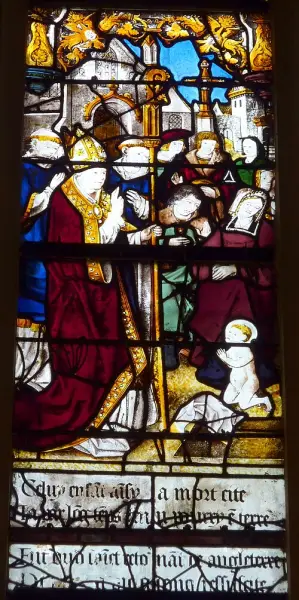
The French half of the tradition tells a stranger story. Maurilius, the Italian-born bishop of Angers in Anjou in the fifth century, was summoned one day to baptize a dying child but was detained by a pressing duty in his church and arrived too late; the child died unbaptized. Seized with remorse, the bishop slipped away from Angers in secret, boarded a ship, and hurled the keys of the cathedral treasury into the high seas, taking refuge in England as the royal gardener. The people of Angers, meanwhile, found the keys within the liver of a great fish caught by their fishermen — a sign they could not mistake — traced their bishop to England, and persuaded him to come home. Back in his city, Maurilius knelt in prayer at the child's tomb, and the boy rose, smiling, fresh as the flowers growing upon the grave. The bishop baptized him with the name Renatus, the reborn one, and in time the child grew up to succeed Maurilius himself in the see of Angers and to be honored as Saint-René. The tale rests on a late life of Maurilius, penned in 905 by the deacon Archinald and passed about under the great name of Gregory of Tours, and historians judge it to have no real foundation — yet it gave France its saint.
§ Maurilius of Angers and saint Renatus of Angers
One Saint out of Two
The two Renatuses became one by the convergence of politics and devotion. In 1262 Charles I d'Anjou conquered Naples, and the French rulers of the south soon encountered the cult of San Renato at Sorrento while knowing the story of Saint-René of Angers. The two figures seemed to be contemporaries, and their portraits described the same man — bald, old, long-bearded. By common consent a single devotional figure was born, and the legend grew to say that the Bishop of Angers had crossed to Sorrento in his old age, lived there as a hermit, and become the city's bishop. Plausible as it sounds, no documentary proof of the identity ever came to light. The merged saint's cult spread across Campania: his old oratory, the first cathedral of Sorrento, was replaced in 1603 by a basilica of the Benedictines of Monte Cassino during a renewal of interest in his relics and Valerius's; Naples housed cult centers recorded in 1276 and 1367; Capua, Sarno, and Nola joined in the fourteenth century; and the present Duomo of Sorrento keeps a chapel dedicated to San Renato, where he is venerated as Confessor of the Faith. In France, his name confused with reins — the kidneys, once thought the seat of sexual power — made him one of the so-called phallic saints invoked for fertility, and a millennium on, René of Anjou, born in the castle of Angers and named for him, reigned as the Good King René of Naples.
§ Fusion
Timeline
- 846
In the narrative of the Life of Saint Antoninus of Sorrento, Renatus appears among the patron saints of the city to Duke Sergius I of Naples on the night before battle with Moorish forces.
§ Saint Renatus of Sorrento (San Renato di Sorrento)
- 905
The deacon Archinald wrote the late life of Saint Maurilius of Angers on which the French legend of Renatus's baptism and resurrection as a child rests.
§ Maurilius of Angers and saint Renatus of Angers
- 1262
Charles I d'Anjou conquered Naples; the French newcomers and the Sorrentini compared their two saints of the same name and merged them into a single figure of devotion.
§ Fusion
- Jul 1276
Documents first record centers of Renatus's cult in the city of Naples.
§ Saint Renatus of Sorrento (San Renato di Sorrento)
- Mar 1367
Further documents attest cult centers of Renatus, which by the fourteenth century had also appeared at Capua, Sarno, and Nola.
§ Saint Renatus of Sorrento (San Renato di Sorrento)
- 1603
The Benedictines of Monte Cassino replaced Renatus's old oratory, the city's first cathedral, with a large basilica amid renewed interest in the relics of Renatus and Valerius of Sorrento.
§ Saint Renatus of Sorrento (San Renato di Sorrento)
In Their Own Words
fresh as the flowers growing on the tomb
The Record
- Major works
- The first cathedral of Sorrento, founded as his place of prayer
- Patron of
- Sorrento·invoked for fertility in the medieval French folk tradition
- Symbols
- a bald old man with a long beard·a bishop's vestments
- Canonization
- Pre-congregation; venerated in the Roman Catholic Church in both Italy and France
Prayer
Bibliography
Show 4 sources
- Antonio Borrelli (2002). "San Renato di Sorrento". Santi e beati. Retrieved February 24, 2011.
- Goyau, Georges. "Angers." The Catholic Encyclopedia Vol. 1. New York: Robert Appleton Company, 1907.
- Antonio Balducci (2008). "San Bacolo di Sorrento". Santi e beati. Retrieved February 23, 2011.
- "The Minor Themes".
Profile text adapted from the Wikipedia article, licensed CC BY-SA 4.0.
Pray with this saint every day
Save St. Renatus to your favorites, read the full profile, and get feast-day reminders in the Saints app.
Get the Saints AppFree on the App Store for iPhone and iPad