
died 3rd century·Feast October 8
St. Reparata
Virgin Martyr of Caesarea, Patroness of Florence
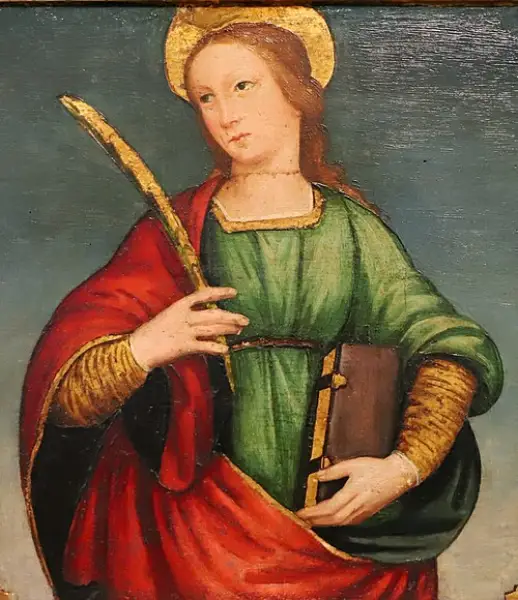
Overview
Reparata — Santa Reparata in Italian, Sainte Réparate in French — is honored by tradition as a young virgin of Caesarea in Roman Palestine who died for the Christian faith under the emperor Decius. The sources that transmit her story give her age variously between eleven and twenty, with the cathedral of Nice settling on fifteen. Arrested for her faith during the persecution of 249 to 251, she was put to torture, survived an attempt to burn her alive when a shower of rain extinguished the flames, and was forced to drink boiling pitch. Still refusing to deny Christ, she was beheaded; her legend says a dove appeared at the moment of her death, bearing her spirit to heaven. Later elaboration carried her body by angelic breath across the sea to the bay at Nice still called the Baie des Anges. Her cult, unattested before Bede's martyrology in the ninth century, spread widely through medieval Europe and took deepest root in Italy, above all at Florence, which honored her as its principal patroness until the end of the thirteenth century and still keeps her feast each October 8 in thanksgiving for deliverance from the Ostrogoths in 406.
The Complete Life
A Virgin of Caesarea
Reparata belonged to the Christian community of Caesarea Maritima, the great port city of Roman Palestine where so many confessors of the third century gave their lives. The sources disagree about how old she was when her trial came: some record her as young as eleven, others as twenty, while the cathedral dedicated to her at Nice settles the question of devotion with the figure of fifteen. Whatever her exact years, she stands among the child and adolescent martyrs whose constancy astonished the courts that condemned them. The persecution that caught her was that of the emperor Decius, who reigned from 249 to 251 and demanded of every subject a public act of apostasy. For a Christian of Caesarea — a city whose bishop's church had only recently been rebuilt after an earlier wave of executions — the imperial order posed a simple and terrible choice. Reparata refused the choice offered on the empire's terms and held to her faith, and for that refusal she was arrested as a virgin consecrated to Christ and delivered to the torturers. Her story, like so many of the age, would reach the medieval West in the form of a passio, elaborated as it traveled, but anchored in the memory of a young woman who would not betray what she believed.
§ Initial legend and evolution
Fire, Pitch, and the Sword
The tortures recounted of Reparata follow the pattern of the martyr-acts of Palestine, each failure of the executioners an argument for the faith she would not surrender. First the persecutors attempted to burn her alive, but a shower of rain fell and saved her from the flames. Then they compelled her to drink boiling pitch, a torment as cruel to describe as to endure. Through all of it she refused to apostatize, and when persuasion and torment had alike failed, the sentence was carried out by the sword: she was decapitated. Her legend closes the scene with the image that fixed her in the imagination of later centuries — at the instant of her death a dove appeared over her body, the visible sign of her spirit's flight to heaven. A later elaboration of the story carried her memory westward as well: her body, the tale says, was laid in a boat and blown across the sea by the breath of angels until it came ashore at the bay near Nice that is called the Baie des Anges to this day. The motif links her with other saints of the western Mediterranean whose relics were said to have made miraculous voyages — Restituta, Devota of Monaco and Corsica, and Torpes of Pisa — saints whose bodies arrived where their cults took root.
§ Initial legend and evolution
Patroness of Nice and Florence
No certain evidence of Reparata's cult survives from the early centuries. Her name first appears in the ninth century in the martyrology compiled by Bede, and Eusebius of Caesarea, who recorded the martyrdoms of the Holy Land in the third century, never mentions her. Yet from the ninth century onward her fame grew steadily, and in the Middle Ages her cult spread across Europe, attested by numerous passiones copied in various regions of the continent. Italy loved her most: Florence, Atri, Naples, and Chieti all venerated her, and painters of the first rank — Fra Bartolomeo, Arnolfo di Cambio, Andrea Pisano, Domenico Passignano, and Bernardo Daddi — set her image on panel and in stone. In Florence she reigned as the city's primary patroness through the High Middle Ages, until, as Anna Jameson records, about 1298 she was displaced from sole patronage in favor of the Virgin and St. John the Baptist, though she remained co-patroness alongside Zenobius of Florence. The former cathedral of the city, Santa Reparata, stood dedicated under her name beneath what is now the Duomo. At Nice she has always been the city's patroness, honored in its cathedral of Sainte-Réparate; and Florence keeps her feast each October 8 in memory of its deliverance from Radagaisus and his Ostrogoths in the year 406, a rescue the city ascribed to her prayers.
§ Spread, depiction, and local significance
Timeline
- 250
Arrested at Caesarea in the persecution of Emperor Decius (r. 249–251), Reparata was tortured, survived an attempt to burn her alive, drank boiling pitch rather than apostatize, and was beheaded; her legend records a dove appearing at her death.
§ Initial legend and evolution
- 406
Florence, delivered from the Ostrogoths led by Radagaisus, attributed its rescue to Reparata's intercession and commemorated it annually on her feast, October 8.
§ Spread, depiction, and local significance
- 1298
According to Anna Jameson, Reparata was deposed as sole patroness of Florence, the city passing beneath the immediate guardianship of Our Lady and St. John the Baptist.
§ Spread, depiction, and local significance
In Their Own Words
circa 1298 she appears to have been deposed from her dignity as sole patroness; the city was placed under the immediate tutelage of the Virgin and St. John the Baptist
The Record
- Patron of
- Nice, France·Florence, Italy (co-patroness with Zenobius of Florence)
- Symbols
- crown and martyr's palm·a dove·a banner with a red cross on a white field·accompanied by St. Ansanus
- Canonization
- Pre-congregation; her name entered the martyrology of Bede in the ninth century and her cult was confirmed by ancient custom in the Catholic Church
Prayer
Bibliography
Show 4 sources
- Jameson, Anna (1857). Sacred and Legendary Art. Longman, Brown, Green. p. 648.
- Patron Saints Index: Saint Reparata. Archived 2008-03-30 at the Wayback Machine.
- Borrelli, Antonio. "Santa Reparata di Cesarea di Palestina", Santi e Beati.
- The Metropolitan Museum of Art, New York.
Profile text adapted from the Wikipedia article, licensed CC BY-SA 4.0.
Pray with this saint every day
Save St. Reparata to your favorites, read the full profile, and get feast-day reminders in the Saints app.
Get the Saints AppFree on the App Store for iPhone and iPad