
died 255 or 304·Feast May 17
St. Restituta
Berber Martyr of Roman Africa
Overview
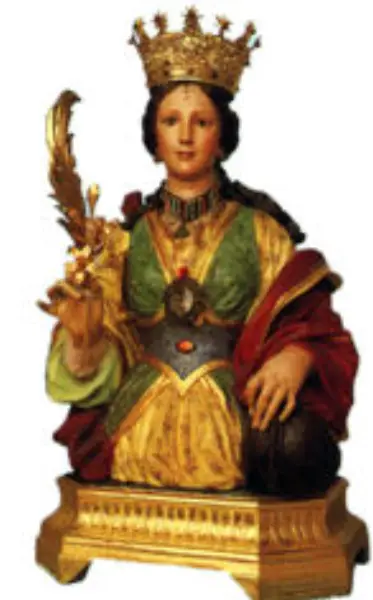
Restituta, honored as Restituta of Africa, was a Berber woman who died a martyr in Roman Africa, in 255 or, as the best-attested tradition holds, in 304 under the emperor Diocletian. She was said to have been born at Carthage or at Teniza, today Ras Djebel on the Tunisian coast, and she is sometimes counted among the Martyrs of Abitinae of the Roman province of Africa, the band of North Africans that included Dativus and Saturninus and perished in 304. The precise place and date of her execution have not survived. A medieval legend, recounted by Pietro Suddiacono in the tenth century and kin to the tales of Devota, Reparata, and Torpes of Pisa, tells that after terrible torture she was put out to sea in a vessel primed with resin and oakum and set alight; the flames spared her, and when she called on God, an angel took the helm and steered her craft to the island of Aenaria, today's Ischia. There a Christian woman named Lucina, warned in a dream, found her incorrupt body and buried it at the foot of Monte Vico in Lacco Ameno. Her cult passed from Africa to Italy, probably with the Catholics exiled under the Vandal king Genseric, and she became patroness of Lacco Ameno, where her sanctuary stands today.
The Complete Life
A Daughter of Carthaginian Africa
Restituta belonged to the Berber people of Roman North Africa, the population that gave the early Church some of its greatest martyrs and doctors. Tradition places her birth at Carthage, the metropolis of the African province, or at Teniza, identified with present-day Ras Djebel on the Tunisian coast near Bizerte; the oldest accounts are not more precise, and she may equally be claimed by either town. Of her family, upbringing, and conversion the records say nothing, as is usual for the martyrs of the great persecutions, whose acts were often lost and whose memories were carried instead by cult and legend. What the tradition does assert is her faith unto death: she confessed Christ in the age when confession cost everything. Some calendars rank her among the Martyrs of Abitinae, the group of North African Christians, among them Dativus and Saturninus, who were put to death in 304 for defying the emperor Diocletian's edicts against Christian assembly and worship. If that association is right, she died in the company of a communion of villagers and townspeople whose steadfastness astonished their judges, and whose fidelity became the seed of the African Church's honor.
§ Introduction
Torture, Fire, and the Open Sea
The story the medieval faithful told of Restituta's passion gathers the themes of the African martyr acts into a single unforgettable image. According to the legend recounted by the tenth-century deacon Pietro Suddiacono, kin to the narratives that grew up around Devota, Reparata, and Torpes of Pisa, the martyr endured atrocious torments before being put aboard a vessel stuffed with resin and oakum, set on fire, and pushed out onto the open water. But the flames did not harm her, and she asked God for aid. An angel was sent to guide her boat across the water to the island of Aenaria, modern Ischia in the bay of Naples, where it touched the shore at the place now called San Montano. There the martyr's ordeal ended and her glory began. Whether history or poetry, the tale preaches what the African Church knew by heart: that the powers of this world cannot control the witness they try to destroy, and that God himself conducts his own to the shore he chooses. Stories of this shape were the Church's answer to the cruelty of the persecutors, who disposed of the bodies of the condemned as they pleased, and they were told along the whole southern shore of the Mediterranean, wherever a martyr's relics arrived with no acta to explain them. In Restituta's case the sea itself became the witness: the burning vessel was her tomb procession, and the island that received her her burial ground. The tradition does not pretend to record the words she spoke or the details of her interrogation; it records what the coastal churches of Africa and Campania remembered together, that a daughter of their soil had died for Christ and that God had honored her, guarding her from the fire and steering her home across the water.
§ Legend
From the African Coast to Ischia
Lucina, a Christian woman of the island, came into the story at its close: she dreamt of the angel and the boat, walked to the beach, and found the resplendent and incorrupt body of the martyr. Gathering the population, she saw Restituta solemnly buried at the foot of Monte Vico in Lacco Ameno, where a paleochristian basilica was raised in her honor and where a sanctuary stands today. Historians connect her cult's passage from Africa to Italy with the Catholics driven out of Africa by Genseric, the Vandal king and Arian persecutor; her relics were quite possibly borne to Naples in the 400s by the exiled bishop Gaudiosus. A church of Santa Restituta rose in Naples in the sixth century and was later enclosed within the cathedral built on the same site in the thirteenth. She is patroness of Lacco Ameno, celebrated there in a three-day feast from May 16 to 18; a crypt honors her at Cagliari in Sardinia; the main square of Sora bears her name; a frazione of Avigliano Umbro keeps her title; and in 1842 Lamartine's poem on the lily of the gulf of Santa Restituta carried her legend into French literature.
§ Veneration
Timeline
- 304
Martyred in Roman Africa under the emperor Diocletian, perhaps as one of the Martyrs of Abitinae
§ Introduction
- 1842
Alphonse de Lamartine, inspired by her legend, composes "Le lis du golfe de Santa Restituta dans l'ìle d'Ischia"
§ Veneration
The Record
- Patron of
- Lacco Ameno, Ischia
- Canonization
- Pre-congregation; ancient martyr cult venerated in the Catholic and Orthodox Churches
Prayer
Bibliography
Show 4 sources
- "St. Restituta - Saints & Angels", Catholic Online, retrieved 2020-05-17
- "Ἡ Ἁγία Ρεστιτούτα ἡ Μάρτυς. 17 Μαΐου", ΜΕΓΑΣ ΣΥΝΑΞΑΡΙΣΤΗΣ
- "Santa Restituta d'Africa (o di Teniza)"
- "San Gaudioso di Abitine"
Profile text adapted from the Wikipedia article, licensed CC BY-SA 4.0.
Pray with this saint every day
Save St. Restituta to your favorites, read the full profile, and get feast-day reminders in the Saints app.
Get the Saints AppFree on the App Store for iPhone and iPad