
6th century·Feast November 1
St. Rhwydrys
Irish Prince and Saint of Anglesey
Overview
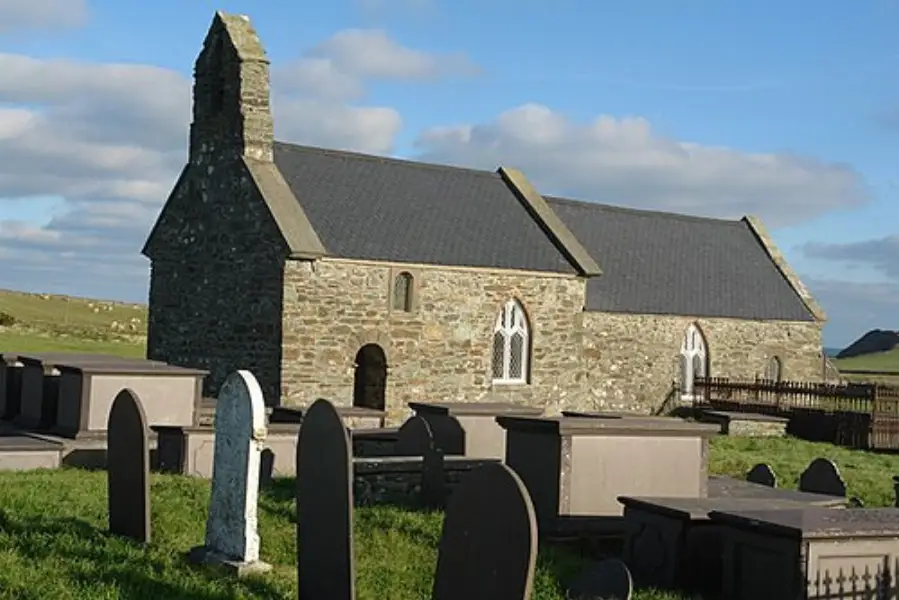
Rhwydrys was a sixth-century Irish saint whose life's work took root in Wales. Bonedd y Saint, the medieval Welsh collection of the saints' pedigrees, names him among the children of Rodrem, who reigned over Connacht; this makes him one of the many children of Irish royal houses who carried monastic Christianity across the Irish Sea in the age of the Celtic saints. Pre-congregation in cult, he belongs to that first generation of evangelizers whose deeds survive mostly in place-names, dedications, and pedigrees rather than in narratives. His lasting memorial stands on the island of Anglesey: in about 570 he is believed to have built a chapel at Llanrhwydrys, the enclosure named for him on the island's northern coast. On or near the site of that chapel a parish church rose in the twelfth century, and it still bears his dedication as St Rhwydrys's Church, keeping the saint's name alive in the landscape a full thousand years after his death. His feast day is kept on November 1.
The Complete Life
A Prince of Connacht
The medieval Welsh genealogy Bonedd y Saint, the treasury of the pedigrees of the Celtic saints, records Rhwydrys as a son of Rodrem, king of Connacht in the west of Ireland. The claim places him squarely within a well-attested pattern of the sixth century, when the children and kindred of Irish dynasties embraced the monastic life and carried it overseas. Princes' sons became abbots and missionaries precisely because they possessed the training, authority, and household connections that founding a church in a new land required, and the Welsh saint-lists are filled with their Irish names. Nothing else of Rhwydrys's upbringing has survived: his mother's name, his education, and the circumstances of his conversion are all lost to record. What the pedigree preserves is enough to explain the rest of his life. A royal Irishman who took up the cross left behind the inheritance his blood entitled him to, and the movement of saints between Ireland and Britain, of which he forms part, joined the two coasts into a single spiritual world in which a chapel on Anglesey and a palace on the Shannon belonged to the same Christian geography.
§ Introduction
A Chapel on Anglesey
Rhwydrys's work is remembered in a single decisive act: the building, around the year 570, of a chapel at Llanrhwydrys on Anglesey. The place-name itself is his monument, for the llan that prefixes so many Welsh village names marks the sacred enclosure of a founding saint, and this one has carried his name without interruption. In the sixth century Anglesey was a frontier of the new Christianity, fertile, wealthy, and close to the Irish Sea routes along which the saints traveled. To raise a chapel there was to plant the sacramental life of the Church in a rural community, giving the people of the district a baptistery, an altar, and a burial ground of their own. Such foundations were rarely lonely works: a chapel implied a small monastic household to serve it, and the saint who built it ordinarily remained as its first pastor and teacher. Though the details of Rhwydrys's ministry on the island have vanished, the continued existence of Christian worship at Llanrhwydrys from his day to ours testifies that the foundation he laid took deep root in the island's soil.
§ Introduction
Church, Dedication, and Feast
The clearest evidence of Rhwydrys's lasting honor is the parish church that stands at Llanrhwydrys today. Built in the twelfth century on or near the site of his ancient chapel, St Rhwydrys's Church has kept his dedication across more than eight centuries of its own existence, a rare continuity for a saint of whom so little is recorded. The church is a witness both to the antiquity of Christianity on Anglesey and to the respect of the medieval Welsh for the founders of their earliest churches, whose names they preserved when almost every other detail of the men had been forgotten. His feast, kept on November 1, assigns him a place among the saints of the universal calendar's most solemn tide, the commemoration of all the holy ones of God. For the people of Llanrhwydrys he remains the local father in the faith, the Irish king's son whose chapel began the Christian story of their village; for the wider Church he stands for the whole anonymous company of sixth-century missionaries whose works outlasted their biographies. In this he resembles hundreds of Celtic founders whose parishes still greet the traveler with their names: history keeps the dedication when it has lost everything else about the man.
§ Introduction
The Record
- Major works
- Chapel at Llanrhwydrys, Anglesey, built around 570
- Patron of
- Llanrhwydrys, Anglesey
- Canonization
- Pre-congregation; venerated among the early saints of Wales
Prayer
Bibliography
Show 3 sources
- Baring-Gould, Sabine. The Lives of the Saints, Vol. XVI, "The Celtic Church and its Saints", Longmans, Green, & Co. (New York), 1898. Vol. I, p. 75
- "Genealogy of the Saints (Continued)", The Cambro-Briton, Vol. 3, No. 29 (May 1822), pp. 394-396
- Carlisle, Nicholas. A Topographical Dictionary of Wales, a continuation of the Topography of the United Kingdom of Great Britain and Ireland, 1811
Profile text adapted from the Wikipedia article, licensed CC BY-SA 4.0.
Pray with this saint every day
Save St. Rhwydrys to your favorites, read the full profile, and get feast-day reminders in the Saints app.
Get the Saints AppFree on the App Store for iPhone and iPad