
6th century·Feast Unknown
St. Rhychwyn
Patron Saint of Llanrhychwyn
Overview
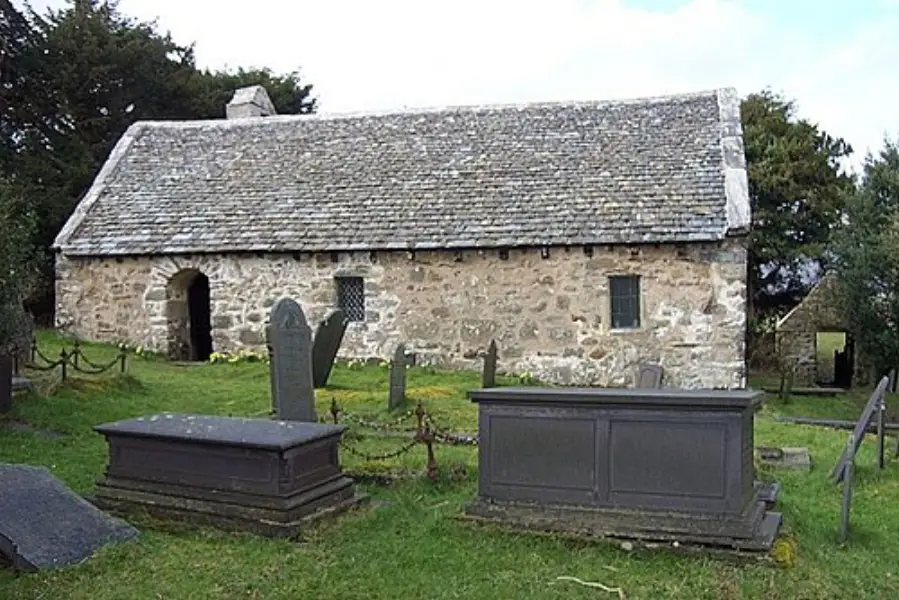
Rhychwyn, sometimes recorded as Rhochwyn, was a sixth-century saint of North Wales and the patron of the parish of Llanrhychwyn, high in the Conwy valley. His father was Helig ap Glannog, the prince whose palace at Llys Helig the sea later engulfed, an event that has made both father and court enduring subjects of Welsh myth and legend. Rhychwyn belonged to a family that became a small dynasty of sanctity: several of his brothers likewise founded churches and were honored as saints, among them Celynin, builder of the ancient church of Llangelynnin by Henryd in the valley below. To Rhychwyn himself tradition attaches the church of Llanrhychwyn, which is thought to be the most ancient church building surviving in Wales, a bare mountain edifice whose very austerity carries the memory of the age of the first saints. Almost nothing else of his life is recorded; he is honored instead through the dedication of the parish that bears his name and through the endurance of the church said to be his.
The Complete Life
The Son of Helig
Rhychwyn's family story is one of the strangest in Welsh tradition. His father, Helig ap Glannog, was a prince whose residence, Llys Helig, is remembered as a court that stood on ground the sea afterward overwhelmed; the drowned palace has been the subject of myth and legend ever since, and the lore of the submerged estate has attached itself to all his children. Of Rhychwyn's mother, birth date, and formation the record is silent, but the tradition of the family is consistent in one respect: Helig's sons turned catastrophe into consecration, scattering across the coast and valleys of North Wales to found churches and win the title of saints. Among them stood Celynin, founder of the ancient church of Llangelynnin by Henryd, below Llanrhychwyn in the same valley, so that brother and brother served God within sight of one another's altars. Whatever the historical kernel of the Llys Helig story, the genealogical tradition places Rhychwyn within the first Christian generation of Snowdonia, the age when the old British church was planting permanent worship in the mountain country that Roman authority and Saxon conquest had alike passed by.
§ Introduction
A Church Above the Valley
Rhychwyn's apostolate is embodied in the church of Llanrhychwyn, the parish of which he is patron. Tradition prizes the building as possibly the most ancient church standing in Wales, and its endurance in a high, exposed corner of the Conwy valley says much about the earliest Christian settlement of the region. A sixth-century foundation in such country was an act of quiet tenacity: the saint and whatever household gathered around him had to minister to a scattered farming people, celebrating the sacraments through winters that isolated the valley for months. The church that survives is small and unadorned, and its very plainness corresponds to what the sources suggest of its founder, a man remembered not for deeds of power but for a dedication that never had to be rebuilt from nothing. As patron of Llanrhychwyn, Rhychwyn gave the community its identity, for in Wales the saint's name became the place's name, and the parish still carries him in its very title. His recorded name varies, appearing sometimes as Rhochwyn, a reminder of how oral tradition preserved these founders imperfectly but faithfully.
§ Introduction
A Family of Saints
Rhychwyn's chief legacy may be the family of which he was part. The sons of Helig ap Glannog form one of the most striking clusters in the Welsh calendar of saints, a single household whose members founded churches across North Wales and were venerated in them for centuries. His brother Celynin's foundation at Llangelynnin, near Henryd, still looks down the same valley toward Llanrhychwyn, and together the dedications trace a map of a family's mission, advancing up the coast and into the mountains from whatever home the sea destroyed. The church of Llanrhychwyn keeps that mission alive in stone: its claim to be the oldest church building in Wales makes it a place of pilgrimage for all who care about the origins of Welsh Christianity, and every visitor who climbs to it encounters the name of the saint for whom it was named. Rhychwyn himself, of whom no act, writing, or saying is recorded, thus stands for the earliest and most hidden layer of the Church in Wales, the founding generation whose memory clings to place-names, mountain churchyards, and the pedigrees of the saints.
§ Introduction
The Record
- Major works
- The church of Llanrhychwyn, traditionally associated with him and possibly the oldest church building in Wales
- Patron of
- Llanrhychwyn, North Wales
- Canonization
- Pre-congregation; early saint of North Wales
Prayer
Profile text adapted from the Wikipedia article, licensed CC BY-SA 4.0.
Pray with this saint every day
Save St. Rhychwyn to your favorites, read the full profile, and get feast-day reminders in the Saints app.
Get the Saints AppFree on the App Store for iPhone and iPad