
c. 1537 – 1584·Feast May 4 and October 25
St. Richard Gwyn
Schoolmaster, Bard, and Martyr of Wales
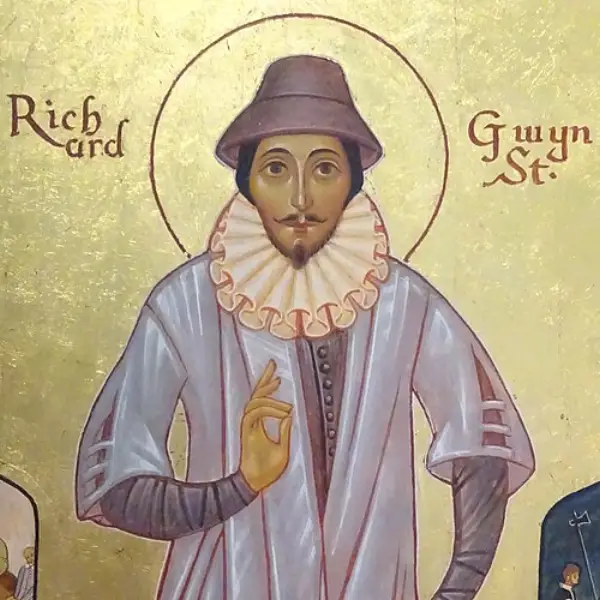
Overview
Richard Gwyn, known in English records as Richard White, was a Welsh schoolmaster and bard who died a martyr under Queen Elizabeth I. Born about 1537 at Llanidloes in Montgomeryshire, he studied at Oxford and then at St John's College, Cambridge, where the Catholic master George Bullock sheltered him until the new regime forced the young man out in 1559. Poverty turned him to teaching in the villages around Wrexham, and he married Catherine of Overton-on-Dee, by whom he had six children. A recusant by conviction, he was frightened back to the Catholic faith of his childhood by a grave illness after once conforming under pressure, and from then on he refused every compromise. Driven from the diocese of Chester, he opened a secret school in a deserted barn at Erbistock for the children of Catholic families, while his Welsh poetry carried Catholic teaching through the bardic underground. Arrested in 1579 and recaptured in 1580, he spent his remaining years in irons in the prisons of Wrexham, Ruthin, and Denbigh, fined, hauled into Protestant sermons, and finally stretched on the manacles at Bridgnorth in November 1583. At Wrexham in October 1584 he was condemned for high treason, and on October 15 he was hanged, drawn, and quartered at the Beast Market, forgiving his executioner to the last. Beatified in 1929, he was canonized by Pope Paul VI in 1970 among the Forty Martyrs of England and Wales, and since 1987 he has been principal patron of the diocese of Wrexham.
The Complete Life
Llanidloes and the Universities
Richard Gwyn was born about 1537 at Llanidloes in Montgomeryshire, reportedly descended of honest parentage bearing the surname Gwin. Only at the age of twenty did he, in the phrase of an early biographer, set his mind to good letters, matriculating at Oxford, where he made no long stay and took no degree. He moved on to St John's College, Cambridge, living on the college's charity under its Catholic master, Dr. George Bullock, and there his fellow students christened him with the English alias Richard White, a rendering of his Welsh name. The settlement of Elizabeth's religious policy ended this quiet formation: in July 1559 Bullock was compelled to resign the mastership, and Gwyn had to leave the college. Need and poverty, as he himself said, forced him to become a teacher before he had finished being a learner. Back in his native region he served in turn as schoolmaster at Gresford, Yswyd, and Overton-on-Dee, continuing on his own the study of the liberal arts, theology, and history. In those years he also married Catherine, a young woman of Overton-on-Dee, and their household grew to six children, three of whom would outlive their father.
§ Early life
Teacher, Husband, Recusant
Gwyn's first trial of conscience came in the pressure the new bishop, William Downham of Chester, himself a former Catholic priest, brought to bear on recusant schoolmasters. Threatened with fines and imprisonment, Gwyn yielded so far as to receive Communion once at an Anglican service, greatly against his will. The punishment was immediate and strange: leaving St Mary's Church at Overton-on-Dee, he was set upon by a flock of crows and kites that pecked him all the way home, and before long he had sunk into an illness so dangerous that those around him gave him up for dead. He vowed that if God spared him he would never again violate his conscience by worshiping in a Protestant church. The illness passed, and with the coming of seminary priests to North Wales he made his confession and returned wholly to the Catholic faith. The retaliation was swift: harassed by the bishop and the conformists of Overton until life became unbearable, he fled with his family on foot across the River Dee to Erbistock, where he opened a hedge school in a deserted barn and secretly taught the children of Catholic families until arrest forced him to run again. There his vocation as catechist and fugitive was fixed for the rest of his life.
§ Early life
Hedge School and Bard
Gwyn's apostolate had two instruments, the schoolroom and the poem. As a teacher he worked in the villages of the Wrexham area and then underground at Erbistock, forming the children of recusant families in letters and in the faith their parents would not surrender. As a bard he belonged to the Welsh poetic world, whose members, unlicensed and threatened with forced labor by the Crown, acted as secret messengers between Catholic priests and the faithful gentry and commons, carrying word of hidden Masses and pilgrimages. An Elizabethan writer judged his command of Welsh second to none in his country. Six poems in strict meter survive, five of them found in a manuscript copied by the recusant poet Gwilym Puw. In them Gwyn versified the case for the one true Church, urged the fifteen decades of the rosary, set out Robert Persons's reasons for refusing Anglican worship, and denounced the preachers of the new theology; his satirical funeral ode on the assassinated Prince of Orange, written in Wrexham Jail, was the work of a man who could mock as sharply as he could pray. It was precisely this double trade, teaching and versifying, that made a village schoolmaster seem to the Councils of the Crown dangerous enough to destroy.
§ Bard
Constant in Chains
The spiritual center of Gwyn's martyrdom was forgiveness under injury. Seized by the Puritan cloth merchant David Edwards in 1580, he endured chains, dungeons, and contempt from the same man for years, yet on the scaffold he publicly pardoned Edwards and all who had harmed him. When the jailer Coytmore, ordered against his will to act as executioner, knelt for pardon, Gwyn answered that he forgave him entirely, and kissed his hand. Under torture he showed the same composure: racked on the manacles at Bridgnorth, he spent the hours of torment praying aloud for mercy on his tormentors and deliverance for himself through the Passion of Christ, until his interrogators seemed, in a contemporary's words, tormented by his words as if possessed. In prison he was a father to his fellow captives; on the last morning he blessed each prisoner in the jail, blessed his infant son with the sign of the cross, and sent the white silk laces he had blessed to priests and friendly nobility as parting gifts. At the gallows he prayed his rosary on a string, and his last recorded cries were acts of contrition and the Welsh words, Jesus, have mercy on me.
§ Torture
Trial and Gallows
On October 9, 1584, Gwyn, Hughes, and Morris were arraigned at Wrexham for high treason under the Act of Supremacy and the Religion Act, forbidden counsel, and forced to plead their own cause. The witnesses against them were men afterward shown to have been bribed, and the jury was visibly unhappy with its task; the judges threatened it and read out the Privy Council's commission to compel a verdict. On the morning of October 10 the jury found Gwyn and Hughes guilty and acquitted Morris, who wept aloud; Gwyn answered with a Latin jibe about men who dare not speak for fear, then asked calmly, upon hearing the sentence, what it was all, since it was only one death. A final offer of liberty on October 13, if he would acknowledge the Queen's supremacy over the Church, he refused. On the fourteenth he prepared for death with his wife, blessing the laces and keepsakes meant for priests and friends. On the fifteenth he was drawn on a sled through the rain to the Beast Market, where he exhorted the crowd to remember their souls, forgave his executioner to his face, prayed the rosary, and died with the words Jesus, have mercy on me. His head and quarters were set up at Denbigh, Wrexham, Ruthin, and Holt.
§ Trial
From Beatification to the Altar
The memory of the schoolmaster of Wrexham was preserved by two remarkable records: a Latin account published at Trier in 1588 in the Concertatio Ecclesiae Anglicanae, and an Elizabethan English manuscript, A True Report of the Life and Martyrdom of Mr. Richard White, later found at Holywell and first printed by John Henry Newman in 1860, an account modern scholars judge the more reliable and attribute to the priest John Bennett, who had known Gwyn in prison. The cause moved slowly through the centuries of persecution until, after Catholic Emancipation, it gathered pace. Cardinal William Godfrey of Westminster laid twenty-four reported cures before the Sacred Congregation, and a young mother's healing from a cancerous growth was judged the clearest case and counted as the required miracle; as Thomas More and John Fisher had been, the group was permitted to proceed on a single miracle. Gwyn was beatified by Pope Pius XI on December 15, 1929, and canonized by Pope Paul VI at Rome on October 25, 1970, in the great ceremony that raised the Forty Martyrs of England and Wales to the altars together. Few martyrs of the Elizabethan age can show so dense a documentary trail, and few trials were recorded by hostile and friendly pens alike in such detail.
§ Investigation, canonization, and feast day
Bard, Patron, Pilgrimage
Gwyn's cult lives most intensely where he died. His relics are venerated at Wrexham's Cathedral of Our Lady of Sorrows, and every year the Catholics of the city walk in procession to the former Beast Market, the site of his execution; since 2015 the Latin Mass Society, of which he is co-patron with St. Margaret Clitherow, has sponsored an annual pilgrimage and sung Tridentine Mass near the anniversary of his death. His feast is kept on May 4 with the canonized and beatified martyrs of the English Reformation, and on October 25 in Wales with the Six Welsh Martyrs and their companions; the Roman Martyrology lists October 17. Since 1987 he has been patron of the diocese of Wrexham. In his native Llanidloes the church of Our Lady and St Richard Gwyn holds further relics, and Catholic high schools at Flint and in the Vale of Glamorgan bear his name. His six Welsh poems, translated in full in 1908 and edited by T.H. Parry-Williams in 1931, keep alive a rarer title still: he belongs to the small company of saints whose native literature honors them as poets, the schoolmaster whose verses outlasted the kingdom that killed him.
§ Commemoration
Timeline
- Jul 1559
Forced to leave St John's College, Cambridge, after the Catholic master George Bullock is made to resign in July
§ Early life
- 1579
Arrested at the Wrexham cattle market by the conforming vicar Hugh Soulley, but escapes from jail the same night and remains a fugitive for eighteen months
§ Early life
- Jul 1580
Recognized near Wrexham by the Puritan merchant David Edwards while carrying a request for a priest; seized, chained, and imprisoned in the Black Chamber, then sent under harsh guard to Ruthin Castle
§ Imprisonment
- 1580
At the Michaelmas Assizes refuses freedom on condition of attending Anglican services and naming the Catholic parents whose children he taught
§ Imprisonment
- May 1581
Carried by force into St Giles' Church at the May Assizes, convicted of 'brawling' for rattling his chains during the sermon, set in the stocks, and fined one hundred marks
§ Brawling in Church
- Sep 1581
Moved to Denbigh Castle in September and fined £280 for refusing to attend Anglican Sunday services
§ Brawling in Church
- 1582
In the spring, with fellow prisoners John Hughes and Robert Morris, heckles an imposed Anglican sermon in three languages until the exercise is abandoned
§ Three recusants
- 1582
Indicted at the Michaelmas Assizes at Holt for high treason on the testimony of Lewis Gronow and others, but the prosecution case collapses
§ Three recusants
- May 1583
A directive transfers him and his two companions into the custody of the King's Council sitting for Wales and the Marches
§ Torture
- 27 Nov 1583
Questioned at dawn by Attorney-General Richard Atkyns about the papal bull Regnans in Excelsis, then racked on the manacles for hours while praying aloud for his tormentors
§ Torture
- 9 Oct 1584
Arraigned at Wrexham before a panel headed by Sir George Bromley, charged with treason under the Act of Supremacy and the Religion Act, and made to act as his own attorney
§ Preliminary hearing
- 10 Oct 1584
The jury, warned by the court, returns a verdict of guilty of high treason; John Hughes is condemned with him while Robert Morris is acquitted
§ Deliberation and verdict
- 15 Oct 1584
Executed by hanging, drawing, and quartering at the Beast Market of Wrexham, forgiving the jailer forced to act as executioner; his quarters are displayed at Denbigh, Wrexham, Ruthin, and Holt
§ Martyrdom
- 15 Dec 1929
Beatified by Pope Pius XI in Rome
§ Investigation, canonization, and feast day
- 25 Oct 1970
Canonized by Pope Paul VI with the Forty Martyrs of England and Wales at Rome
§ Investigation, canonization, and feast day
In Their Own Words
Weep not for me, for I do but pay the rent before the rent-day.
God is merciful to us; behold the elements shed tears for our sins.
My dear countrymen, remember your souls and do not lose them for this vile transitory muck which Christ hath so dearly bought.
Not by eating flesh speadily / And filling the paunch on Fridays / And turning one's opinion with the wind / Were folk made Saints of old.
The Record
- Major works
- Six Welsh poems in strict metre, five found in the Llanover Manuscript and one in the Cardiff Free Library, translated by John Hobson Matthews and David Lloyd Thomas (1908)·'Carol I' through 'Carol V', poems defending the one true Church, the rosary, and Catholic doctrine·'Cowydd Marwnadd yn llawn cabledd ir prins o Orens', a satirical funeral ode on William the Silent composed at Wrexham Jail
- Patron of
- Latin Mass Society of England and Wales (co-patron with St. Margaret Clitherow)·Roman Catholic Diocese of Wrexham (since 1987)·Teachers·Large families·Parents of large families·Torture victims
- Canonization
- Beatified 15 December 1929 by Pope Pius XI; canonized 25 October 1970 by Pope Paul VI among the Forty Martyrs of England and Wales
Prayer
Bibliography
Show 5 sources
- Pullan, Malcolm (2008). The Lives and Times of the Forty Martyrs of England and Wales 1535-1680. Athena Press, London
- Parry-Williams, T.H. (1931). Carolau Richard White. Gwasg Prifysgol Cymru
- Thomas, David Aneurin (1971). The Welsh Elizabethan Catholic Martyrs: The trial documents of Saint Richard Gwyn and of the Venerable William Davies. University of Wales Press
- Burton, Edwin H. & Pollen, J.H., S.J. (eds.) (1914). Lives of the English Martyrs: Second Series, Volume I: 1583-1588, pages 127-144
- Pollen, John Hungerford, S.J. (ed.) (1908). Unpublished Documents Relating to the English Martyrs, Volume I: 1584-1603, pages 90-99
Profile text adapted from the Wikipedia article, licensed CC BY-SA 4.0.
Pray with this saint every day
Save St. Richard Gwyn to your favorites, read the full profile, and get feast-day reminders in the Saints app.
Get the Saints AppFree on the App Store for iPhone and iPad