
died 1196·Feast June 9
St. Richard of Andria
English bishop of Andria in Apulia
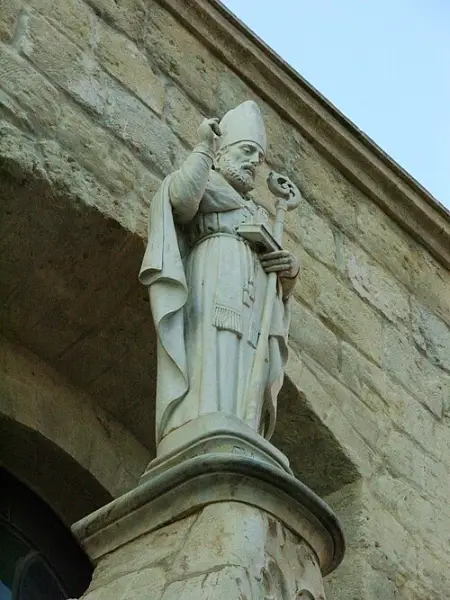
Overview
Richard was an English churchman who spent nearly the whole of his recorded life far from his native land, as bishop of Andria in southern Italy. He was raised to that see by Pope Adrian IV, himself an Englishman, the only English pope in history, and he governed the diocese for well over forty years, remaining in office until his death in 1196. His episcopate spanned some of the most turbulent decades of the twelfth-century Church, and in 1179 he travelled to Rome to take part in the Eleventh Ecumenical Council, the Third Lateran Council convened by Pope Alexander III, joining the assembled bishops of the Latin Church at a moment of reform and reconciliation after the long dispute between pope and emperor. Nearly two and a half centuries after his death, his remains were rediscovered beneath the main altar of the cathedral of Andria, where they were said to have been concealed during the Hungarian invasions. The finding of the relics led to his canonization by Pope Eugene IV, and he is honoured today as the patron of Andria and of its diocese.
The Complete Life
An Englishman on an Italian See
Richard's origins lay in England, but his life's work unfolded in the Mezzogiorno, among the people of Andria in what is now the Italian south. He was appointed bishop of the city by Pope Adrian IV, the fellow Englishman who then occupied the throne of Peter as the only Englishman ever to reign as pope. The appointment placed a countryman's confidence behind the distant diocese, and Richard repaid it with a tenure of extraordinary length: he held the see for the rest of his life, an episcopate the record places at well beyond forty years. Such longevity on a southern Italian see, in an age when episcopal thrones were contested and overturned with alarming frequency, testifies to a ministry of steadiness and endurance. In 1179, deep into that episcopate, he travelled to Rome for the Eleventh Ecumenical Council, the Third Lateran, which Pope Alexander III convened. There he stood among the bishops of the whole Latin Church as it legislated for reform after the long schism that had troubled the pontificate. He then returned to Andria and continued to govern until his death in 1196.
§ Richard of Andria
The Hidden Relics and the Altars
For almost two and a half centuries after his death, Richard's grave lay forgotten beneath the pavement of the cathedral of Andria, his remains hidden, as tradition held, during the Hungarian invasions that had swept through the region. In 1438, while the city stood under Duke Francesco II Del Balzo, a woman putatively found the relics again beneath the cathedral's high altar, and the recovery of the bishop's body reawakened his memory among the people. Under the patronage of Federico, the case of the long-dead bishop was brought before the Holy See, and Pope Eugene IV granted the canonization that enrolled Richard among the saints of the universal Church. The cathedral of Andria, where his remains had slept for generations, became the natural centre of his cult. He is honoured as the patron of Andria itself and of the Roman Catholic Diocese of Andria, the See he had governed for four decades, and his feast is celebrated each year on 9 June, keeping alive in southern Italy the memory of the English bishop who served there so long. The finding of a saint's body beneath an altar, a familiar pattern in the Italy of the late Middle Ages, here carried a bishop's memory across the centuries that separated his death from his elevation.
§ Richard of Andria
Timeline
- 1179
Attended the Eleventh Ecumenical Council, the Third Lateran Council, held in Rome by Pope Alexander III.
§ Richard of Andria
- 1196
Died at Andria after governing the see for well over forty years.
§ Richard of Andria
- 1438
His remains, concealed during the Hungarian invasions, were putatively found again beneath the cathedral's high altar by a woman.
§ Richard of Andria
The Record
- Patron of
- Andria, Italy·Roman Catholic Diocese of Andria
- Canonization
- Canonized by Pope Eugene IV in 1438, at the request of Federico under the rule of Duke Francesco II Del Balzo
Prayer
Bibliography
Show 3 sources
- "St. Richard of Andria". Catholic Online.
- "Saint Richard of Andria". Patron Saint Index.
- D'Urso, Riccardo. Storia della citta di Andria dalla sua origine sino al corrente anno 1841, pp. 102-104.
Profile text adapted from the Wikipedia article, licensed CC BY-SA 4.0.
Pray with this saint every day
Save St. Richard of Andria to your favorites, read the full profile, and get feast-day reminders in the Saints app.
Get the Saints AppFree on the App Store for iPhone and iPad