
c. 1197 – 1253·Feast April 3
St. Richard of Chichester
Bishop of Chichester and reforming confessor
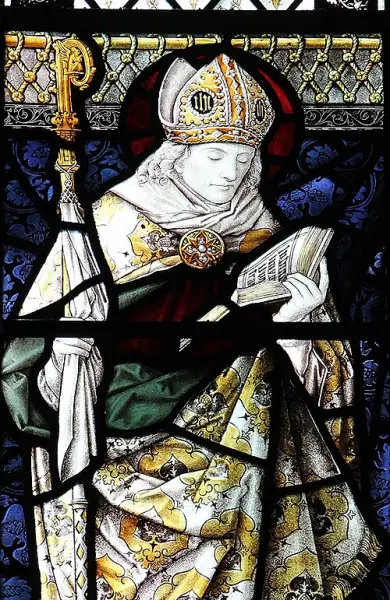
Overview
Richard of Chichester, also called Richard de Wych, was born around 1197 near Droitwich in Worcestershire into a gentry family left orphaned and impoverished. He gave up his inheritance and a proposed marriage to pursue study, teaching at Oxford before earning distinction in canon law at Paris and Bologna, and becoming chancellor of Oxford in 1235. A disciple of St. Edmund of Abingdon, he served the archbishop of Canterbury as diocesan chancellor, stood by him in exile at Pontigny, and only after Edmund's death resolved on priesthood, studying with the Dominicans at Orléans. Elected Bishop of Chichester in 1244, he met the resistance of Henry III, who seized the see's revenues and forbade anyone to shelter him; Innocent IV consecrated him at Lyons in 1245, and for two years Richard walked his diocese on foot, living on charity. Restored in 1246, he proved an exacting reformer, issuing statutes on clerical conduct and the reverence due to the liturgy. He died at Dover on 3 April 1253 and was canonized at Viterbo by Urban IV in 1262. His shrine at Chichester became one of England's great pilgrim destinations until its destruction in 1538.
The Complete Life
An Orphan Who Chose Study Over Estates
Richard was born around 1197 in the Burford district near the town of Wyche, the modern Droitwich in Worcestershire, into a gentry family that fate quickly reduced. Orphaned young, he watched the family patrimony slip away: when his elder brother came of age and took up the estates, a medieval form of death duty impoverished the household so badly that Richard had to labour for him on the farm. The brother, in time, named Richard heir to the estate, and friends pressed upon the young man a match with a noble lady that would have secured his worldly future. Richard declined both prospects with the same quiet decision, urging that his brother might wed the lady himself, and conveying his rights in the family lands back to its head. He preferred a life of study and of the Church. At the University of Oxford he was educated and soon taught; from there he went on to Paris, and then to Bologna, where his command of canon law drew notice. He came back to England in 1235, now nearing forty, and Oxford chose him for its chancellorship, the first great office of a career that would place learning at the service of the Church.
§ Life
Disciple of Edmund of Abingdon
The turning of Richard's life came through his former tutor, Edmund of Abingdon, who had become archbishop of Canterbury by the time Richard returned from the Continent. The two men shared the ideals of clerical reform, and Richard stood with the archbishop in defending papal rights even against the king. In 1237 Edmund named him chancellor of the diocese of Canterbury, and when the archbishop's stand against the crown drove him into exile, Richard went with him to Pontigny and remained at his side until Edmund's death there around 1240. Only then did Richard determine to become a priest himself, spending two years in theological study among the Dominicans at Orléans. Back in England he served as parish priest at Charing and at Deal, and the new archbishop, Boniface of Savoy, soon returned him to the chancellorship of Canterbury. In 1244 the bishopric of Chichester fell vacant, and Richard was elected to the see. The king, favouring the courtier Robert Passelewe, refused to accept the choice and seized the properties and revenues of the diocese; Archbishop Boniface declined to confirm the royal candidate, and the dispute went to Rome, where Innocent IV recognised the choice and conferred episcopal consecration upon Richard at Lyons on 5 March 1245.
§ Life
Reforming the Diocese
Restored to his rights and revenues in 1246, Richard turned with energy to the reform of his clergy and the honouring of the Church's services. His statutes, drawn up with the aid of his chapter, set a detailed discipline for the diocese. Clergy who persisted in unrecognised marriages were to lose their benefices; candidates for ordination were to vow chastity; rectors were required to reside among their people and to practise hospitality and charity. The statutes reached into the sanctuary itself: priests were to celebrate in clean robes with a silver or golden chalice, the bread of pure wheaten flour and the wine mingled with water, the cross planted before the celebrant, and the reserved sacrament carried to the sick with cross, candle, holy water, and bell. Deacons were barred from hearing confessions; children were to receive confirmation within a twelvemonth of baptism; Creed and Lord's Prayer were to be memorised in their own language. Richard enforced his standards against the powerful as readily as the lowly, defrocking a priest who had drawn a nun from her convent despite a royal petition in the man's favour, punishing townsmen of Lewes who had lynched a fugitive seized from sanctuary, and imposing severe penance on knights who assaulted priests. Usurers, immoral clerics, and priests who garbled the words of the Mass all met with no mercy from him.
§ Episcopal statutes
Poverty, Temperance, and Preaching
Behind the reforming bishop stood an ascetic. Contemporaries described a private life of rigid frugality and temperance: Richard wore a hair-shirt next to his skin, refused to eat from silver, and kept a diet so strictly simple that he excluded animal flesh altogether, having abstained from meat since his days at Oxford. His earliest experience of dispossession never left him; barred for two years from his own see's revenues and forbidden by the king on pain of royal displeasure to be housed or fed anywhere, he lodged with his friend Simon, priest of Tarring, visited every corner of his diocese on foot, and passed his spare hours cultivating figs. Yet poverty never dulled his zeal. He showed marked favour to the Dominicans, whose house at Orléans had sheltered him as a student, and he preached the crusade with earnestness, undertaking that mission at Dover at the pope's command in the last days of his life. He also fostered devotion in forms that endured: the offerings he instituted at his cathedral became known as St. Richard's pence, and he supplied the chronicler Matthew Paris with notes that fed the latter's life of his old master, St. Edmund Rich.
§ Life
Death at Dover
In the spring of 1253, in obedience to the pope's order to preach the crusade at Dover, Richard dedicated the chapel of St Edmund in that town. There, at the Maison Dieu, he died at midnight on 3 April 1253, aged fifty-six, his work cut short at the edge of his diocese far from his cathedral city. His internal organs were removed and laid in the altar of the local chapel, and his body was carried to Chichester and interred, in keeping with his wishes, in the north nave chapel that honoured his patron, St Edmund. On the reputation of that holy death, and on the stories of miracles believed to be wrought at his tomb, his cause advanced with extraordinary speed: within nine years Rome had enrolled him among the saints. Those who stood around his deathbed remembered the prayer on his lips, a thanksgiving to Christ for benefits received and pains borne, with its three petitions, to know the Lord more clearly, to love him more dearly, to follow him more nearly, words his confessor Ralph Bocking transcribed in Latin and which have been recited by Christians ever since.
§ Prayer
Shrine and Destruction
Richard was canonized at Viterbo on 25 January 1262 by Pope Urban IV, and in 1276, on 16 June, his body was moved to a newly built shrine within Chichester Cathedral. For more than two and a half centuries that shrine ranked among the great sanctuaries of England, its pilgrimage so flourishing that contemporary observers compared its popularity to that of Thomas Becket at Canterbury, and miracles were generally believed to be wrought there. The Reformation ended it. On 14 December 1538, in the thirtieth year of his reign, Henry VIII issued a privy seal document through Thomas Cromwell denouncing the superstition and idolatry said to surround the shrine and ordering the commissioners to take away the shrine, the bones, and every ornament of silver, gold, and jewel, to convey them to the Tower of London, and to destroy the place where the shrine had stood even to the ground. Sir William Goring of Burton and William Ernley carried out the commission and were paid forty pounds for it on 20 December 1538. Yet the saint was not wholly lost: tradition holds that someone from West Wittering, in the parish Ernley served, spirited the relics away and hid them in the parish church, where an ancient broken marble slab bearing a pastoral staff and Greek cross is still shown.
§ Shrine
Patron of Sussex and a Prayer for All Ages
Richard's memory proved impossible to suppress. In 1930 Dean Duncan Jones re-established his shrine in the retro-quire of Chichester Cathedral, furnished in our own day with an altar by Robert Potter, a tapestry by Ursula Benker-Schirmer, and an icon by Sergei Fyodorov showing the bishop blessing the viewer while supplicating Christ in glory. In 1987, during restoration of the abbey of La Lucerne in Normandy, the lower segment of a human arm came to light inside a reliquary and was judged to be Richard's; after examination the relic was welcomed into the cathedral on 15 June 1990 and laid in the earth the next year beneath the altar of St Richard. His fame has spread far beyond Sussex: the deathbed prayer, adapted in the song Day by Day for the 1971 musical Godspell, and incorporated into the liturgy of the Catholic personal ordinariates, carries his triple petition around the world. He is patron of coachmen, of the Diocese of Chichester, and of the county of Sussex, where 16 June is kept as Sussex Day. In Droitwich Spa, his baptismal town, the church of the Sacred Heart and St Catherine tells his story in eight tonnes of Venetian mosaic from baptism to death, and draws thousands of visitors a year.
§ Current patronage, festivals and dedication
Timeline
- 1197
Born near Droitwich, Worcestershire, into a gentry family.
§ Life
- 1235
Returned from studies in Paris and Bologna and was elected chancellor of the University of Oxford.
§ Life
- 1237
Appointed chancellor of the diocese of Canterbury by Archbishop Edmund of Abingdon.
§ Life
- 1240
Was with Archbishop Edmund at Pontigny when the archbishop died around this year.
§ Life
- 1244
Chosen as Bishop of Chichester, though King Henry III, backed by a portion of the chapter, declined to recognise the choice.
§ Life
- 5 Mar 1245
Consecrated bishop by Pope Innocent IV at Lyons.
§ Life
- 1246
Recovered the full rights and revenues of his see, which the king had confiscated.
§ Episcopal statutes
- 3 Apr 1253
Died at midnight at the Maison Dieu in Dover, aged fifty-six, after dedicating St Edmund's Chapel there.
§ Life
- 25 Jan 1262
Canonized by Pope Urban IV at Viterbo, nine years after his death.
§ Shrine
- 16 Jun 1276
His body was raised and moved to a newly built shrine within Chichester Cathedral.
§ Life
- 14 Dec 1538
Henry VIII, through Thomas Cromwell, ordered the destruction of his shrine and the removal of its treasures to the Tower of London.
§ Shrine
- 1930
Dean Duncan Jones re-established the shrine of St Richard in the retro-quire of Chichester Cathedral.
§ Shrine
- 15 Jun 1990
A relic from the restored abbey of La Lucerne in Normandy was received into Chichester Cathedral.
§ Shrine
- 1991
The Normandy relic was buried beneath the altar of St Richard in the cathedral.
§ Shrine
- 2007
The Anglican Church began celebrating his translated feast on 16 June, observed in Sussex as Sussex Day.
§ Current patronage, festivals and dedication
In Their Own Words
Thanks be to Thee, my Lord Jesus Christ / For all the benefits Thou hast given me, / For all the pains and insults Thou hast borne for me. / O most merciful Redeemer, friend and brother, / May I know Thee more clearly, / Love Thee more dearly, / Follow Thee more nearly.
The Record
- Major works
- Episcopal statutes for the clergy of the Diocese of Chichester·Institution of the cathedral offerings later known as St. Richard's pence·Material supplied to Matthew Paris for the life of St. Edmund Rich
- Patron of
- Coachmen·Diocese of Chichester·Sussex, England
- Symbols
- Bishop with a chalice on its side at his feet·Kneeling with the chalice before him·Ploughing his brother's fields·A bishop blessing his flock with a chalice nearby
- Canonization
- Canonized by Pope Urban IV at Viterbo on 25 January 1262
Prayer
Bibliography
Show 18 sources
- Atkinson, Pete; Poyner, Ruth (2007). Chichester Cathedral. Norwich: Jarold Publishing. ISBN 978-0-7117-4478-3.
- Beard, Frederica (1895). The Kindergarten Sunday School. Kindergarten Publishing.
- Greenway, Diana E. (1996). "Bishops". Fasti Ecclesiae Anglicanae 1066-1300: volume 5: Chichester. Institute of Historical Research.
- Bullock-Webster, G.R. (1913). The Churchman's Prayer Manual. London: Published by Author.
- Capes, Sister Mary Reginald, ed. (1913). Richard of Wyche, labourer, scholar, Bishop and Saint (1197-1253). London & Edinburgh: Sands.
- Farmer, David Hugh (2003). The Oxford Dictionary of Saints. Oxford University Press. ISBN 978-0-19-959660-7.
- Foster, Paul (2009). Richard of Chichester (1197-1253). Chichester: University of Chichester. ISBN 978-0-948765-42-1.
- Fryde, E. B.; Greenway, D. E.; Porter, S.; Roy, I. (1996). Handbook of British Chronology (Third Edition, revised). Cambridge: Cambridge University Press. ISBN 0-521-56350-X.
- Headlam, Cecil (1898). Prayers of Saints. London: F.E. Robinson.
- Hobbs, Mary, ed. (1994). Chichester Cathedral. An Historic Survey. Chichester: Phillimore. ISBN 0-85033-924-3.
- Lawrence, C.H. (3 January 2008). "Wyche, Richard of [St Richard of Chichester] (d. 1253)". Oxford Dictionary of National Biography (online ed.). Oxford University Press. doi:10.1093/ref:odnb/23522.
- Lower, Mark Anthony (1865). The Worthies of Sussex. Lewes, Sussex: Sussex Advertiser.
- Schwartz, Simon (1971). Godspell: Vocal Selections. Wisconsin: Hal Leonard. ISBN 978-0-88188-446-3.
- Stephens, W.R.W. (1876). Memorials of the South Saxon See and Cathedral Church of Chichester. London: Bentley.
- Roberts, Holly Harlayne (1 September 2004). Vegetarian Christian Saints: Mystics, Ascetics & Monks. New York: Anjeli Press. ISBN 978-0-9754844-0-1.
- Vaughan Williams, Ralph; Dearmer, Percy; Shaw, Martin, eds. (1931). Songs of Praise. Enlarged Edition. Oxford: OUP.
- "Sussex Day". West Sussex County Council, Chichester. Retrieved 21 September 2014.
- Chisholm, Hugh, ed. (1911). "Richard, St". Encyclopædia Britannica. Vol. 23 (11th ed.). Cambridge University Press. p. 293.
Profile text adapted from the Wikipedia article, licensed CC BY-SA 4.0.
Pray with this saint every day
Save St. Richard of Chichester to your favorites, read the full profile, and get feast-day reminders in the Saints app.
Get the Saints AppFree on the App Store for iPhone and iPad