
c. 1492 – 1535·Feast May 4
St. Richard Reynolds
Bridgettine martyr of Syon Abbey
Overview
Richard Reynolds was an English Bridgettine monk of Syon Abbey, the monastery founded at Twickenham by Henry V. Born in Devon around 1492 and educated at Corpus Christi College, Cambridge, he entered the abbey in 1513 and became its most celebrated scholar, reputed by Cardinal Reginald Pole to be the only English monk of his day who commanded Latin, Greek, and Hebrew alike. Renowned as a spiritual counsellor, he was called the Angel of Syon. His downfall came with Henry VIII's break from Rome: Reynolds refused to accept the royal supremacy over the Church, and a former connection with Elizabeth Barton, the Holy Maid of Kent, further compromised him in the eyes of the Crown. Arrested in April 1535 alongside three Carthusian priors, he was tried, condemned for treason, and executed by drawing and quartering at Tyburn on 4 May 1535, the first man to refuse the oath. He was beatified by Pope Leo XIII in 1886 and was numbered by Pope Paul VI among the Forty Martyrs of England and Wales when he raised that company to the altars in 1970.
The Complete Life
Devon Origins and Cambridge Learning
Richard Reynolds was born in Devon around 1492, in the closing years of a medieval England whose religious world he would one day die to defend. He was sent to Corpus Christi College, Cambridge, one of the universities at which the New Learning was beginning to flourish, and there received the classical and theological formation that marked him out among his contemporaries. On completing his studies he chose the cloister over a career, joining Syon Abbey in 1513. The house, founded at Twickenham by Henry V, was the only Bridgettine monastery in England and enjoyed a reputation for learning and holiness unusual even among the great religious houses of the kingdom. It was a community of high intellectual standards, and the young Cambridge graduate proved well suited to it. His abilities were such that Cardinal Reginald Pole would later describe him as the only monk in England thoroughly versed in the three principal languages of sacred study, Latin, Greek, and Hebrew. The country boy from Devon had become, within a few years of profession, one of the most accomplished religious scholars in the realm.
§ Life
The Angel of Syon
Within Syon Abbey, Reynolds grew into the role for which he is best remembered: that of the community's most renowned spiritual counsellor. People of every rank made their way to the Bridgettines of Twickenham for guidance, and it was to Reynolds that the more searching consciences were directed. His breadth of learning gave his counsel weight, and his holiness gave it authority; contemporaries came to call him the Angel of Syon, a title that joined his monastery's name to a reputation for heavenly wisdom. Among those whose paths crossed his in those years was Elizabeth Barton, the Holy Maid of Kent, whose visions against the king's marriage had made her a figure of national consequence. Dom Adam Hamilton, his biographer, judged that a counsellor so sought after would very likely have been consulted by Barton herself. Indeed Reynolds at one point arranged a meeting between her and Sir Thomas More. It was this association, more than anything else, that later compromised him in the sight of the Crown's officers, for Barton had been executed at Tyburn scarcely a year before for speaking out against the royal marriage.
§ Life
The Oath Refused
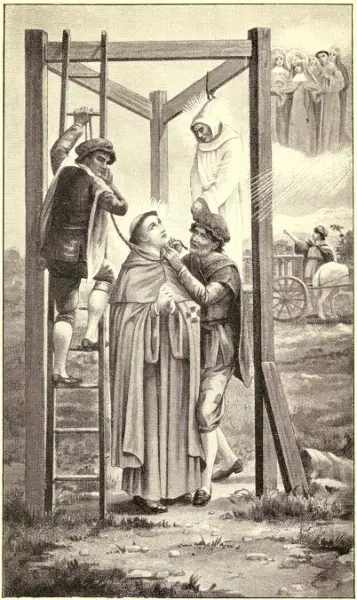
When Henry VIII required his subjects to acknowledge him supreme head of the Church in England, Reynolds refused. Around the middle of April 1535 he was arrested and committed to the Tower of London together with the Carthusian priors John Houghton, Robert Lawrence, and Augustine Webster, a monk of Sheen Priory. All four were tried for denying the royal supremacy. A further accusation held that Reynolds had encouraged others to withhold submission from royal authority, resting on a deposition in which a witness swore he had pronounced the Dowager Princess Catherine the rightful queen. Reynolds in reply insisted that any such view had left his lips only within confession, and under compulsion, for an age existed in which penitents were suborned to accuse their confessors. Condemned, the four were dragged through the streets to Tyburn and there hanged, drawn, and quartered on 4 May 1535. John Haile, parish priest of Isleworth, died with them. Reynolds, first of the four to withhold consent from the oath, suffered his remains to be divided and displayed about London, one portion raised upon the gate of his own abbey. From his cell in the Tower, Sir Thomas More watched the condemned go to death and remarked to his daughter how cheerfully they went, as bridegrooms to their marriage.
§ Life
Martyr and Saint
The Church's judgment on Reynolds's death matured over three centuries. He was beatified on 29 December 1886 by Pope Leo XIII, among the confessors and martyrs of the English persecutions whose causes Rome then confirmed. The crown of sainthood followed in the modern era: on 25 October 1970 Pope Paul VI canonized him as one of the Forty Martyrs of England and Wales, the group of men and women put to death for the Catholic faith between the reign of Henry VIII and that of James II, raised together in a single ceremony that honoured the cost of conscience across two centuries of conflict. His individual feast is kept on 4 May, the day of his execution, a date he shares with the other English martyrs, while the Forty are commemorated collectively on 25 October. In the catalogue of that company Reynolds holds a place of special witness, for he was the first to refuse the oath of supremacy, sealing with his blood the position for which the Carthusian priors, the priest of Isleworth, and many after them would also die.
§ Veneration
Memorials of the Martyr
Reynolds's memory endures in places bound to his life and death. In the church of Our Lady of Sorrows and St Bridget at Isleworth, near where Syon Abbey stood, a statue commemorates him; a picture of the martyr is preserved in Rome's church of St Bridget, mother house of his order; and a stained glass window in St Etheldreda's Church in Ely Place, London, portrays him as the figure on the right. A section of the dissolved abbey itself is venerated as his relic, since it supported his quartered remains after the execution; the nuns of Syon preserved it when the house was broken up. His patronage has been claimed by a new generation: St Richard Reynolds Catholic College in Twickenham, a federation of a high school and a primary school serving pupils aged four to eighteen, bears his name within sight of the ground his monastery once occupied. Bridgettine tradition preserves him under the title the Angel of Syon, and the account of his life and martyrdom written by Dom Adam Hamilton in 1905 keeps his story before later ages.
§ Veneration
Timeline
- 1492
Born in Devon around this year.
§ Life
- 1513
Entered Syon Abbey, the Bridgettine house at Twickenham founded by Henry V.
§ Life
- Apr 1535
Arrested and imprisoned in the Tower of London with three Carthusian priors around the middle of the month.
§ Life
- 4 May 1535
Executed by drawing and quartering at Tyburn for refusing the Oath of Supremacy.
§ Life
- 29 Dec 1886
Beatified by Pope Leo XIII.
§ Veneration
- 25 Oct 1970
Numbered among the Forty Martyrs of England and Wales when Pope Paul VI raised the company to sainthood.
§ Veneration
In Their Own Words
... after a sharp breakfast, they should have a sweet supper.
The Record
- Symbols
- Book or bible·Martyr's palm·Bridgettine habit·Holding a noose or worn in neck
- Canonization
- Canonized by Pope Paul VI on 25 October 1970 as one of the Forty Martyrs of England and Wales
Prayer
Bibliography
Show 10 sources
- "Archived copy". Archived from the original on 21 July 2011. Retrieved 17 May 2010.
- "Biography: Forty Martyrs (RC) of England and Wales (25 Oct 1570)". elvis.rowan.edu. Retrieved 4 May 2020.
- "About St. Richard Reynolds", St. Richard Reynolds Catholic College. Archived 16 March 2013 at the Wayback Machine.
- Hamilton O.S.B., Adam. The Angel of Syon, The Life and Martyrdom of Blessed Richard Reynolds. Sands & Co., London, 1905.
- Wainewright, John. "Blessed John Houghton." The Catholic Encyclopedia. Vol. 8. New York: Robert Appleton Company, 1910. 3 February 2014.
- Roper, William. The Life of Sir Thomas More. New Haven, Yale University Press, 1962.
- "ISLEWORTH MISCELLANY – DID YOU KNOW? – Hounslow Heritage Guides". Retrieved 4 November 2022.
- "St. Richard Reynolds – Church of St. Bridget, Rome | Heralds of the Gospel Magazine". Retrieved 4 November 2022.
- Thomson, Aidan McRae (17 August 2017), Martyred Priests & Carthusians. Retrieved 4 November 2022.
- "Whose vision was it in Stiffkey's vale?". www.churchtimes.co.uk. Retrieved 4 November 2022.
Profile text adapted from the Wikipedia article, licensed CC BY-SA 4.0.
Pray with this saint every day
Save St. Richard Reynolds to your favorites, read the full profile, and get feast-day reminders in the Saints app.
Get the Saints AppFree on the App Store for iPhone and iPad