
died 720·Feast February 7
St. Richard the Pilgrim
Wessex nobleman and pilgrim father of saints
Overview
Richard the Pilgrim, also known as Richard of Wessex, was an Anglo-Saxon nobleman who renounced his lands late in life to walk to the Holy Land with his sons, and who died on the road at Lucca in 720. By his wife Wuna of Wessex he was the father of three saints: Willibald, bishop of Eichstätt; Winibald, abbot of Heidenheim; and Walpurga, abbess of Heidenheim. When the child Willibald lay near death, Richard laid him at the foot of a great public crucifix in Wessex and obtained his recovery by prayer. Around 720 he entrusted his young daughter to the abbess of Wimborne, gave up his estates, and set sail from Hamblehaven near Southampton with his two sons, pausing at Rouen before following the pilgrim route through France toward Italy. A fever took him unexpectedly at Lucca; the church of San Frediano received his remains, and wonders reported at his grave soon drew a cult. The faithful of the city supplied the name Richard and cast him in their tales as a prince of England. He is venerated in the Catholic and Orthodox churches, with his feast on 7 February.
The Complete Life
Nobleman and Father in Wessex
Richard belonged to the Anglo-Saxon nobility of Wessex, and his true name remains uncertain, the name Richard being a later gift of the people of Lucca. He seems to have been a Saxon chieftain or a subordinate Brittonic king in Wessex, with sway likely over a portion of Dumnonia. By his wife Wuna of Wessex he had three children who would all be numbered among the saints: Willibald, who became bishop of Eichstätt; Winibald, who became abbot of Heidenheim; and Walpurga, who became abbess of Heidenheim. Prayer marked the household from the children's earliest years. When Willibald, aged three, lay sick of a grievous illness and his life was despaired of, Richard carried the child to a large cross raised in an open public spot in Wessex, laid him there, and won his healing through prayer. The child who lived became the missionary bishop whose travels reached the Holy Land itself, and the father's resolve to make that same journey grew from the soil of a family already given over to God. In the years around 720, Richard made his dispositions: he placed his eleven-year-old daughter Walpurga in the care of the abbess of Wimborne in Dorset, renounced his estates, and prepared to leave England for good.
§ Legend
The Road to Lucca
Setting out with his two sons, Richard sailed from Hamblehaven near Southampton and landed in France, where the pilgrims stayed for a time at Rouen. From there they took the road toward Italy, praying at the shrines that lined the pilgrimage route. The journey that his sons would carry on to Jerusalem ended for the father in Tuscany. At Lucca Richard developed a fever and died unexpectedly, far from the sea and far from the Holy Land he had hoped to reach. The Lucchesi buried him in the church of San Frediano, founded by the Irish monk Fridianus, and there, at the tomb of the unknown English pilgrim, wonders began to be reported. A cult formed around his grave almost at once, and legend grew with it: the citizens supplied the name Richard, adorning his story with the title of an English prince; another apocryphal account made him duke of Swabia in Germany. His sons went forward without him, Willibald completing the pilgrimage to the Holy Land, and the family's journey was later recounted by Richard's niece, the nun Hygeburg, in her Hodoeporicon, a text historians place between 761 and 786.
§ Legend
Veneration at Lucca and Eichstätt
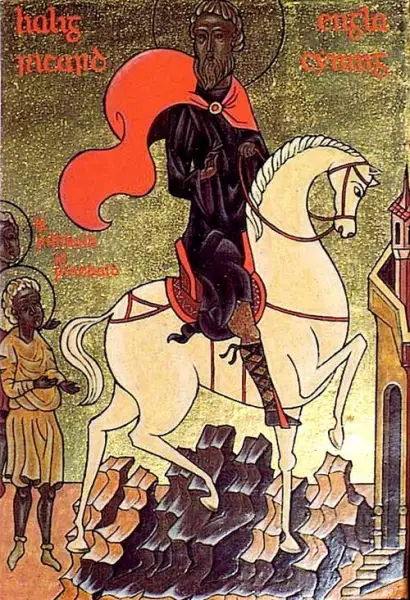
Richard's cult belongs to the ancient, unregulated pattern of local veneration: no decree of canonization exists, only the tomb at Lucca, the miracles reported there, and the devotion that gathered around them. The earliest source, the eighth-century Hodoeporicon of Hygeburg, never gives the saints' father a name, and the earliest martyrologies do not list him; the name Richard and the title King of the English were inventions of the tenth century at the monastery of Heidenheim, the house his children founded. By the twelfth century both Lucca and Eichstätt were showing his relics to public veneration, the two cities bound to his family, since his son Willibald became bishop of the latter see, and some of his relics were transported to that see. Artists show him as a kingly pilgrim wrapped in an ermine-lined mantle, his two sons at his side, one wearing the bishop's office and the other the abbot's, while his crown lies atop a book. He is especially honoured at Heidenheim and Lucca, and the single church in England dedicated to him, St Ricarius Church at Aberford, keeps his name in his homeland. In our own day Eastern Orthodox communities have revived his office: in 2022 and again in 2023 a Greek Orthodox parish in Somerville, Massachusetts, served an All-Night Vigil for him with newly composed chant and a new icon.
§ Veneration
Timeline
- 720
Entrusted his daughter Walpurga to the abbess of Wimborne, renounced his estates, and sailed from Hamblehaven near Southampton with his sons Willibald and Winibald.
§ Legend
- 720
Died of a fever at Lucca while on pilgrimage, and was buried in the church of San Frediano.
§ Legend
- 6 Feb 2022
A Greek Orthodox parish in Somerville, Massachusetts served a newly-composed All-Night Vigil office in his honour.
§ Veneration
- 6 Feb 2023
The same parish served the All-Night Vigil for him a second time.
§ Veneration
The Record
- Symbols
- Royal pilgrim in an ermine-lined cloak with his two sons·Crown lying on a book
- Canonization
- Pre-congregation; a cult arose at his tomb in Lucca soon after his death, and his relics were publicly displayed at Lucca and Eichstätt by the 12th century
Prayer
Bibliography
Show 12 sources
- February 20 / February 7. holytrinityorthodox.com.
- Rabenstein, Katherine I. (1998). "Saint of the Day: February 7". St. Patrick's Catholic Church. Washington, D.C. Richard the King (RM), quoting Roeder, Helen (1956). Saints and Their Attributes. Chicago: H. Regnery Co.
- Farmer, David (ed.), "Richard (d. 720)", in The Oxford Dictionary of Saints, 5th rev. ed. (Oxford University Press, 2011), p. 378.
- Burns, Paul, ed., Butler's Lives of the Saints: February (The Liturgical Press, 1998), pp. 68-69.
- Handbook of British Chronology, ed. Fryde et al., 3rd ed., RHS, 1986, p. 22.
- "St. Richard the Pilgrim". faith.nd.edu. Retrieved 2020-03-21.
- Monks of Ramsgate. "Richard". Book of Saints, 1921. CatholicSaints.Info. 6 February 2017.
- "Butler's Lives of the Saints – Saint Richard, King in England, and Confessor". CatholicSaints.Info. 2013-02-07.
- Casanova, Gertrude. "St. Walburga." The Catholic Encyclopedia Vol. 15. New York: Robert Appleton Company, 1912.
- "Prologue to the Hodoeporicon of St. Willibald". Huneberc of Heidenheim.
- "An All-Night Vigil for St. Richard of Wessex". www.orthodoxartsjournal.org. 10 May 2022.
- "Dormition of the Virgin Mary Greek Orthodox Church Weekly Bulletin, February 5, 2023". www.dormitionchurch.org.
Profile text adapted from the Wikipedia article, licensed CC BY-SA 4.0.
Pray with this saint every day
Save St. Richard the Pilgrim to your favorites, read the full profile, and get feast-day reminders in the Saints app.
Get the Saints AppFree on the App Store for iPhone and iPad