
c. 840 – 895·Feast September 18
St. Richardis
Carolingian empress and abbess of Andlau
Overview
Richardis, also called Richgard or Richardis of Swabia, was born in Alsace around 840, her father being Erchanger, the count who held the Nordgau, and her house that of the Ahalolfinger. In 862 she wed Charles, later known as Charles the Fat, and in 881 the two received their crowns in Rome from Pope John VIII, making her empress of the Carolingian realm. The marriage was childless, and when Charles's reign collapsed into crisis he and his courtiers accused her and the bishop Liutward of adultery, demanding an end to the marriage; the commission the pope established to weigh the matter found her to be a virgin in truth. Her family shielded her, and Richardis retired to Andlau Abbey, the house she had raised on family ground in 880, and there she lived out her remaining years. Celebrated for her piety, she came to be honoured as an exemplar of devotion and upright rule, and as the first abbess of Andlau. She died there on 18 September, probably in 895, and was buried in the abbey. Pope Leo IX canonized her in 1049 and translated her remains to a new tomb, and she is venerated as patron of Andlau and protector against fire.
The Complete Life
A Daughter of the Alsatian Nobility
Richardis was born in Alsace around 840, into the highest ranks of the Carolingian aristocracy. Her father was Erchanger, count of the Nordgau, and her family belonged to the Ahalolfinger, a house whose estates and influence stretched across the southern territories of the empire. In 862 she was married to Charles, a grandson of Louis the German whose improbable succession would eventually unite nearly the whole Carolingian world under his sceptre. The union was childless, a fact that would later be turned against her, but for two decades she fulfilled the role of a royal consort as her husband rose through the kingships of the Franks. Charles's reign, once attained, was beset from every side, above all by the plundering of Norman raiders who had pushed from the coasts deep into the river towns of the northern French countryside. Powerless to break the invasion despite military superiority, Charles bought the raiders' departure with silver, and the weakness of the crown deepened the factional rivalries of the court, rivalries in which the empress herself would soon be the victim. Through the marriage the imperial house was joined to one of the great kindreds of the southern lands, the kindred whose property would one day endow her own abbey.
§ Life
Empress of the Carolingians
In 881 Richardis travelled to Rome with her husband and was crowned empress by Pope John VIII, the height of Carolingian legitimacy in an age when the imperial title was contested among the descendants of Charlemagne. She reigned as empress until 888, and through those years the empire's fortunes waned: the northern coasts were plundered, the rivers were raided, and the court's inability to answer the Northmen with arms eroded Charles's authority. By 887 the emperor appeared to be succumbing to fits of madness. In the crisis Richardis strove to govern in the emperor's place, a loyal and capable effort that nonetheless failed amid the court's disintegration. Enemies found their instrument in her. Court factions hoping to topple Liutward, the powerful and resented archchancellor, or perhaps merely hoping to clear the way for a queen who might provide an heir, prevailed upon Charles and his counsellors to accuse the empress and the bishop of adultery. Charles asserted that their marriage had never been consummated and demanded a divorce; both Richardis and Charles in fact swore under oath in 887 that this was true of their marriage.
§ Life
The Ordeal and the Founding of Andlau
The charge of adultery was answered in a manner that fixed itself in memory. According to legend and her hagiography, Richardis was put to the ordeal by fire and passed it unharmed; in historical fact, the commission founded by the pope to consider the requested annulment reported simply that she was a virgin. Her honour publicly vindicated, she turned from the empire to the cloister. She had already exercised authority over religious houses as lay abbess of the monasteries at Säckingen and Zurich, and in 880, seven years before her marriage was dissolved, she had founded Andlau Abbey on her own ancestral lands in Alsace, where her niece Rotrod served as abbess. There, protected by her family, she withdrew after the collapse of her marriage, exchanging the title of empress for the habit of a nun. The legend preserved at Andlau tells that, disheartened by her husband's years of mistrust, she left the palace and wandered into the forest, where an angel directed her to found a convent on the spot a bear would show her. Another telling relates that she found a mother bear grieving over her dead cub, and that when she held the creature it returned to life; mother and cub were said to have remained devoted to her for the rest of their lives.
§ The Legend of Richardis
Abbess at Andlau
At Andlau, Richardis spent the last years of her life as the house's first abbess, governing the community she had planted on family soil and witnessing the growth of a monastery that would become one of Alsace's great religious houses. She died there on 18 September, aged about fifty-five, most probably in 895, and was buried in the abbey church, the imperial past set aside for the quiet of a nun's grave among her own nuns. The repudiated empress had become a model of devotion and of just rule, and her death in the habit she had chosen, in the abbey she had founded, closed a life whose two halves, palace and cloister, bore the same witness of integrity. The abbey long kept the memory of its founder in living custom: incorporating the mythos of the bear from her foundation legend, the nuns maintained a live bear and granted free board and passage to bear-keepers passing through the region, a hospitality that kept the story of the empress and the bear alive in the valley for generations. The niece who ruled the house during her withdrawal kept Andlau in the family's hands, and Richardis lived there as its first mother rather than as an imperial guest.
§ Life
Canonisation and the Tomb of 1350
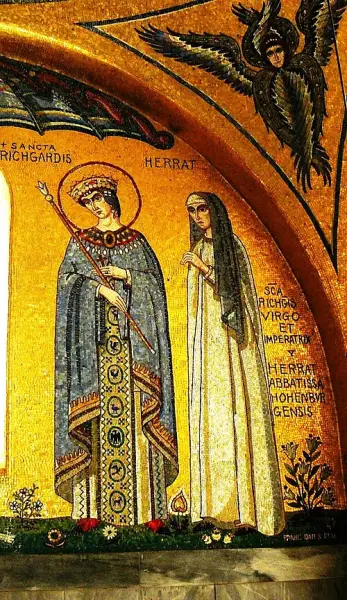
Veneration of Richardis grew at her tomb until, on 10 November 1049, Pope Leo IX canonized her, himself an Alsatian by birth with ties to the region's great houses. At the same time her remains were moved that month to a grander tomb within the abbey church of Andlau, rebuilt anew, a fitting elevation for the foundress whose cult had by then spread beyond the valley. The tomb that visitors see today dates from 1350, and above it the life of the saint has been depicted in the abbey's art, including a portrayal of Richardis alongside Herrad of Landsberg, the celebrated abbess of Hohenburg. Her iconography gathers the whole of her story into a few emblems: she is shown in imperial robes with crown and palm surrounded by flames, recalling her rank and her ordeal by fire, or dressed as a nun with the crown laid aside, holding burning pieces of wood, attended by a bear and a ploughshare that speak of the foundation legend of Andlau. She is invoked as patron of Andlau itself and as a protector against fires, the element that once tested her and could not harm her.
§ Veneration
Timeline
- 840
Born in Alsace around this year, daughter of Erchanger, count of the Nordgau.
§ Life
- 862
Married Charles, the future emperor Charles the Fat.
§ Life
- 880
Founded Andlau Abbey on her ancestral lands.
§ Life
- 881
Crowned empress in Rome alongside Charles by Pope John VIII.
§ Life
- 887
Accused of adultery amid her husband's crisis, she faced charges that ended in the demanded dissolution of her marriage.
§ Life
- 895
Died at Andlau Abbey on 18 September and was buried there.
§ Life
- 10 Nov 1049
Canonized by Pope Leo IX, who translated her remains to a more impressive tomb in the rebuilt abbey church.
§ Veneration
- 1350
The present tomb of the saint at Andlau was made.
§ Veneration
The Record
- Major works
- Andlau Abbey, founded 880 on her ancestral lands
- Patron of
- Andlau·Protection against fire
- Symbols
- Dressed in imperial robes with crown and palm, surrounded by flames·Dressed as a nun with crown laid aside·Burning pieces of wood·A bear·A ploughshare
- Canonization
- Canonized by Pope Leo IX on 10 November 1049
Prayer
Bibliography
Show 12 sources
- McKitterick, Rosamond (2018-10-08). The Frankish Kingdoms Under the Carolingians 751-987. Routledge. ISBN 978-1-317-87248-1.
- Frassetto, Michael (2013-03-14). The Early Medieval World: From the Fall of Rome to the Time of Charlemagne. Bloomsbury Publishing USA. ISBN 978-1-59884-996-7.
- "Richardis sainte", Fédération des Sociétés d'Histoire et d'Archéologie d'Alsace.
- Pac, Grzegorz (2022-03-07). Women in the Piast Dynasty: A Comparative Study of Piast Wives and Daughters (c. 965-c.1144). BRILL. ISBN 978-90-04-50853-8.
- Elliott, Dyan (2021-05-11). Spiritual Marriage: Sexual Abstinence in Medieval Wedlock. Princeton University Press. ISBN 978-1-4008-4434-0.
- Schaus, Margaret (2017-07-12). Routledge Revivals: Women and Gender in Medieval Europe (2006): An Encyclopedia. Routledge. ISBN 978-1-351-68158-2.
- Monumenta Germaniae Historica, tomus V; Bernoldi Chronicon, p. 421.
- Reuter, Timothy (2006-11-02). Medieval Polities and Modern Mentalities. Cambridge University Press. ISBN 978-1-139-45954-9.
- Ragnow, Marguerite (2006). The Worldly Cares of Abbess Richildis: Power, Property, and Female Religious in 11th-century Anjou. University of Minnesota.
- Patron Saints Index: Saint Richardis. Accessed 2012-07-13.
- Sauser, Ekkart (2000). "Richardis (Richarde, Richgarda, Richkart): hl. Kaiserin". In Bautz, Traugott (ed.). Biographisch-Bibliographisches Kirchenlexikon (BBKL). Vol. 17. Herzberg: Bautz. cols. 1141-1142. ISBN 3-88309-080-8.
- Wiegand, Wilhelm (1889). "Richgard". Allgemeine Deutsche Biographie. Vol. 28. Leipzig: Duncker & Humblot. pp. 420-421.
Profile text adapted from the Wikipedia article, licensed CC BY-SA 4.0.
Pray with this saint every day
Save St. Richardis to your favorites, read the full profile, and get feast-day reminders in the Saints app.
Get the Saints AppFree on the App Store for iPhone and iPad