
c. 560 – 645·Feast April 26
St. Richarius
Frankish monk, founder of Centule, and hermit of Crécy
Overview
Richarius, in French Riquier, was a Frankish hermit, monk, and founder of two monasteries, venerated in both the Catholic and Eastern Orthodox Churches. Born a pagan around 560 in the county of Ponthieu near Amiens, he converted to Christianity after sheltering two Welsh missionaries, Caidocus and Frechorius, whom his neighbours had driven away, blaming them for failed crops. For that act of welcome he later said he had received God's mercy. Once a Christian, he embraced a severe ascetic discipline, fasting on barley bread mixed with ashes and drinking nothing but water. Ordained a priest, he travelled to England, preaching the Gospel and curing the sick, riding a donkey rather than a horse and reciting the psalter as he went. In 638 he returned home and founded the monastery of Centule in Ponthieu, a house that followed the Rule of Saint Columbanus of Luxeuil and around which a settlement grew, later renamed Saint-Riquier. King Dagobert I visited the monastery, and Richarius addressed him with such frankness, without fear or flattery, that the king became its benefactor. Donations allowed Richarius to aid lepers, feed the poor, and ransom prisoners held in England. He founded a second monastery, Forest-Montier, but withdrew into the woods of Crécy, taking a hermit's dwelling some fifteen miles off, where he lived with his disciple Sigobart. He died there on April 26, 645, aged about eighty-five.
The Complete Life
The Pagan Who Sheltered Missionaries
Richarius was born in the late sixth century, around the year 560, into a pagan family in the county of Ponthieu, near Amiens in Picardy, in the north of the Frankish kingdom. His conversion came about through an act of simple hospitality. Two missionaries from Wales, Caidocus and Frechorius, arrived in the region preaching the Christian faith, and the local people received them with great hostility, blaming the strangers for the failure of their crops. Richarius alone gave them shelter in his home. Alcuin's revision of his life explains that, having welcomed God in the persons of those wanderers, he earned the divine mercy in return. Under the influence of the two missionaries he abandoned the religion of his fathers and became a Christian. The conversion was not a mere change of opinion but a total reorientation of his life: he took up an asceticism of startling severity, fasting on barley bread mixed with ashes and drinking only water, a discipline he maintained as the outward sign of an inward turning. The pattern of his whole career was set in that first act of charity, for the man who had opened his house to persecuted strangers went on to spend his life opening the faith of Christ to others, carrying the Gospel across the Channel and founding houses of prayer in his own homeland.
§ Life
Priest, Preacher, and Pilgrim to England
After his conversion Richarius was ordained a priest, and his ministry took him far beyond the fields of his native Ponthieu. He travelled to England, preaching the Gospel and curing the sick among its peoples, one of the Frankish clerics who carried the Christian mission across the sea in an age when the faith was still finding its footing among the kingdoms of Britain. The details of his journeys reveal the texture of the man. He refused the comfort of a horse and rode instead on a donkey, and as he rode he read the psalter, so that the psalms of David accompanied every mile of his missionary roads. The image sums up his vocation: humble in his means, tireless in his movement, and constant in prayer. After some years of this labour across the Channel he returned to Francia, and in 638 he founded a monastery in his own hometown in Ponthieu. The house was named Centule, or Centula, from the Latin Centum Turres, a hundred towers, and it followed the Rule of Saint Columbanus of Luxeuil, the austere Irish-inspired discipline then spreading through the Frankish church. Around the monastery a settlement arose which in the Middle Ages took the name Saint-Riquier, and whose inhabitants still call themselves Centulois more than a millennium later. The convert from Ponthieu had become a builder of the Church in the very place where he had once worshipped idols.
§ Life
Frank Speech Before a King
The monastery of Centule drew the attention of the highest power in the Frankish world. King Dagobert I himself came to visit the house, and Richarius offered the king advice face to face. He spoke with a frankness that became legendary: clear in his speech, without fear and without flattery, he told the monarch what a holy man was obliged to tell him rather than what a courtier would have preferred. Instead of taking offence, Dagobert became a benefactor of the monastery, and his patronage was matched by that of others who gave generously to Richarius's work. The saint directed this wealth not to his own comfort but to those his age abandoned. He used the money to help lepers, to relieve the poor, and to ransom prisoners held in England, freeing captives whose liberty had been sold for a price. In this way the monastery of Centule became a centre of mercy as well as prayer, and its founder demonstrated that the ascetic who ate bread and ashes could nonetheless handle great wealth without corruption. Richarius went on to found a second monastery, Forest-Montier, extending the work he had begun. Yet the more his foundations flourished, the more he inclined toward solitude, preparing for the final withdrawal that would close his life in the woods of Crécy, fifteen miles from the monasteries he had built.
§ Life
Ashes, Water, and the Psalms
The spirituality of Richarius joined radical bodily austerity to unceasing Scripture and unworldly courage. From the moment of his baptism he practised a fasting of extreme rigour: barley bread mixed with ashes was his food, and water his only drink, a programme of mortification in the tradition of the desert fathers transplanted to Frankish soil. Upon the back of a donkey, in place of a warhorse, he made his missionary journeys with the psalter ever in his hands, letting the psalms of David shape his speech and his silence alike. His boldness before King Dagobert flowed from the same source, for a man who has disciplined his body has little fear of princes, and Richarius addressed the most powerful ruler in Francia without fear or flattery, an example of pastoral courage that won the king's respect rather than his anger. His charity completed the pattern: the gifts that flowed to his monastery from royal and noble patrons were poured out for lepers, for the poor, and for the ransoming of captives in England, so that money passed through his hands without stopping there. In his last years the ascetic impulse carried him to its logical end, out of the abbeys he governed and into a simple shelter in the forest of Crécy, where with one disciple as companion he gave himself to contemplation. The flowering wintercress was later dedicated to his memory, blooming near his spring feast.
§ Life
The Hermit of Crécy
Richarius ended his life as he had honoured God throughout it, in withdrawal and prayer. Having founded Centule and Forest-Montier and administered their affairs, he retired fifteen miles from his monastery into the forest of Crécy, where he made a shelter and embraced the hermit's life. His only companion was his disciple Sigobart, who shared the solitude of the woods with the aged founder. The man who had converted as a layman, preached in England, founded two monasteries, and rebuked a king, finished his days in the silence of a forest cell, the classical pattern of the monk whose active work done, he passes to pure contemplation. On April 26, 645, Richarius bid his disciple farewell and died, at about eighty-four or eighty-five years of age, having been born a pagan in that same region some eight decades before. His body was first laid in a coffin made from an oak trunk, a humble resting place befitting a hermit, before being translated to the abbey of Centule, where an abbey church rose above his tomb and eventually took his name, as did the surrounding city. The Roman Martyrology records him simply as Saint Richarius, priest and confessor, in the monastery of Centula in France, keeping his memory on the twenty-sixth day of April, the day of his holy death.
§ Life
A Saint of East and West
Richarius was venerated as a saint from the generation after his death, without the formal processes of later centuries; his canonization belongs to the pre-congregational age in which popular devotion and episcopal recognition raised holy men to the altars. His cult centred on the abbey built over his tomb at Centule, which came to bear his name as Saint-Riquier, and his memory was fixed in the universal calendars of the Church: the Roman Martyrology commemorates Saint Richarius, priest and confessor, at the monastery of Centula in France on April 26. He is honoured in the Eastern Orthodox Church as well as the Roman Catholic Church, one of the Frankish saints whose fame crossed the confessional and regional boundaries of Christendom. His relic cult flourished spectacularly in the Carolingian age: about one hundred and fifty years after his death, Charlemagne enclosed the relics in a golden shrine and had the celebrated Saint-Riquier Gospels made to accompany them, and in 950 Count Arnulf I of Flanders moved the bones to Montreuil and the Abbey of Saint Bertin in present-day St-Omer, before Hugh Capet restored them to St-Riquier in 980. A second feast, kept on October 9, celebrates the translation of his relics, so that the calendar of Saint-Riquier marks both his death and the journey of his body through Frankish history.
§ Veneration
The Name That Remained
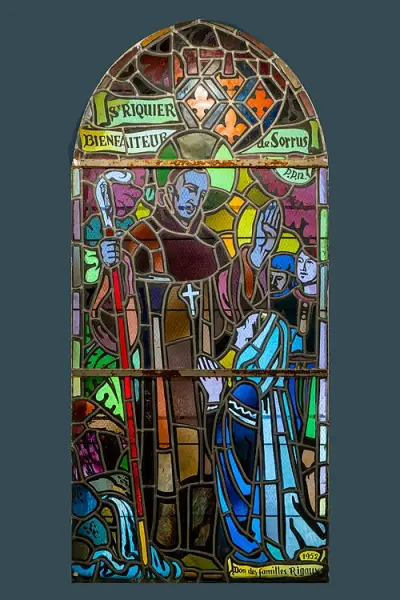
Few missionaries of the Merovingian age left their name upon the map as durably as Richarius. The monastery he founded at Centule gave rise to a town renamed Saint-Riquier in his honour, whose inhabitants to this day call themselves Centulois in memory of the Latin Centum Turres, the hundred towers of the abbey's name. His name likewise rests on two Norman villages, Saint-Riquier-en-Rivière as well as Saint-Riquier-ès-Plains, and the great Abbey of Saint-Riquier, built above his tomb, remained for centuries one of the glories of Picardy. The Carolingian association with his shrine produced the Saint-Riquier Gospels, commissioned by Charlemagne to rest beside the golden shrine that enclosed the saint's bones. Medieval devotion found gentler expressions as well: monks compiled catalogues assigning a flower to each day of the year, chosen for blooming near a saint's feast, and to Richarius they dedicated the yellow rocket or wintercress, Erysimum barbarea, which flowers around April 26. In the church of St. Omer at Houchin his statue has long been invoked for the protection of children, extending his patronage into the family life of later generations. Stained glass in the church of Saint-Riquier at Sorrus in Pas-de-Calais keeps his image before the faithful, and his story has reached modern readers through the lives compiled by Butler and the monastic martyrologies of the Church.
§ Veneration
Timeline
- 560
Born a pagan in the county of Ponthieu near Amiens, in the north of Francia.
§ Life
- 638
Founded the monastery of Centule in his hometown in Ponthieu, under the Rule of Saint Columbanus.
§ Life
- 26 Apr 645
Bade farewell to his disciple Sigobart and died as a hermit in the forest of Crécy.
§ Life
- 800
Charlemagne enclosed Richarius's relics, first buried in an oak coffin, in a golden shrine at the abbey of Centule and commissioned the Saint-Riquier Gospels for it.
§ Veneration
- 950
Count Arnulf I of Flanders transferred the saint's bones to Montreuil and then to the Abbey of Saint Bertin at St-Omer.
§ Veneration
- 980
Hugh Capet returned the relics to the abbey of St-Riquier.
§ Veneration
In Their Own Words
welcomed God in the persons of the travelers ... this was why he was granted God's mercy
The Record
- Major works
- Foundation of the monastery of Centule (Centula), later the Abbey of Saint-Riquier·Foundation of the monastery of Forest-Montier·Hermitage in the forest of Crécy
- Patron of
- Protection of children
- Symbols
- Donkey and psalter·Monastic habit of a hermit·Barley bread
- Canonization
- Pre-congregation canonization; venerated as a saint in the Catholic and Eastern Orthodox Churches from early times
Prayer
Bibliography
Show 6 sources
- Schäfer, Joachim. "Richarius von Centula". Ökumenisches Heiligenlexikon.
- Jones, Terry. "Saint Richarius of Celles". Patron Saints Index. Retrieved June 5, 2010.
- Michałowski, Roman. The Gniezno Summit: The Religious Premises of the Founding of the Archbishopric of Gniezno. BRILL, 2016. ISBN 9789004317512, p. 165.
- Butler, Alban (1866). The Lives of the Fathers, Martyrs, and Other Principal Saints. Vol. IV. Dublin: James Duffy. pp. 262–263.
- Monks of Ramsgate. "Richarius". Book of Saints, 1921. CatholicSaints.Info, 12 November 2017.
- Confraternity of Ss. Peter & Paul. "April 26". The Roman Martyrology. Retrieved June 5, 2010.
Profile text adapted from the Wikipedia article, licensed CC BY-SA 4.0.
Pray with this saint every day
Save St. Richarius to your favorites, read the full profile, and get feast-day reminders in the Saints app.
Get the Saints AppFree on the App Store for iPhone and iPad