
c. 995/1000 – 1063·Feast March 21
St. Richeza of Lotharingia
Queen of Poland and Benedictine benefactor of Brauweiler
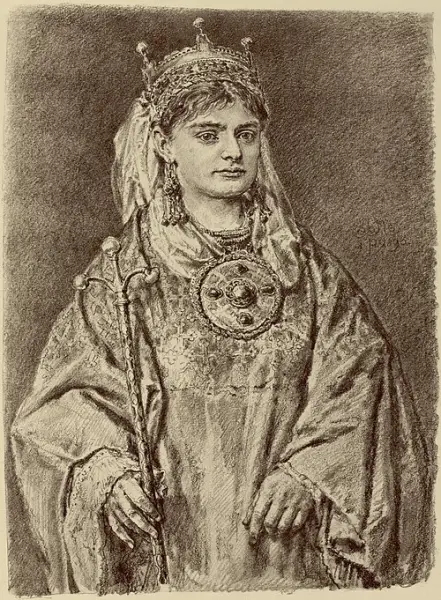
Overview
Richeza of Lotharingia — Richenza, Rixa, and Ryksa are variants of her name — belonged to the Ezzonen dynasty and reigned as queen consort of Poland through her marriage to Mieszko II Lambert. Her birth fell about 995/1000; she was the eldest daughter of Count Palatine Ezzo of Lotharingia and Matilda, daughter of Emperor Otto II, she was betrothed as part of the Polish-German settlement reached at the Congress of Gniezno in 1000, and married Mieszko at Merseburg. After the Peace of Bautzen in 1018 the couple kept close ties with the German court, and on Christmas Day 1025 she and her husband were crowned king and queen of Poland in Gniezno Cathedral. The reign collapsed in 1031 when German and Kievan armies invaded; Richeza fled to Germany with her children and, after Mieszko's sudden death in 1034 and a further flight from Poland in 1037, never returned. Settled at Saalfeld and later Klotten, she supported her son Casimir's recovery of the Polish throne. When her brother Duke Otto II of Swabia, the last male Ezzonen, died in 1047, she laid her jewels on the altar at his burial and vowed to pass her remaining days under the veil, giving her vast inheritance to the keeping of the Ezzonen memory, above all by rebuilding the Abbey of Brauweiler. She died at Saalfeld on 21 March 1063 and has been beatified.
The Complete Life
A Granddaughter of Emperors
Richeza was born about 995/1000, the eldest daughter of Count Palatine Ezzo of Lotharingia and his wife Matilda, the daughter of Emperor Otto II and the Byzantine princess Theophanu. Her parents had married in 993, and their union joined one of the greatest comital houses of the Rhineland to the blood of the Saxon emperors. Of the seven daughters of that marriage, Richeza stood first, and her imperial grandmother's name and inheritance placed her among the most marriageable princesses in Europe. In the judgement of the Polish historian Kazimierz Jasiński, she stood a few years below the man she would eventually wed in age, Mieszko II Lambert, son and heir of Bolesław the Brave. The match was devised at the very summit of Ottonian diplomacy: at the Congress of Gniezno in the year 1000, her uncle Emperor Otto III met Bolesław and apparently agreed to bind the Polish Piast dynasty to the imperial family through marriage. Otto's childlessness made the daughters of his sister Mathilde the natural brides for the Polish heir, and the eldest niece, Richeza, was chosen. The plan was delayed by Otto's unexpected death in 1002, by the changed politics of his successor Henry II, and by wars between Henry and Bolesław, so that the imperial child grew to womanhood while emperors and Polish dukes negotiated around her future.
§ Family and betrothal
Queen of Poland
The wedding was finally celebrated at Merseburg, probably during the festivities of Pentecost, once the Empire and the Ezzonen reached a settlement and a temporary peace was negotiated with Poland. After the definitive Peace of Bautzen of 1018, the royal couple kept up close ties with the German court, and in 1021 the couple together attended the consecration of part of Bamberg Cathedral, appearing as a royal pair in the orbit of the empire from which the bride had come. Bolesław the Brave died on 17 June 1025, and six months later, on Christmas Day, Archbishop Hipolit of Gniezno crowned Mieszko II Lambert and Richeza together as king and queen of Poland in that city's cathedral. Her queenship was brief and stormy. In 1031 a joint invasion of German and Kievan forces overthrew Mieszko, who fled to Bohemia and was imprisoned and mutilated there; his half-brother Bezprym seized the government and persecuted the fallen king's followers. The Brauweiler Chronicle relates that Richeza fled to Germany with her children and the Polish regalia, which were handed to Emperor Conrad II, and that she afterwards mediated the peace between Poland and the Empire, though modern historians discount that account. The couple never reunited; some sources describe them as divorced, others as separated. Mieszko recovered and reunified Poland by 1033, but he died suddenly on 10 or 11 July 1034, probably murdered in a conspiracy.
§ Queenship
Exile and the Survival of a Dynasty
Her husband dead and her sons' throne in collapse, Richeza spent her remaining decades as the guardian of two heritages, Polish and Ezzonen. Her young son Casimir was at the court of her brother Hermann II, Archbishop of Cologne, when he came of age to claim the Polish crown; in 1037 he returned to Poland, Richeza apparently accompanying him, but an uprising of the barons, joined by the so-called Pagan Reaction among the common people, forced the two of them back into Germany, and she never saw Poland again. From Saalfeld, a possession granted to her in the redistribution of her father's inheritance, she led the Polish opposition in support of Casimir, whose throne was at last secured in 1039 through Conrad II's help. She went on to call herself queen of Poland, a privilege the emperor confirmed, and from 1040 to 1047 she lived at Klotten in the Moselle region. Then, on 7 September 1047, her brother Duke Otto II of Swabia — the last male of the Ezzonen — died, and with him his family's territorial and political ambitions; Richeza inherited great parts of the Ezzonen possessions. At Otto's funeral in Brauweiler — so Bruno of Toul, the future Pope Leo IX, relates — she laid her fine jewellery on the altar and announced that her remaining days belonged to the cloister, so that the memory of her dynasty might be preserved and its rights secured.
§ Return to Germany
The Jewels on the Altar
The gesture at her brother's funeral revealed the spiritual logic of Richeza's later life. A queen in exile, she had clung for years to her title and to the cause of her son's throne; when Otto's death extinguished the male line of the Ezzonen, she renounced the world's ornaments in a single public act, placing her jewels upon the altar of Brauweiler and declaring herself a nun for the rest of her days. As a religious she took monastic vows after 1047, and her concern shifted from dynastic power to dynastic memory, from territory to prayer. Her dealings with churchmen show a shrewd piety: she and her sister Theophanu, Abbess of Essen, together with Archbishop Hermann II of Cologne, transferred Brauweiler Abbey to the Archdiocese of Cologne by the charter of 17 July 1051, hoping to secure the cohesion of the family's property under episcopal protection; when Archbishop Anno II later pressed his diocese's advantage, she countered by renouncing her Brauweiler holdings to the monastery on the Moselle while reserving their use for life, and made similar arrangements at Saalfeld for the Diocese of Würzburg. In 1054, in grants made to Brauweiler, she made known her wish to lie there beside her mother, asking that her body rest where the Ezzonen memory would be kept alive in prayer. Her Gospel Book, filled with prayers and memorials for her family, survives as evidence of that interior life.
§ Return to Germany
Saalfeld and the Disputed Grave
The reorganization of the Ezzonen inheritance on which Richeza had staked her last years miscarried when Archbishop Hermann II, on whom she had relied, died in 1056. His successor Anno II of Cologne sought to enlarge his see at the Ezzonen's expense, and Richeza answered with the legal countermeasures that secured Brauweiler and Saalfeld for the church while preserving her own use of the lands. In the end she retained direct rule only over the towns of Saalfeld and Coburg, together with the lifelong right to the revenues of seven Rhineland locations and an annual pension of one hundred silver pounds from the Archdiocese of Cologne. There, in the Franconian town that had been her refuge since her first flight from Poland, she died on 21 March 1063. Her burial became a contest of wills: she had wished to lie at Brauweiler beside her mother, but Archbishop Anno II appealed to an oral agreement and had her buried in the church of St. Maria ad Gradus in Cologne instead. Brauweiler Abbey invoked the charter of 1051 and demanded the queen's remains, and in 1090 Archbishop Hermann III ruled in the monastery's favour. Yet her grave stayed at St. Maria ad Gradus until 1816, the year of its transfer to Cologne Cathedral, where it rests in the chapel of St. John the Baptist beneath medieval portraits of Richeza and Anno II.
§ Heritage
Blessed Richeza
Richeza has been beatified, and her cult has been attached from the beginning to her tomb and relics. She was buried with royal honours in Cologne, and the medieval grave in the church of St. Maria ad Gradus bore portraits of the queen; the surviving images, now hanging beside her sarcophagus in Cologne Cathedral, testify to a devotion that outlasted the dynastic quarrels of the eleventh century. Her remains were opened several times after the transfer to the cathedral, most recently in 1959, when witnesses described a woman of small and graceful stature whose collarbone carried the traces of an old fracture — the physical remains of a life spent in flight, exile, and penance. Her relics were long kept in the church of St. Nicholas at Brauweiler, the abbey she had rebuilt and endowed, and in 2002 they were moved to the Klotter parish church, where they continue to be venerated. The Cologne cathedral chapter preserves a wall tomb and shrine to the Blessed Richeza of Lotharingia, and her memory is kept on the day of her death, 21 March. The precise date and pontiff of her beatification have not come down to us, but her cult at Cologne and Brauweiler has endured for nearly a millennium, honouring the queen who exchanged a crown for the stability of a nun's vow.
§ Heritage
Brauweiler and the Gospel Book
The most important of Richeza's works was the rebuilding of the Abbey of Brauweiler, founded by her parents but furnished too modestly for the dynasty's dignity. She resolved to make it the centre of Ezzonen memory, and raised there a new three-aisled pillared basilica with a projecting transept, an eastern apse over a crypt, groined vaults in the aisles, and a flat ceiling in the central nave, its cross-vaulting echoing other Ezzonen buildings and the church of St. Maria im Kapitol in Cologne, founded by her sister Ida. The building is seen as a copy of the old Cologne Cathedral, probably through the influence of her brother Hermann II. The crypt's consecration took place on 11 December 1051, with the finished church dedicated on 30 October 1063, seven months after her death. She made Brauweiler the family crypt, interring her sister Adelaide, Abbess of Nivelles, in 1051 and transferring her father's remains from Augsburg in 1054. To her memory also belongs the Gospel Book of Queen Richeza, now in the Universitäts- und Landesbibliothek Darmstadt: a manuscript of 153 pages, probably produced around 1040 in Maasland, containing 150 pages of prayers and entries recording the Ezzonen memorial in Richeza's own circle, with its evangelist portraits left unfinished — a monument to the learning and piety of the last great figure of her house.
§ Legacy
Timeline
- 1000
At the Congress of Gniezno, Emperor Otto III and Bolesław the Brave agreed to unite their houses by marrying Richeza to Mieszko II.
§ Family and betrothal
- 1018
After the Peace of Bautzen between the Empire and Poland, the couple kept up steady ties with the German court.
§ Queenship
- 1021
Richeza and Mieszko took part in the consecration of part of Bamberg Cathedral.
§ Queenship
- 25 Dec 1025
Crowned with Mieszko II as queen of Poland by Archbishop Hipolit of Gniezno in Gniezno Cathedral.
§ Queenship
- 1031
Fled to Germany with her children and the Polish regalia after the invasion that deposed Mieszko II.
§ Queenship
- Jul 1034
Mieszko II died suddenly, probably by conspiracy, leaving Richeza a separated wife in Germany.
§ Queenship
- 1037
Returned to Poland with her son Casimir, but a barons' rebellion and the Pagan Reaction forced them both to flee to Germany again.
§ Queenship
- 1039
With imperial help, her son Casimir finally obtained the Polish throne, aided by the Polish opposition Richeza led from Saalfeld.
§ Return to Germany
- 1040
Took up residence at Klotten in the Moselle region, where she lived until 1047.
§ Return to Germany
- 7 Sep 1047
Her brother Duke Otto II of Swabia, last male of the Ezzonen, died; at his funeral Richeza laid her jewellery on the altar and vowed to become a nun.
§ Return to Germany
- 17 Jul 1051
A charter recorded her part in the reorganization of the Ezzonen properties and the transfer of Brauweiler Abbey to the Archdiocese of Cologne.
§ Return to Germany
- 11 Dec 1051
The crypt of her new abbey church at Brauweiler was consecrated.
§ Legacy
- 1054
Transferred her father's remains from Augsburg to Brauweiler and expressed her wish to be buried there beside her mother.
§ Legacy
- 21 Mar 1063
Died at Saalfeld, retaining direct rule over Saalfeld and Coburg.
§ Return to Germany
- 30 Oct 1063
The abbey church she had built at Brauweiler was consecrated, seven months after her death.
§ Legacy
- 1090
Archbishop Hermann III of Cologne ruled that her remains belonged to Brauweiler, ending the dispute over her grave.
§ Heritage
- 1816
Her grave, which had remained in the church of St. Maria ad Gradus, was transferred to Cologne Cathedral.
§ Heritage
- 2002
Her relics, kept in the church of St. Nicholas at Brauweiler, were moved to the Klotter parish church.
§ Heritage
The Record
- Major works
- Rebuilding of the Abbey of Brauweiler as the dynastic church and memory-centre of the Ezzonen·Transfer of Brauweiler Abbey to the Archdiocese of Cologne by the charter of 17 July 1051·Dynastic burials of her sister Adelaide and her father Ezzo at Brauweiler·The Gospel Book of Queen Richeza, now in the Universitäts- und Landesbibliothek Darmstadt
- Symbols
- Crown and royal mantle·Abbess's veil·Model of Brauweiler Abbey
- Canonization
- Beatified; venerated as Blessed Richeza of Lotharingia, with a cult centred on her relics at Cologne and Brauweiler
Prayer
Bibliography
Show 6 sources
- Bernhardt, John W. (2002). Itinerant Kingship & Royal Monasteries in Early Medieval Germany, c.936-1075. Cambridge University Press, p. 310.
- Jasiński, Kazimierz (1992). Rodowód pierwszych Piastów. Warszawa - Wrocław, pp. 115-116.
- Robinson, I.S. (2008). Eleventh-century Germany: The Swabian chronicles. Manchester University Press, p. 83.
- Wilson, Peter H. (2016). Heart of Europe. Harvard University Press, Tree 2.
- "Wall tomb and shrine to the Blessed Richeza of Lotharingia". Kölner Dom. Archived from the original on 22 July 2019. Retrieved 9 April 2019.
- Michael Anne Guido and John P. Ravilious, "From Theophanu to St. Margaret of Scotland: A study of Agatha's ancestry", Foundations, vol. 4 (2012), pp. 81-121.
Profile text adapted from the Wikipedia article, licensed CC BY-SA 4.0.
Pray with this saint every day
Save St. Richeza of Lotharingia to your favorites, read the full profile, and get feast-day reminders in the Saints app.
Get the Saints AppFree on the App Store for iPhone and iPad