
c. 612 – 676/691·Feast May 12
St. Rictrude
Gascon noblewoman, widow, and abbess of Marchiennes
Overview
Rictrude, also called Rictrudis or Richtrudis, was a Gascon noblewoman who became abbess of Marchiennes Abbey in Flanders and one of the great matrons of Merovingian sanctity. Born around 612 in Gascony to a noble and devout family — her father was Ernold and her mother Lichia — she came under the spiritual direction of the missionary bishop St. Amandus, exiled to Gascony by Dagobert I. Against the violent opposition of her parents she married Adalbald, a Frankish nobleman of the courts of Dagobert I and Clovis II, during a military expedition in her homeland. The couple lived at Marchiennes and had four children, every one of whom was later honoured as a saint: Maurontus of Douai, and the daughters Clotsendus, Eusebia of Hamage, and Adalsinda. Their youngest child had scarcely been born when Adalbald was murdered on the road toward Gascony, perhaps at the instigation of Rictrude's own father, angered that his daughter had wed a foe of his people. On Amandus's counsel, Rictrude raised an abbey and monastery at Marchiennes; when the king demanded that she remarry one of his officials, she resisted with gifts of flattery answered by resolve, culminating in a banquet at which she publicly veiled herself. Clovis II finally permitted her entry into Marchiennes, a double monastery she governed for forty years. She died there aged seventy-four, between 676 and 691.
The Complete Life
A Daughter of Gascony
Rictrude was born around 612 in Gascony, a frontier region of the Frankish world then shaken by Basque raids across the Pyrenean marches, in the reign of Clothar II. Her family is described by her biographers as noble and devout, most likely of the Gascon aristocracy; her father was named Ernold and her mother Lichia. The region of her birth gave her Vita occasion to describe her as an exception predestined to sanctity, raised in a land still largely pagan. As a young girl she came under the guidance of the most imposing missionary of the age, St. Amandus, the bishop and evangelist of Flanders whom Dagobert I had exiled to Gascony; from the exiled preacher the noble daughter received her first formation in the faith, a bond that would shape every subsequent turn of her life. Her own account of those years survives through the hagiography written five centuries later, the Vita Sanctae Rictrudis, composed in 907 by Hucbald, a Benedictine monk of Saint-Amand Abbey, at the commission of the abbey she would one day govern. Through that text the Gascon girl appears as she was remembered at Marchiennes: devout from childhood, marked out by her holiness, and prepared by Providence in a pagan country for a marriage that would join two peoples and fill the calendar of Flanders with saints.
§ Life
Marriage Against Opposition
The decisive event of Rictrude's youth was her marriage to Adalbald, a Frankish nobleman remembered by the Church as a saint. Her Vita tells how the Frank beheld her, grew to love her, and set her apart for himself; the biographer names him a fully worthy man for the worthy Rictrude, though her parents opposed the union with violence, offended that their daughter should marry a man of the people who had raided their homeland. The wedding took place during a military expedition in Gascony, amid the Frankish penetration of the south, and the marriage joined the conquered region's nobility to the conquering court: Adalbald was a loved and honoured member of the households of Dagobert I and Clovis II. The couple settled at Marchiennes in the north, where Adalbald owned land, and their life together is described as devout and joyful. Four children were born to them, all later named as saints: a son, Maurontus of Douai, who served as a court official before his ordination as priest and abbot, and three daughters — Clotsendus, destined to take her mother's place as abbess, Eusebia of Hamage, abbess at Hamage, and Adalsinda, a nun of the same house. The baptisms of the children were entrusted to the most eminent churchmen of their day: Maurontius by the hermit monk St. Richarius, Clotsendus by St. Amandus himself, while Queen Nanthild, wife of Dagobert, stood godmother to Eusebia.
§ Life
Widowhood and the Veil at the Banquet
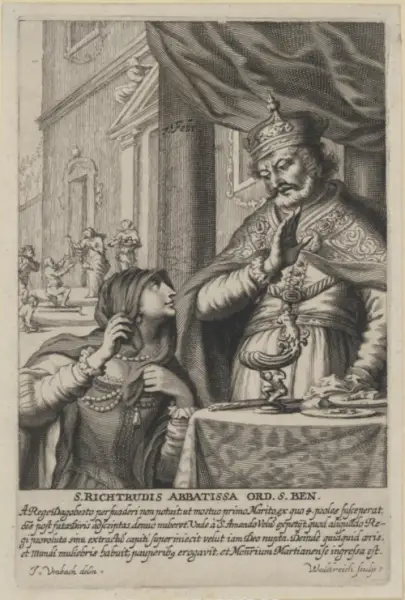
Not long after their youngest child was born, Adalbald was murdered on the road from Marquette-en-Ostrevant toward Gascony, perhaps at the hands of Rictrude's own father, enraged that his daughter had wed a foe of his people. The Vita records that she mourned him deeply, and from her grief came the works by which she is remembered. Amandus, her spiritual guide from her earliest years, urged her to establish an abbey and monastery at Marchiennes, turning her household lands into a house of God; he further advised her, once her son Maurontus came of age, to enter the religious life herself. The king — not named in the Vita but probably Dagobert I — was determined otherwise, resolved that the rich widow should marry one of his officials. He began with gifts and flattery, and when those failed he turned to threats. Rictrude pretended to comply while remaining constant in her vows to serve God, as Amandus promised to use his influence to win the royal consent. At length she staged a dramatic public declaration: hosting a banquet for the king and his court at her villa in Boiry, she rose at the height of the feast and, declining to raise her cup to her guests, drew over her head the veil Amandus had blessed, showing before them all her longing for the religious life. The king left in anger, but Amandus mediated a reconciliation, and Clovis II permitted her to enter Marchiennes Abbey.
§ Life
Holy Widowhood in a Violent Age
Rictrude's sanctity took the form of her station: wife, mother, widow, and finally abbess, each state consecrated. Her marriage to Adalbald was remembered as devout and joyful, a union that produced four saints and bound the Gascon and Frankish worlds in a family of holiness. Her widowhood she transformed from an occasion of mourning into an act of foundation, raising at Marchiennes a double monastery whose prayer would outlive the dynasty that had murdered her husband. Her resistance to the king's demand for remarriage expressed a spirituality of vowed fidelity rather than mere obstinacy; the veil she took up at the banquet had been blessed by Amandus, and she wore it as the seal of a promise already made to God. Modern historians have placed her choice in its political setting: scholars such as Jo Ann McNamara show that noblewomen of that era, often banding together as families, took up the religious life and planted enduring houses across the kingdom's north and east — a practice that withdrew land and power from the grasp of secular politics, and what McNamara describes as a deliberate family plan for steering riches and daughters beyond the predatory king and his ambitious courtiers. Rictrude's forty years as abbess embodied that deployment of women in religious service, joining administrative skill to, above all, charitable activity.
§ Life
Forty Years at Marchiennes
Having gained the king's permission to enter religious life, Rictrude passed from her villa and her widow's independence into the abbey she had founded at Marchiennes, a double monastery housing communities of men and women under one rule. There she exercised the office of abbess for forty years, directing the growth of the house her grief had built and forming the generation of holy women who carried its tradition forward. Her own family continued the work around her: her son Maurontus forsook the court to become a priest and abbot, and her daughters filled the abbacies and convents of the region, Clotsendus destined to take her mother's place, Eusebia ruling at Hamage, Adalsinda living as a nun there until her early death, which came before her mother's own passing. Rictrude's death came at Marchiennes in her seventy-fourth year, at a date the sources place between 676 and 691, closing a life that had stretched from the Gascon raids of Clothar II's last years to the eve of the Merovingian decline. Historians count her a significant figure in the current that would end with the Merovingian dynasty's replacement during the mid-eighth century: the houses founded by women like her shifted the wealth and loyalty of the northern aristocracy from the king's court to the cloister, and Marchiennes stood among the monuments of that great change.
§ Life
Veneration at Her Tomb
Rictrude was honoured as a saint from the generations following her death, her canonization belonging to the pre-congregation age in which the cult of a holy abbess arose at her tomb and spread through the region. Her Vita records miracles worked through her intercession after her death: the blind recovered their sight, the mute their speech, the paralysed their limbs, and sufferers of high fevers and various illnesses their health. Her body remains entombed at Marchiennes, the abbey she founded and governed, and several churches in Flanders were dedicated to her memory, a mark of the devotion she inspired across the region where her family had planted the monastic life. Her feast is kept in the Catholic Church on May 12, the day on which Butler's Lives of the Saints commemorates St. Rictrudes, Abbess. According to the historian Jo Ann McNamara, she is still venerated in modern Belgium, where the memory of the Marchiennes saints — Rictrude, Adalbald, and their four children — endured through the centuries in local piety. No formal process of canonization is recorded, for she belongs to the company of Merovingian saints whose cults were authenticated by continuous popular and monastic veneration rather than by papal decree.
§ Life
A Family of Saints and a Five-Century Memory
Rictrude's most extraordinary legacy was her family, a household in which every member reached the altars: her husband Adalbald, honoured as a martyr; her son Maurontus of Douai, court official turned abbot; and her daughters Clotsendus, Eusebia of Hamage, and Adalsinda, abbess and nun of the Flemish houses. Together they made Marchiennes and Hamage centres of sanctity whose fame endured for centuries in Flanders. The survival of her story owes much to the abbey's own memory-keeping: in 907, three centuries after her death, the monk Hucbald of Saint-Amand composed the Vita Sanctae Rictrudis at the abbey's commission, fixing in elegant Latin the Gascon marriage, the murder, the veil at the banquet, and the forty years of rule that modern historians still mine for the history of Merovingian women. Scholars have read her life in two keys at once: as hagiography celebrating a predestined saint from a pagan land, and as evidence for the social strategies of the early medieval aristocracy, in which women like Rictrude diverted family wealth from predatory courts into enduring religious foundations. Several churches in Flanders dedicated to her, her entombment at Marchiennes, and her continued veneration in modern Belgium attest that the Gascon bride who defied a king remains a living presence in the Low Countries nine centuries after Hucbald wrote her Life.
§ Life
Timeline
- 612
Born in Gascony to the noble couple Ernold and Lichia, during the reign of Clothar II.
§ Life
- 635
Her daughter Clotsendus is recorded as succeeding her as abbess.
§ Life
- 676
Died at Marchiennes at the age of 74; the date of her death is placed between 676 and 691.
§ Life
- 907
The Benedictine monk Hucbald composed the Vita Sanctae Rictrudis at Saint-Amand Abbey, the main source for her life.
§ Life
In Their Own Words
A certain Frank—born Adalbard, child of a just and noble stock, saw [Rictrude], loved her and chose her for his own
a fully worthy man who would take the worthy Rictrude in marriage
The Record
- Major works
- Foundation of the abbey and monastery of Marchiennes, a double monastery she governed for forty years
- Symbols
- Abbess's veil·Crozier·Model of Marchiennes Abbey
- Canonization
- Pre-congregation canonization; venerated in the Catholic Church from the early Middle Ages, feast on May 12
Prayer
Bibliography
Show 6 sources
- McNamara, Jo Ann; Halborg, John E.; Whatley, E. Gordon (1996). "Rictrude, Abbess of Marchiennes". Sainted Women of the Dark Ages. Duke University Press. pp. 195-219. ISBN 0-8223-1200-X.
- Uge, Karine (2005). Creating the Monastic Past in Medieval Flanders. Woodbridge, U.K.: York Medieval Press. ISBN 1-903153-16-6.
- Butler, Alban (1866). "St. Rictrudes, Abbess". The Lives of the Saints. Vol. 10.
- Wasselvnck, René (1 November 2008). "Saint Adalbald the Martyr". Santi Beati.
- "Saint Clotsinde". Nominis.
- "Santa Rictrude: Spouse, Abbess". Santi e Beati.
Profile text adapted from the Wikipedia article, licensed CC BY-SA 4.0.
Pray with this saint every day
Save St. Rictrude to your favorites, read the full profile, and get feast-day reminders in the Saints app.
Get the Saints AppFree on the App Store for iPhone and iPad