
died c. 689·Feast Unknown
St. Rieul of Reims
Bishop of Reims in the age of Ebroin's wars
Overview
Rieul was Bishop of Reims from 673 to around 689, in the turbulent final decades of the Merovingian kingdom, and is remembered as a saint of the French Church. His episcopate fell in the age of Ebroin, the powerful and ruthless mayor of the palace of Neustria, whose cause Rieul supported. In that allegiance he stood with a company of bishops — Praejectus, Agilbert of Paris, and Ouen of Rouen — who held a council at Marly near Paris and sat in judgement on Leger, the bishop of Autun and Ebroin's great enemy. The politics of the party proved deadly: Praejectus's murderer may have been a partisan of Leger, and Leger himself was murdered on 2 October 679. After the Austrasian dukes went down in the Battle of Lucofao, fought at the turn of 679 and 680, Rieul was drawn into the episode for which his name is chiefly recalled. Martin, one of the fleeing dukes, took refuge at Laon; Rieul and a certain Agilbert drew him out toward Ecry under the pretence of talks with King Theuderic III, offering solemn pledges sworn upon reliquaries whose emptiness Martin could not suspect. Believing the oath, Martin made his way to Ecry, where he and his followers were slain. Rieul governed the see of Reims until about 689, when he was succeeded by Rigobert.
The Complete Life
A Bishop in Ebroin's Party
Rieul took up the bishopric of Reims in 673, succeeding Nivard in one of the most ancient and honoured sees of the Frankish church. His tenure coincided with the desperate contest for power between the aristocratic factions of Neustria and Austrasia, in which the mayor of the palace Ebroin was the dominating and feared figure of Neustrian politics. Rieul attached himself to Ebroin's cause, and in that allegiance he stood among a remarkable company of bishops: Praejectus, Agilbert of Paris, and Ouen of Rouen, all counted among the mayor's supporters. Together they formed the episcopal instrument of Ebroin's policy, holding a council of bishops at Marly, near Paris, which sat in judgement on Leger, the bishop of Autun who had become the mayor's irreconcilable enemy. The council condemned the man whom his own party venerated as a martyr, and the condemnation was followed by blood: Leger was murdered on 2 October 679, and Praejectus himself was slain, by a murderer who may have been a supporter of Leger taking vengeance for his bishop. In the sources that survive, Rieul's episcopate appears wholly within this world of faction, council, and reprisal — a churchman whose holiness was honoured by later generations even as his politics served the hardest master of his day.
§ Rieul of Reims
The Empty Reliquaries of Ecry
The episode for which Rieul is chiefly remembered came after the Battle of Lucofao, fought in late 679 or early 680, in which the forces of Neustria crushed the Austrasian rising. The defeated dukes Martin and Pepin of Herstal fled the field; Martin took refuge in the strong city of Laon. Bishop Rieul, together with one Agilbert, undertook to draw him out. They brought Martin toward Ecry under colour of talks with King Theuderic III, pledging safe dealing sealed in the most solemn form the age knew: they swore upon reliquaries, swearing oaths upon the sacred remains of the saints. What Martin did not know was that the reliquaries were empty. Believing an oath sworn upon what he took for holy bones, the duke journeyed to Ecry, where death was waiting for him and his men. The story entered the histories of the Merovingian kingdoms as a byword for the perjury of the age, a bishop's oath turned into a snare by the hollowness of the shrine beneath it. Rieul continued to hold the see of Reims until around 689, closing an episcopate of some sixteen years, and was succeeded in the bishopric by Rigobert, whose own reputation stood in gentler colours.
§ False oaths
Memory in Stone and Calendar
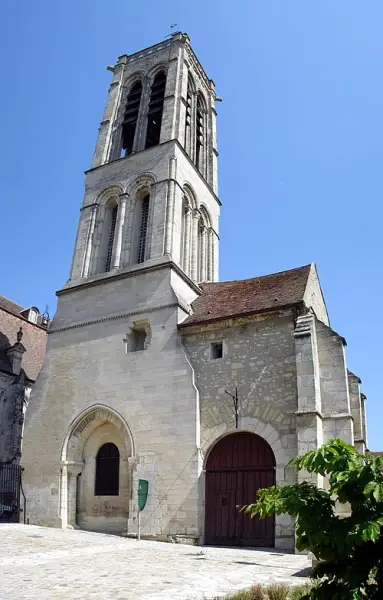
Rieul was numbered among the saints of the French church, his veneration belonging to the Merovingian and early medieval centuries in which bishops of the great sees were honoured at their tombs without formal canonization. His memory is preserved in stone as well as in the calendars: the Tour Saint-Rieul at Louvres in the Val-d'Oise, north of Paris, carries his name and stands as a monument to the cult that grew around him in the Frankish lands. In the lists of the bishops of Reims his name marks the years from 673 to 689, standing between his predecessor Nivard and his successor Rigobert, and the succession itself became part of the sacred history of the see, for Rigobert too was remembered as a saint. The historical record of his life, however, remains a stub of what once must have been fuller traditions: the sources that survive speak of his faction, his council, and his stratagem at Ecry, and are silent on his origins, his works, and the manner of his death. What remains is the figure of a great churchman of a violent century — honoured in the communion of saints, remembered in the tower that bears his name, and known to history chiefly through the one dark and memorable night of perjury at Ecry.
§ Rieul of Reims
Timeline
- 673
Became Bishop of Reims.
§ Rieul of Reims
- 2 Oct 679
In the struggle between the factions of Ebroin and Leger, in which Rieul sided with Ebroin, Leger was murdered.
§ Rieul of Reims
- 679
After the Battle of Lucofao, fought in late 679 or early 680, lured the fleeing duke Martin from Laon to Ecry with oaths sworn on empty reliquaries; Martin and his supporters were killed.
§ False oaths
- 689
His episcopate ended after about sixteen years; he was succeeded at Reims by Rigobert.
§ Rieul of Reims
The Record
- Symbols
- Bishop's crozier and mitre
- Canonization
- Pre-congregation canonization; honoured as a French saint from the Merovingian period
Prayer
Bibliography
Show 3 sources
- Milman, Henry Hart. History of Latin Christianity. New York: T.Y. Crowell, 1881, p. 398.
- Rosenwein, Barbara H. Emotional Communities in the Early Middle Ages. Ithaca, New York: Cornell University Press, 2006, p. 170.
- Wood, Ian N. The Merovingian Kingdoms. London: Longman, 1994, p. 234.
Profile text adapted from the Wikipedia article, licensed CC BY-SA 4.0.
Pray with this saint every day
Save St. Rieul of Reims to your favorites, read the full profile, and get feast-day reminders in the Saints app.
Get the Saints AppFree on the App Store for iPhone and iPad