
1381-1457·Feast May 22
St. Rita of Cascia
Widow and Augustinian Nun
Overview
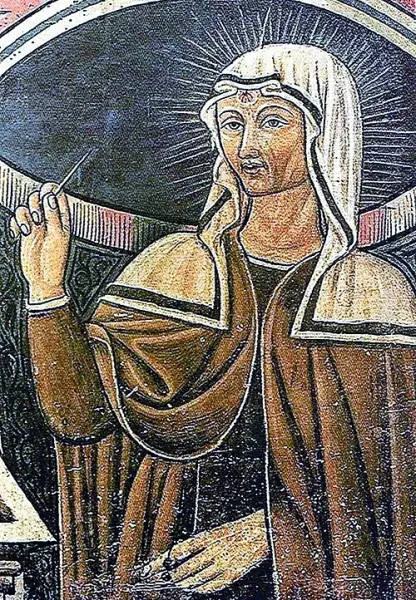
Margherita Ferri Lotti — Rita — was born at Roccaporena near Cascia in Umbria around 1381, the daughter of parents remembered locally as peacemakers. Her own wish was the convent; her parents' wish was marriage, and she spent eighteen years with Paolo Mancini, a man of violent temper whom her patience is credited with slowly softening into a more Christian life. Two sons were born to them. Then Paolo was murdered in a family feud, and at his funeral Rita publicly forgave the killers. Her sons, pushed toward vendetta by their uncle Bernardo, died of dysentery while still young — an early death tradition reads as the answer to her prayer that they be spared the sin of revenge. Refused at first by the Augustinian monastery of Saint Mary Magdalene in Cascia, she was received at thirty-six after bringing peace between her family and the murderers' kin. Forty years of monastic life followed, given to prayer, penance, and service of Cascia's poor. Around the age of sixty, praying before an image of Christ crucified, she received a wound on her forehead from a thorn of the crown — a partial stigmata she bore to the end; she died of tuberculosis on 22 May 1457.
The Complete Life
Early Life
Margherita — Rita — Ferri Lotti was born around 1381 at Roccaporena, a hamlet in the mountains above Cascia in Umbria, the daughter of parents remembered in local tradition as peacemakers in a violent valley. Umbria in her century was the land of the great mendicant saints a generation before and the scene of endless local feuding among noble families, in which ordinary households were entangled whether they wished it or not. Rita's own wish, by the tradition that carries her childhood, was the convent; her parents' wish was marriage, and for the families of Roccaporena a daughter's marriage was an alliance. The collision between her desire and her obedience became the first act of her story and the reason the Church would later hold her up as a saint who lived every state of life in turn.
§ Introduction
Conversion and Vocation
At her parents' arrangement Rita married Paolo Mancini, a man of violent temper, and spent eighteen years with him. Her patient endurance of a difficult husband, and her quiet practice of faith within the marriage, are credited with slowly softening him into a more Christian life — the tradition presents the conversion of a harsh man as her first great work, achieved not by preaching but by the daily refusal to answer violence with violence. Two sons were born to them. Then Paolo was murdered in a feud, and at his funeral Rita publicly forgave the killers — in a society where the vendetta was a duty, a widow's public pardon was itself an act of heroic scale. Her sons, urged toward revenge by their uncle Bernardo, died of dysentery while still young; tradition reads their early death as the answer to her prayer that they be spared the sin of murder.
§ Early life
Mission and Ministry
Rita's second vocation began when, widowed and childless at thirty-six, she sought entry to the Augustinian monastery of Saint Mary Magdalene at Cascia. The community refused her: by its rule it took only virgins, and besides, her entry while the feud with her husband's killers was unresolved would have imported the quarrel into the cloister. Rita set herself to make peace between the two families — the hardest work her valley offered — and when it was accomplished she was received into the monastery. Forty years of monastic life followed: prayer, penance, the observance of the Augustinian rule, and a continuing practical service of Cascia's poor, whose needs she was never to be too enclosed to notice.
§ Later life
Spirituality and Teaching
Rita's spirituality was that of an Augustinian heart — desire for God restlessly pursued through every state of life — joined to a extraordinary devotion to the Passion. Around the age of sixty, praying before an image of Christ crucified before a community meditation on the crown of thorns, she received on her forehead a wound from a thorn, a partial stigmata that remained with her, painful and unhealed, until her death. She bore it hidden as far as she could. In her final illness, confined to bed, she asked a relative to bring her a rose from her garden at Roccaporena — in January — and the rose was found blooming in the snow; the episode fixed the roses-and-figs iconography by which she is known and the popular name of the saint of the impossible.
§ Introduction
Trial and Final Years
Rita's last years were spent in the infirmary of the Cascia monastery, in the tuberculosis that killed her. The wound on her forehead, tradition says, opened further and troubled her to the end; she bore her long final illness with the patience that had carried her through marriage, widowhood, bereavement, and the cloister. She died on 22 May 1457, about seventy-six years old, and was buried in the monastery. The people of Cascia, who had known her in all her lives, immediately began to come to her tomb, and the stream of those asking her intercession has not stopped in the five and a half centuries since.
§ Introduction
Canonization
Rita was never formally canonized in the medieval manner; she belongs to the great company of saints of the people's devotion, whose cult was ratified rather than created by Rome. Pilgrims came to Cascia in increasing numbers through the sixteenth century, and the cause was finally completed on 24 May 1900, when Pope Leo XIII canonized her — one of the last canonizations before the modern procedural reforms, and the formal recognition of a cult already four centuries old. Her feast is kept on 22 May. The ceremony fell in the Holy Year 1900, when Leo XIII was canonizing widely, and it gave the Umbrian saint, until then a local cult, to the universal Church.
§ Introduction
Legacy
Rita of Cascia is invoked as the saint of impossible causes, beside Jude and Gregory of Nyssa's legend-widow reputation, and her roses are blessed and distributed on her feast day. Her shrine at Cascia, with the monastery and the rose garden at Roccaporena, draws enormous crowds each May. Her deepest legacy, though, is her completeness: married, widowed, bereaved, and at last a contemplative nun, she is the rare saint in whom almost every state of life can find its own pattern — which is why popes since Leo XIII have repeatedly proposed her to families, to widows, and to victims of violence as a model rather than a marvel.
§ External links
Timeline
- 1381
Born Margherita Ferri Lotti at Roccaporena, a hamlet near Cascia in Umbria
§ Early life
- 1385
Marries Paolo Mancini around this year, yielding to her parents' opposition to her wish for the convent
§ Early life
- 22 May 1457
Dies of tuberculosis at the Cascia monastery on 22 May, after some forty years of monastic life
§ Later life
- 1610
Cavallucci's Vita, the first biography of Rita, is published by Matteo Florimi at Siena
§ Early cult
- 1626
Beatified by Pope Urban VIII
§ Sainthood
- 24 May 1900
Canonized by Pope Leo XIII in St. Peter's Basilica and given the title Patroness of Impossible Causes
§ Sainthood
- 1907
The National Shrine of Saint Rita of Cascia is built in Philadelphia
§ Patronage
In Their Own Words
My soul, fixed to the sacred wounds of Jesus Christ, is fed with other food.
The Record
- Patron of
- Impossible and lost causes·Abuse victims·Difficult marriages and couples in crisis·Widows·Mothers and parenthood·The sick, the wounded, and bodily ills
- Symbols
- Forehead wound·Rose·Bees·Grape vine·Thorn or crown of thorns
- Canonization
- Beatified 1626 by Pope Urban VIII; canonized 24 May 1900 by Pope Leo XIII and titled Patroness of Impossible Causes
Prayer
Bibliography
Show 12 sources
- 1 2 3 " Catholic Encyclopedia : St. Rita of Cascia" .
- 1 2 3 4 5 6 7 "St. Rita of Cascia, Agostinian - Information on the Saint of the Day - Vatican News" . www.vaticannews.va . Retrieved 28 January 2025 .
- 1 2 3 "DiGregorio OSA, Michael. The Precious Pearl/The Story of Saint Rita of Cascia , National Shrine of St. Rita of Cascia, Philadelphia, Pennsylvania" . Archived from the original on 30 June 2021 . Retrieved 10 April 2013 .
- 1 2 3 "Saint Rita: Despite bitter suffering, always full of joy, working countless miracles - Vatican News" . www.vaticannews.va . 22 May 2023 . Retrieved 28 January 2025 .
- 1 2 3 4 5 6 "St. Rita of Cascia | EWTN" . EWTN Global Catholic Television Network . Retrieved 28 January 2025 .
- 1 2 3 4 5 "St. Rita of Cascia" . Catholic News Agency . EWTN . 20 November 2015. Archived from the original on 21 November 2015 . Retrieved 20 November 2015 .
- ↑ Massini, Carlo (1767). Seconda raccolta di vite de' Santi per ciaschedun giorno dell'anno (in Italian). Vol. 1. pp. 305– 306. pregò umilmente il Signore, a levarli piuttosto di vita, che permettere, ch'essi commettessero l'eccesso ideato,
- ↑ 'Rita of Cascia', in E.Young (ed) The Complete Illustrated history of Catholicism and the Catholic Saints . Wigton: Annes Publishing. 2011. p.416.
- 1 2 3 "The Story of St. Rita of Cascia" . Archived from the original on 21 November 2015 . Retrieved 10 April 2013 .
- 1 2 St. Rita di Cascia Archived 5 June 2011 at the Wayback Machine from Fr. Alban Butler 's Lives of the Saints
- 1 2 "Rotelle, John. Book of Augustinian Saints , Augustinian Press, 2000" . Archived from the original on 19 June 2013 . Retrieved 10 April 2013 .
- ↑ Cavallucci, Agostino (1610). Vita della B. Rita da Cassia, dell'Ordine di S. Agostino, Raccolta, e descritta da F. Agostino Cavallucci da Fuligno Agostiniano Baccelliere in Sacra Teologia, Curato, e Custode dell' honorata Compagnia de' Ce
Profile text adapted from the Wikipedia article, licensed CC BY-SA 4.0.
Pray with this saint every day
Save St. Rita of Cascia to your favorites, read the full profile, and get feast-day reminders in the Saints app.
Get the Saints AppFree on the App Store for iPhone and iPad